UlasanAnime.com – A curious aspect of the anime series Black Lagoon involves its exploration of female archetypes. Some viewers have drawn parallels between the character Revy and Faye Valentine from Cowboy Bebop, suggesting a potential underlying theme of uncertainty and confusion within the series. While the veracity of this comparison remains subjective, it hints at a broader narrative intention.

Without having read the manga, it’s difficult to ascertain if these character explorations were present in the original source material. However, in depicting a realistic portrayal of modern-day piracy on the open seas, deviating from typical character archetypes can be a powerful narrative tool. The question arises: how can a character like Tessa maintain her authority and respect within the crew while still embodying certain desirable traits? Or even a mafia boss?

This concept resonates with an escapist ideal, where a compelling female lead possesses both leadership qualities and an attractive demeanor. This trope isn’t unique to anime; Frank Miller’s Sin City, for instance, demonstrates a similar thematic root in visual storytelling across cultures. This observation prompts further investigation into the nuances of Black Lagoon‘s characterization.
You might also be interested in : GXP at NY International Auto Show
The article then delves into specific elements that contribute to this analysis:
- The Ending Sequence: The melancholic instrumental score during the ending credits aims to evoke emotional responses, contrasting with the series’ otherwise action-packed “babes with guns” premise. A closer look reveals attempts to convey deeper meaning. Questions arise about Revy’s concealed shotgun and whether her attire is a deliberate misdirection. The scene, where a character might be undressing, prompts viewers to consider expectations of characters like Revy, whether it’s anticipation for more or less revealed. This motif also brings to mind similar anime ending sequences that employ comparable themes.
- Revy’s In-Show Characterization: Revy appears to be a central figure, despite not dominating screen time, dialogue, or narrative focus. Her prominence is most felt during action sequences and, notably, in her interactions with the character Rock. While episode three offered a glimpse into her backstory, it provided few unexpected revelations. A persistent observation concerns Revy’s distinctive and somewhat unconventional outfit.

The article humorously questions if her shorts are held up in a particular manner, suggesting a playful visual element. The author then draws a parallel to Miyamoto Rebecca from Pani Poni Dash, noting that while the context differs, the inclusion of music in such a way can be considered a form of fanservice. The discussion then shifts to Revy’s undeniable sex appeal, which is presented as a significant aspect of her character, akin to her arsenal of weapons. She is, undeniably, a woman with many guns.
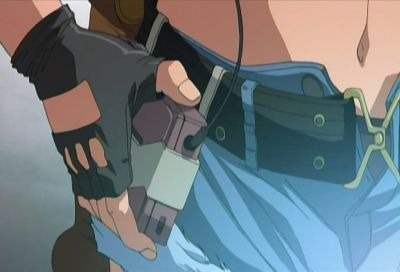
The opening sequence (OP) is described as a tease, designed to please, and potentially to exploit viewer engagement. However, Revy’s on-screen persona diverges from this initial impression. She is portrayed as a laid-back mercenary, confident in her skills and aware of their importance to her profession. In essence, she functions much like any other male character, perhaps even embodying the archetype of an annoying male teammate.
The core question then becomes: what defines the “babes with guns” archetype? Revy is deemed too masculine to fit the mold of Rally Vincent, and while the comparison to Faye Valentine is understandable, it’s not entirely accurate. The masculinity attributed to Rally Vincent is present in Revy, but Revy’s masculinity is distinct from Rally’s, who embodies a more classic 80s archetype. The article suggests that the 90s were not particularly kind to the masculine female anime character. While characters like Priss might come to mind, the author considers her less masculine and more akin to Madoka.
Ultimately, what stands out about Revy is her ability to navigate the fine line between appealing to a broader audience, appearing somewhat naive to be perceived as “one of the guys,” while still retaining an element of cuteness. The author questions the necessity of this duality, finding it inconsistent. Compared to more well-rounded characters like The Major, Revy’s portrayal seems somewhat peculiar.
This peculiarity is significant enough to warrant a dedicated discussion.