UlasanAnime.com – The topic of anime opening and ending sequences is a rather substantial one, much like comparing a mythical creature to a large, immovable object.
Back in the late 1990s, around 1997 or 1998, I was just beginning to explore the internet. Storage space was a significant consideration then; 8 gigabytes was considered a lot. I recall exchanging anime clips, particularly the opening and ending sequences, with individuals who encoded and distributed them. One of my memorable early experiences was getting hooked on Outlaw Star almost immediately due to its incredibly cool opening video. The music video by Two-Mix, depicting their journey without any Gundam elements, was how I connected with a friend I have today. It happened because I shared a copy with him, or perhaps he shared it with me; the details are a bit hazy. Discovering the opening for Himiko-den on a Japanese FTP server felt like finding $20 on the street. It was uncanny because I believe my timing was perfect, as I found that site only a week after Himiko-den had aired.
Looking back, my early days as an anime media enthusiast were filled with such memories. I remember obtaining the opening and ending sequences for Excel Saga, followed by the first episode. I even mailed around $50 to Japan so a Japanese contact I knew from IRC could record and send me the VHS tapes. He did, and the quality was excellent. I believe I still have them somewhere, complete with the 30-second weather segments that followed each episode, which were humorously parodied in episode 4, if memory serves me correctly.
These experiences are just a glimpse, but it’s safe to say that when it comes to opening and ending sequences, I have a strong sentimental attachment to them. Given that anime music constitutes 80-90% of my daily listening, I can’t help but get excited when this subject arises.
In essence, opening and ending sequences, like any other part of a show, serve a purpose. For the cynic, they are a mere reuse of stock footage, consuming 3-4 minutes out of each 25-minute episode. For many, they are a convention, a tradition; removing them would serve little purpose other than to alienate viewers. For even more people, these sequences provide exposition and conclusion. They set the mood, explain context, build anticipation, trigger memories and emotions, and guide the viewers’ imagination.
However, for fans like us, they represent more. They are a marketing tool to promote J-pop. They are a marketing tool to promote the anime series we are about to watch. They act as a litmus test, or perhaps a part of the hook (if the pilot episode is the hook, then the OP and ED are the bait?). They can even give rise to memes.
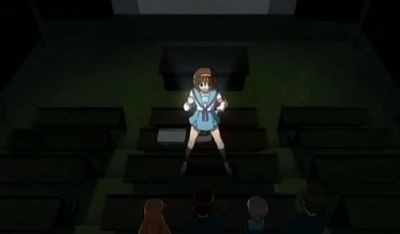
They can even become entities in themselves. Some particularly memorable ones include Excel Saga‘s “Mechi’s Bolero,” Honey and Clover‘s spinning plates sequence, and the ongoing Parapara dance routine from The Melancholy of Haruhi Suzumiya‘s SOS-dan. Some are so impactful that the music alone, paired with fitting visuals, can deeply move a viewer. Many others can achieve the same by triggering emotional release with their ending sequences. Some even manage this with music alone, whether it’s the opening or the ending.
You might also be interested in : Caring for Karin
The music itself is truly something to behold. While there are excellent soundtracks that are enjoyable on their own, I find it difficult to claim they are superior to great soundtracks that might not be as compelling when divorced from their background music context. This is a matter of personal taste, so I won’t delve into it further.
What I will say is that, as a marketing tool, their effectiveness can vary. Take Yoko Takahashi’s powerful vocals, for example. I believe she undoubtedly has a significant place in Japan’s pop music scene. But for anime themes? I’m not so sure. This isn’t to say that typical seiyuu performances (remember DoCo?) don’t measure up, but they are often weaker. Artists like Maaya Sakamoto, Nana Mizuki, and Hekiru Shiina are rare talents. Ms. Takahashi is a prime example of one aspect that makes anime openings and endings so special. Similarly, Ryo Kunihiko stands out. And for me personally, Makkun is noteworthy, as is KOTOKO for the sake of this blog entry.
When such significant talent, or at least resources, are invested into these 100-second slots, I hope they yield something substantial.
And I haven’t even touched upon the direction involved. I recall reading on Kyoani’s English blog about one of their chief animators discussing with a friend. His friend recognized the animator’s distinct style within an opening clip. The reason I mention this is perhaps related to the sanctity of the work. It’s not intended to discourage people from skipping the openings and endings, but for me, they are something special, and I sometimes pay close attention to watching them. The ongoing Higurashi: When They Cry is a good example. Of course, some opening and ending sequences contain plot information, either as a synopsis or as an integral part of the show itself. On top of that, there’s all the distinctive directorial flair that might remind you of Daicon V or similar works.
It’s an understatement to say that opening and ending sequences are important. Of course, this is a broad generalization that overlooks the reality that most OP/EDs are not particularly significant and are perfectly skippable. But when they are, I believe it’s wrong to skip them!
However, you can certainly skip the karaoke and the act of karaoke-ing.