UlasanAnime.com – This article explores a unique perspective on character construction in anime and manga, moving beyond conventional understandings. While the insights may not directly apply to real individuals, the underlying principles could hold some universal truths, and much of what will be discussed might seem like common sense.
To fully grasp this analysis, it’s best to set aside preconceived notions about tsundere characters for a moment, as they might hinder a clear understanding.
Japanese culture places a high value on subtle forms of communication over direct expressions. Individuals convey meaning through their posture, movements, and daily actions, in addition to overt communication which is often a necessary component of interaction. Exchanging marriage vows, for instance, would be incredibly difficult using only body language. A typical confession scene is impactful not just for expressing feelings, but as a symbol of a culmination of emotions, a realization that viewers have often sensed long before the character does.
However, navigating the complexities of expressing these feelings within social and cultural constraints, while also managing interpersonal sensitivity, elegance, and the inherent fears of rejection, can be a significant challenge for some. The tsundere archetype, and many others, can be understood through this lens.
Within a character’s development, certain feelings act as motivators, driving their thoughts and actions. When a character is compelled to fulfill their core motivations, such as a tsundere’s growing affection for the protagonist, they reach a point where these feelings must be internalized and then externalized. The success of this process varies depending on the character’s personality and circumstances. Essentially, the “tsun” expression signifies the internalization of feelings, while the “dere” expression represents their externalization.
Let’s explore some examples to clarify these concepts.
You might also be interested in : Anime On The Move
1. The Hard Tsun. The “hardness” of this tsundere type stems from a significant disconnect between their usual demeanor and how they manage their emotions when in a “tsun” state. The more pronounced this incongruity, the more intensely “tsundere” the character is. While the core of a tsundere character relies on a dual nature, the Hard Tsun presents an uncomfortable dissonance rather than the charming outbursts often associated with the stereotype. In practical terms, a Hard Tsun might be described as a brute who overwhelms themselves with other actions to let the emotion pass.
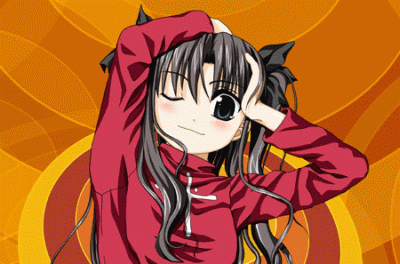
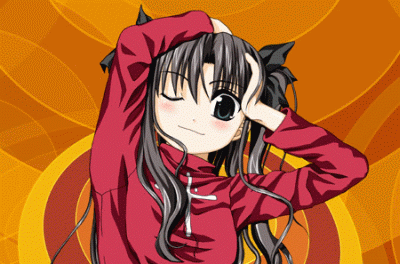
2. The Ordinary Tsun. Characters like Rin Tohsaka, and indeed a large portion of ordinary individuals, may have limited experience dealing with romantic feelings, affection, and infatuation, especially during their teenage years. While archetypal anime girls might embody the “maiden in love” trope, which appeals to “moe” sensibilities and can be analogized to “sprouting” feelings, many characters, like ordinary people, are simply inexperienced. This inexperience can manifest in their body language, which serves as another avenue for expression in anime and manga. An Ordinary Tsun, therefore, behaves in a more conventional manner. We observe the character struggling to manage their emotions sensibly, yet still finding it difficult.
3. The Real Tsun. This type is more challenging to exemplify definitively, but a Real Tsun experiences the same internal emotional conflict as an Ordinary Tsun. However, they are more prone to being clumsy or awkward when dealing with their emotional circumstances. The line between this and the Ordinary Tsun is not always clear-cut, with some characters exhibiting more klutziness than others in expressing unfamiliar feelings.
4. The Un-Tsundere. Some individuals are quicker to process unfamiliar emotions than others. Given that much of television anime focuses on high school romance, this type represents a less common scenario. The distinction between an Un-Tsundere and an Ordinary Tsun lies in their approach to handling emotions. While both might encounter awkward situations, traits like suaveness and courage are not necessarily correlated with how well they manage their feelings. For instance, Yuumi Hoshino might not be considered a tsundere, whereas Asuka Sakino would fit the archetype, despite both having a good understanding of their emotions. Asuka typically handles her feelings with more maturity and courage than Yumi. Both can be clumsy, but one is more proactive in addressing their emotional state.
This discussion can be aptly concluded with the example of Clark Kent. Superman’s alter ego is portrayed as clumsy because he intentionally restrains his superpowers while living an incognito life. This minor clumsiness can be endearing to his love interests and lends him an air of harmlessness and unguardedness, making him seem less threatening. It also provides a significant contrast to his powerful alter ego, emphasizing that he is not merely an agent of authority but an ordinary individual fulfilling his responsibilities.
Kudos to the carefree individuals among us, I suppose.