UlasanAnime.com – The third point regarding Miku’s success, as previously hinted at, is straightforward: Miku has evolved into a character franchise.
Perhaps a more fitting term is “payload.” It’s akin to a bomb, drawing from the Mongol horde analogy, that detonated in Japan. This was fueled by its decentralized nature, combined with a culture receptive to doujin production and the rise of YouTube creators and viewers.
Whether this fervor has crossed the Pacific is uncertain. However, the existence of events like “Mikuopolis” suggests a positive answer. In essence, Miku serves as a delivery system. The payload it carries can vary, but if successful, the world could truly be hers.
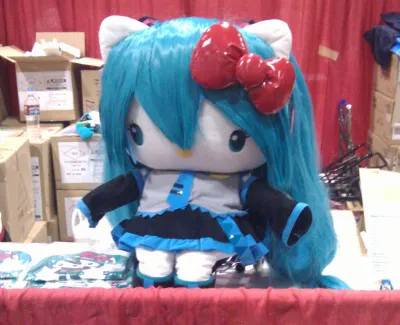
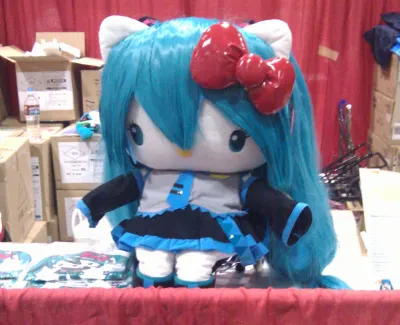
Consider the established character, Hello Kitty, who had a presence at the Mikufest booth during Anime Expo 2011, as she rightfully should.
Before delving into virtual idols, it’s crucial to understand character franchises, as virtual idols are a subset of this. Japan is renowned for its diverse array of cute characters, which are integral to business strategies driving corporate profits. Miku fits into this by acting as a delivery system, with the content it carries being open to interpretation.
In the case of Anime Expo’s Mikuopolis, the payload was Toyota PR’s promotional efforts. Similarly, Hello Kitty readily engages in collaborations, as the two icons complement each other perfectly.
To put it another way, why would one launch missiles or rockets without a payload? They are designed for delivery. Miku functions as the deliverywoman, the carrier, the platform, and the API. The outcomes are determined by what is placed within it.
If it’s a Toyota PR campaign, the result might be related to “bacon-wrapped hot dogs.” For Supercell, it translates into music that propels the group or ryo to a major contract. Ultimately, the payload is whatever one desires. Just as independent Vocaloid producers can create something with Miku, so too can large corporations and their associated characters.
You might also be interested in : The Unstoppable Rise of Hatsune Miku: A Legal Victory
The fact that Miku accommodates individuals and organizations of all sizes under the same blue wig is a significant aspect that has been emphasized in previous discussions.
In their current form, Miku and her companions are peculiar Japanese entities from an American perspective. It is therefore valuable to question Vocaloid’s adaptability outside of Japan. This curiosity was initially sparked when Japanese audiences were captivated by the synthetic idol in 2007 and 2008, and for years, Western observers struggled to decipher Miku’s formula, if one even exists, in the new media landscape.
Looking back, this was the core idea. Lelangir’s post serves as a fitting complement to this perspective.
In contrast, Hello Kitty requires her own managers and producers to create her media, such as games, anime, and audio CDs. Her international success is attributed to her universally appealing cuteness.
This is why the point might have been missed: Miku is largely indifferent to such dependencies, which is quite remarkable. Toyota’s marketing campaigns may incidentally introduce people to Miku, but the focus remains on Toyota’s vehicles. This does not inherently alter or diminish Miku’s unique appeal, any more than a large volume of adult fan-made content would define her as promiscuous.
This means-to-an-end approach is essential for Miku to gain traction in America, beyond being a mere imported novelty. After all, she is merely a messenger.
It would be simplistic to claim Miku’s popularity in America stems solely from her cuteness. This is akin to stating her songs are popular in Japan because they are popular, sidestepping the fact that Miku’s appeal is derived from what we, the audience, find appealing about her. We then selectively reinforce these contributions into the Miku “canon” with elements that resonate with the majority.
Ultimately, it is this sense of fractured unity, the “many faces of Miku,” as described by Kylaran, that contributes to the massive crowds at Miku’s concerts. On the day we cheered for a platform of expression with waving glowsticks, we were also, in essence, cheering for a reflection of our own desires.