UlasanAnime.com – While the internet, particularly platforms like Tumblr, can often be a source of fleeting amusement or even a mundane task, it can also be surprisingly informative, especially when it comes to niche communities like cosplay. Some online content, though seemingly superficial, can offer insights into the broader cultural landscape of fandom.
The concept of capturing the essence of a character through cosplay photography is a complex one, and as an anime fan residing outside of Japan, the issue of cultural context often feels like a persistent point of discussion. It’s a realization that observing cosplay images and experiencing conventions where cosplay is a focal point are distinct activities, each operating within its own unique framework.
A particular sentiment often expressed within the cosplay photography community highlights a potential pitfall: the transformation of the subject into an object. This perspective suggests that cosplayers might sometimes prioritize appearing attractive over embodying the character, and photographers may focus on aesthetics rather than deeper character portrayal. While this viewpoint can be seen as somewhat hypocritical, given its own focus on visual appeal, it does raise valid points about the deeper artistic intentions behind cosplay.
Too often in cosplay photography, the subject becomes an object. Cosplayers are fairly bad at doing anything other than looking sexy (?) and photographers focus too strongly on simply making cosplayers look good. I think we can do better than that.
Beyond this critique, there’s a prevailing school of thought in cosplay that emphasizes “in-character” portrayal. This approach encourages cosplayers to fully immerse themselves in the persona of the character they are embodying. However, this philosophy often coexists with another perspective, one that views cosplay primarily as a matter of fashion and personal identity.
The contextual differences are stark. In Japan, cosplay can sometimes be intertwined with adult-oriented entertainment, particularly seen in certain circles at events like Comiket. This contrasts with the more widely recognized understanding of cosplay today, which often focuses on creative expression and fandom. For those who see themselves as cultural ambassadors of anime and Japanese pop culture, the ideal context for cosplay is often represented by events like the World Cosplay Summit, which promotes a more polished and internationally recognized standard. In contrast, American cosplay often leans towards a more casual, party-like atmosphere, a step above Halloween trick-or-treating but generally not aiming for professional or semi-professional levels.
This disparity is not inherently problematic; it’s akin to comparing professional basketball players with children playing on a street court. While both are forms of basketball, the skill gap is immense. However, in cosplay, the difference between a seasoned professional and a dedicated amateur is often bridgeable with time and effort, unlike the biological limitations that can affect athletes by their mid-twenties.
Instead of focusing on narrative in cosplay photography, as some suggest, a more insightful approach might be to analyze what can be learned from meticulously crafted cosplay photoshoots and the more polished, Asian-style semi-professional cosplay photography. This involves examining elements like zettai ryouiki and fashion choices. The aim here is to understand how to aesthetically enhance a character’s portrayal through deliberate visual choices, much like the original article discusses objectification, but in a preferred, artistic manner. This isn’t a step-by-step guide but rather a theoretical exploration of how fashion choices, like the strategic display of the thigh, can significantly impact visual appeal.
For clarity, zettai ryouiki refers to a fashion style that accentuates the thigh area, typically through a combination of socks or boots and a short skirt. This particular fashion element has been discussed extensively, with various guides offering advice on how to execute it effectively. The focus here, however, is on applying zettai ryouiki as a fashion item in a three-dimensional, real-world context.
While anime characters are rarely defined by their leg length, and such artistic choices are often stylistic, for real individuals, leg proportions play a crucial role in how zettai ryouiki is best implemented. Factors like shape, length, contour, color, and texture all contribute to creating a suitable look. Even the choice of footwear, whether it includes heels or not, can influence how leg muscles are presented, thereby altering the overall appearance of the zettai ryouiki. These subtle details are often overlooked in anime depictions.
Furthermore, incorporating zettai ryouiki into everyday wear can present practical challenges. It often involves additional accessories like sock glue, garter belts, or uncomfortable sock bands, and requires careful coordination between skirt length and sock height. It’s also not the most conservative look, although it can be toned down. Therefore, it’s advisable to approach this style with careful consideration and confidence.
A significant reason for discussing zettai ryouiki is its inherent flexibility and robustness. It emphasizes “outfit” over “flesh,” making it a more adaptable element than cosplaying characters who are primarily defined by their exposed skin, like Yoko Littner from Gurren Lagann. While Western cosplayers might more readily achieve a Yoko look due to body type similarities, zettai ryouiki offers a broader appeal. It allows individuals of various body shapes to incorporate an element of allure by strategically revealing a portion of their thigh, while the rest of the body can be covered. This makes zettai ryouiki a forgiving and effective choice for a wide range of cosplayers, even those who might feel less confident about their physique.
The logic behind zettai ryouiki, in terms of personalizing it for wear, can be understood as a form of “addition by subtraction.” Imagine taking away a section of someone’s pants; the result is a more revealing, yet still modest, presentation. This is akin to the playful concept of revealing undergarments or short shorts, but executed with more subtlety.
In practical terms, human proportions offer a wider range for applying zettai ryouiki compared to the often stylized designs of animated characters. Cosplayers typically aim for the iconic look of the character’s zettai ryouiki. The precise ratio of exposed skin, sock length, and skirt hemline can be adjusted to accommodate individual human proportions, which often differ from anime character proportions. While some prioritize replicating the character’s outfit exactly, others adapt it to suit their own body. Often, a balance can be struck between the two, and zettai ryouiki provides the flexibility to achieve this.
A crucial aspect of creating an effective zettai ryouiki is understanding how the sock, stocking, or boot component accentuates the legs. A common misstep occurs when the legwear extends too high, just past the knee. Because human legs bend at the knee, this can create a “double break” in the visual line of the leg, diminishing the intended impact. Instead of highlighting the distinct zone between the knee and the hemline, it can appear as a continuous, less impactful line.
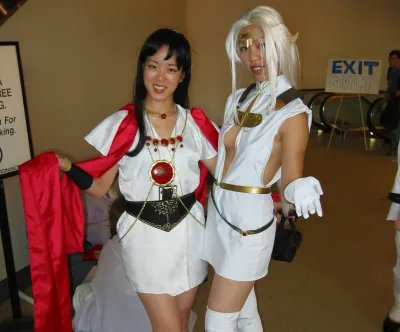
This exploration of zettai ryouiki is the culmination of a summer project that didn’t fully materialize. Initially, the intention was to create a more practical guide for cosplayers, especially with the convention season in full swing. However, the plan was deferred, leaving the author with a season of contemplating zettai ryouiki and gathering anecdotal evidence from conventions.
Reflecting on past convention photos, a notable observation emerged: cosplayers portraying Sera Victoria consistently excel at executing zettai ryouiki. This character’s cosplayers have, on average, achieved this style more successfully than those of other characters, with evidence dating back to the early 2000s. Whether Sera Victoria was the first to popularize this in cosplay is uncertain, but her impact is undeniable.
You might also be interested in : Making Doujinshi in the USA