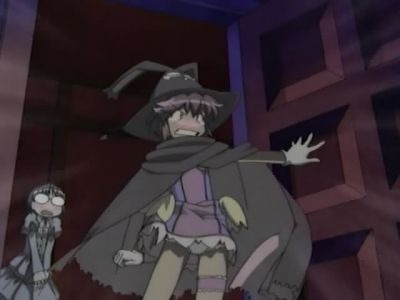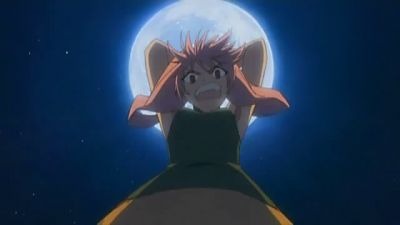
UlasanAnime.com – Have you ever experienced the thrill of catching a fish, whether it was at a simple goldfish scooping event or on a grand fishing expedition in the Caribbean? The largest fish I personally managed to catch was a striped bass, measuring about 26 inches off the Jersey shore. It was a memorable catch, though perhaps not as formidable as a Mahi-mahi, which shares a similar size but offers a significantly more challenging fight. Can you imagine the exhilaration of reeling in a Mahi-mahi, akin to how Natsuki and Yuki do it in Tsuritama? It’s truly an exhilarating sensation.
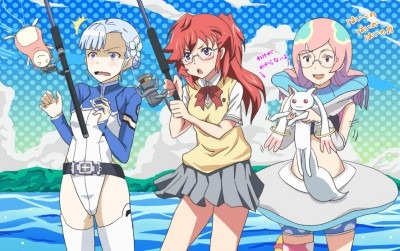
There’s a certain beauty in taking something ordinary and transforming it into something extraordinary, elevating it to the scale of saving the world. However, fishing itself is already a time-honored sport and a practical way to secure a delicious meal. The excitement derived from it isn’t as grim as hunting, yet it demands a true test of skill, luck, and patience. The vastness of the ocean and the open sky possess a unique ability to cleanse the spirit, offering a sense of refreshment akin to that of sea-sky pirates.
This underlying sentiment, I believe, is what drives Tsuritama. At its core, the story unfolds as a fairly conventional youth adventure plot. It’s easy to envision how the 12-episode series could be condensed into a 120-minute feature film, complete with numerous plot twists and climactic moments. The predicament of Haru and his mission to save the world bears a resemblance to an alien’s unexpected arrival in a Summer to Remember scenario, minus the glasses fetish, and with Men In Space Channel 5 cosplayers replacing the Men in Black.
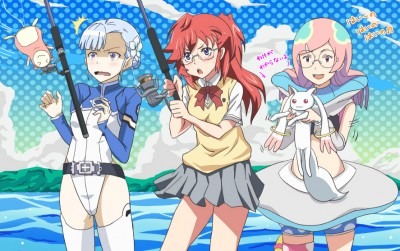
Furthermore, Tsuritama features an ensemble cast that supports the four main characters, each playing a crucial part in the ultimate operation. The narrative has long hinted at this division of labor, perhaps as early as the very first scene of the premiere episode. While this aspect isn’t inherently a positive or negative, for those who aren’t deeply invested in fishing but are fans of popular media, it serves as a lifeline to navigate the complexities of a Kenji Nakamura original. To be fair, “complexities” might be an overstatement, especially before the typhoon makes its appearance – this is arguably the most accessible work by Kenji Nakamura to date.
What might be initially misconstrued at first glance is precisely what lends Tsuritama its genuine credibility: the series is, in fact, about fishing. We witness Haru and Yuki learning to tie knots, and observe the techniques of surfcasting with a lure. The anime also illustrates how Natsuki can rally a school of mahi-mahi, and provides insights into piloting a boat for large tuna hauls. The depiction of these fishing elements within the anime is quite remarkable, and it’s even more impressive to see them brought to life through animation. This lends the show a level of authenticity that even major summer blockbusters often struggle to achieve. A comparison to Summer Wars, for instance, highlights this point.
You might also be interested in : Pastel Summer Miracle
In today’s media landscape, possessing such authenticity is what truly makes a story compelling. It’s relatively easy to find anime or manga that explore virtually any subject imaginable. However, the question remains whether these works will simply offer a formulaic retelling, where the subject matter serves as a mere interchangeable component of a common narrative structure, or if it will genuinely shape the essence of the story itself. In the case of Tsuritama, it appears to occupy a space somewhere in between these two extremes.