UlasanAnime.com – Some viewers might perceive “Natsuyuki Rendezvous” as a masterpiece, but for me, it leaned more towards a torturous experience, and not in the compelling way some narratives can be.
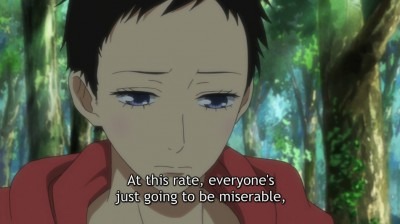
“Natsuyuki Rendezvous” attempts to present a classic love story, interspersed with meta-commentary on idealized story elements through Hatsuki’s dreams. However, the execution felt more like purgatory, leaving me with a sense of dread and tedium through many episodes, with a strong desire for the plot to simply move forward.
You might also be interested in : Reconsidering the Genesis of Value in iDOLM@STER
The narrative’s focus, due to the peculiar and mysterious body-swapping element, unfortunately gravitated towards the protagonist’s selfish and often foolish actions within the host body. While this might not have been the intended core, it significantly impacted my perception of the central romance triangle.
The core issue lay in the episodes that were supposed to delve into Atsushi Shimao’s emotions, his relationship with Rokka, her feelings for him both before and after her passing, and ultimately, to establish a moment of catharsis. This crucial foundation felt inadequately laid. The narrative leaves one questioning: where was the climax? Was it during the tense moments where Hatsuki’s fate and Rokka’s situation hung in the balance? This approach seemed to inadvertently paint Shimao-kun in a rather unflattering light, almost as a villain. Reflecting on this a few weeks prior, I thought to myself that he deserved a fiery end, which, coincidentally, he experienced, making the narrative’s trajectory feel almost too convenient.
Perhaps, in that specific regard, the show achieved a form of perfection. While we often seek out peculiar anime for their unique qualities, “Natsuyuki Rendezvous” presents a peculiarity that many might prefer to avoid, reminiscent of the ambition seen in “Fractale,” though that series at least felt driven by a grander vision.
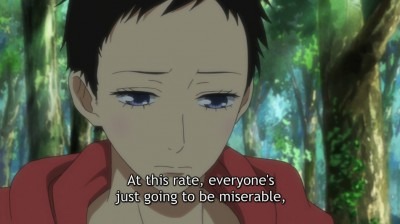
An Alternative Perspective: My initial hope was for Shimao-kun’s demise, which, as it turned out, already occurred. One might then wish for his complete disappearance. I generally appreciate shows that evoke strong reactions, but Shimao-kun was more of a minor irritant than a character eliciting genuine hatred, aside from his occasional selfish outbursts. I even found a peculiar enjoyment in the moments where he exhibited NTR (Netorare) vibes, even when the situation was reversed. The most unsettling, yet darkly amusing, scene involved Rokka consuming his bones. However, even this came across as insensitive rather than playful or eccentric. Upon reflection, the multitude of contrasting elements within the series seemed to neutralize each other rather than enhance the viewing experience. The show struggles to even get right the fundamental premise of a dead person seeking to live.
The central problem, in my estimation, stems from Hatsuki’s lack of distinctiveness. Without a strong personality, there’s little to counterbalance the established relationship between Rokka and Atsushi once the narrative spotlight shifts away from Hatsuki. The most compelling aspect of the entire series was undoubtedly the courtship between Rokka and Hatsuki. The latter half of the series, regrettably, devolved into what felt like filler. I would have preferred to simply watch Rokka expressing her sorrow, set to Ken Muramatsu’s music, for six entire episodes.