
UlasanAnime.com – The Madoka Magica movie experience, following the TV series in 2011, truly emphasizes the resonance of a Faustian deal as depicted by an ideal, solidifying Madoka Magica’s impact on the modern psyche. [Spoilers for the TV series and the first two movies may be present. Feel free to skip to the next set of bold words if you wish to avoid them]
In essence, if the core emotional complex within Madoka revolves around the Faustian relationship between QB and his charges, the series excels at framing this deal not solely on QB’s deceptive nature, but on the divergence between public perception of Magical Girls and their actual reality. The inherent truth is that magical girls are not a real-world phenomenon; they are constructs of anime or manga. This brings to mind a parallel with Madoka’s mother, a character who embodies a certain aspect of this reality.
Upon further reflection, Madoka and her mother emerge as the pivotal relationship. Madoka’s mother serves as a tenuous link, bridging the gap between the archetypal magical family of a generic magical girl and a deeper message Madoka conveys to her audience. The question arises: does Madoka aspire to become a woman like her mother? It seems plausible, given the undeniable admiration present, which contributes significantly to the charm of their relationship. As repeatedly stated by Urobuchi, Madoka Magica carries a positive message. This message, ultimately, suggests that living a life akin to Madoka’s will lead to positive outcomes, even if one doesn’t achieve career success or a dominant role in relationships. The core idea is that by embodying Madoka’s inherent goodness, everything will work out.
You might also be interested in : Who Is ZETSUEN NO TEMPEST
Homura’s initial warning to Madoka in the first episode, and consequently the opening moments of the first movie, gains amplified significance when viewing both films consecutively. The questions posed—”Who is the most precious?” and “How do you protect them?”—serve as noble ideals, functioning effectively as they have in countless anime and manga with similar themes. However, rather than acting as a mere warning, Homura’s intent is subverted when Madoka, empowered by the Ability To Make Rational Decisions, fundamentally alters the established order by “breaking the game.” This is why the entropy lecture feels underwhelming, and time travel, once again, earns its reputation as a convenient plot device. Throughout the narrative, we witness Madoka making sound decisions, despite her occasional childish demeanor, hesitations, changes of mind, clumsiness, or her willingness to stay out late with her magical friends chasing witches.
But is this not the underlying message? Even when faced with a disadvantageous contract, one can still achieve a positive outcome by acting “the right way.” This is precisely what defines her as a Good Girl, further reinforced by Madoka embodying desirable character traits such as valor, honesty, and wisdom. This has historically been the central message of magical girl anime. In this context, “Incubator” serves as a meta-commentary on the genre itself.
One interpretation is that the “lost generation,” disillusioned by the unfulfilled promises of job security and a general distrust in established systems (represented by Madoka’s mother), finds resonance in our idolization of magical girls, an idolization that ultimately proves to be illusory. Or is it? Do we idolize the senior vice president at work, the director with an impressive portfolio, or the individual with a lavish loft in Manhattan (a lifestyle only rivaled by the Araragi House in scale)? Do people aspire to become instruments of war for their country? Some undoubtedly do, and viable career paths exist for them. This scenario is not entirely negative; it more closely resembles the post-Godoka Madoka Magica world. Imagine a world where every fallen soldier rises as the undead, and your mission is to eliminate them, only to potentially join their ranks upon death. This premise echoes the plots of numerous video games. Perhaps it all is a deception. Urobuchi might have pushed further to break Madoka down, exploring the depths of her suffering beyond mere descriptions or the emotional weight of Yuko Goto’s performance.
Perhaps within Urobuchi’s narrative framework, ideals are the most destructive forces, and this is precisely why Madoka became one.
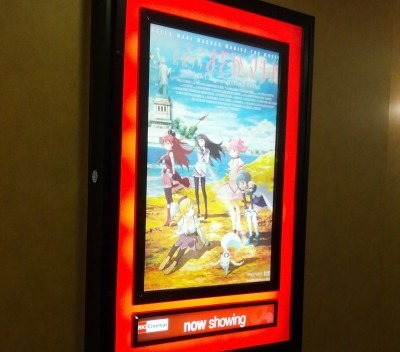
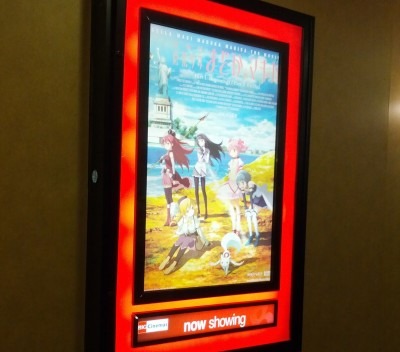
At the inaugural NYC screening of the Madoka movies on October 20, 2012, attendees were met with favorable autumn weather, with clear skies and no rain enhancing the experience for both local fans and visitors. The journey to the venue, where many attendees carpooled, proved to be almost scenic. Inside the theater, an Aniplex representative, identifiable by their t-shirt, was present and later engaged in interviews with attendees, offering posters as tokens of appreciation. The theater was nearly at full capacity, with a notable contingent of cosplayers among the fans who arrived as early as an hour before the screening. My own arrival, about 40 minutes prior, revealed that most seats were already occupied.
The screening commenced late, at 9:30 PM, and concluded close to 2:00 AM. There was no intermission, a decision I personally appreciated as it allowed for a continuous viewing of the films. I carpooled with friends due to uncertainty about the availability of public transportation late at night, although it turned out the train service was still operational. The projection was digital, delivering a visually impressive experience despite minor technical glitches from the projectionist. The amplified sound system, delivering “Magia” and the two new Kalafina-backed insert songs at a rock concert-level volume, was a treat for some but potentially overwhelming for others. The movies also featured a new opening sequence, notably for the intimate scenes between Homura and Madoka.
Anecdotally, two of my companions had only watched up to episode three of Madoka Magica. Both expressed satisfaction with the conclusion of the films, though it is unlikely they became dedicated fans. Their curiosity may have been piqued, or it may not have been; they each had their reasons for not watching the original TV series beyond that point, and their decision was not born of ignorance. If I were to summarize the two movies in a single word, “solid” would be fitting. They incorporated the strongest elements from the TV series and refined aspects that had already been improved in the home video release, leaving little room for criticism, even for the most devoted fans.
Perhaps the most significant detail to note is that the screening was preceded by a brief video message from the six voice actresses, introducing the movie version of Madoka Magica. This personal touch added a unique dimension to the event, making it particularly memorable. While special merchandise might not have been the primary draw, attendees in Los Angeles were fortunate to acquire limited edition items, such as Ume Aoki’s exquisite shikishi and region-specific movie posters.
The NYC screening, and potentially others, held a special appeal as it sold out within a single day, necessitating the addition of screenings on Sunday and Monday nights. While I did not track the turnout for other US screenings, it is reasonable to assume it was also robust. The experience is undoubtedly worthwhile for fans of the series or for anyone who appreciates high-quality theatrical animation.
[I’ve written a slightly different version of this post here.]





















