UlasanAnime.com – It’s challenging to pinpoint the exact essence of Sasami-san@ganbaranai each week. It feels as though there’s an unseen focal point in space, where capturing a panoramic view from that specific vantage point would yield a cohesive narrative about the dual nature of being human and divine, all while making sense of Japanese identity. This is akin to those 3D perspective artworks on sidewalks that transform into a different image when viewed from a particular angle. Currently, I find myself oscillating wildly, trying to grasp that definitive perspective.
My understanding of Shinto isn’t quite robust enough, it seems.
Nevertheless, the entire storyline surrounding Juju’s demise and subsequent rebirth—whether through temporal manipulation or a pact with darker forces—struck me as remarkably profound. She is depicted as a spiritual being with innate spiritual capabilities, even independent of god-like powers and the attendant responsibilities. Perhaps it also contributed that this is one of Asakawa Yuu’s more compelling roles I’ve encountered in some time. I’m not entirely certain.
You might also be interested in : Ame and Yuki
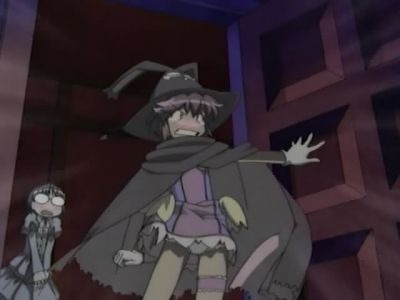
The anime presents this narrative through Sasami’s perspective. It largely follows a linear progression as she navigates through different timelines and events. Tsurugi encountered her at one such juncture. Juju accompanied them because, by some means, she was resurrected in the present and thus available for summoning? The mechanics remain unclear—likely similar to Tamamo-no-Mae’s supernatural feats. However, I was curious to explore how this would appear from Juju’s viewpoint.
Ultimately, it seems Sasami transferred her powers to Juju, allowing her to continue her “ganbaranai” (not trying hard) ethos, humorously. Sasami’s explanation regarding her attitude offers a thoughtful counterpoint to the pervasive “ganbare” (do your best) sentiment. This duality feels inherently Japanese, in a way. Yet, it presents a concept that can, arguably, be interpreted as a modern critique. And is it even possible to have an anime about religion without incorporating critical commentary? I suspect not.
Concurrently, Juju’s spiritual essence needs to be defined in a manner that transcends her mere religious status and obligations. It’s not simply that she possesses what modern youth might call superpowers. It’s not that she can lead a quasi-Shinto cult, although she certainly has the potential. It’s more about how she embodies both the values cherished by humanists and those held dear by religious individuals, manifesting in a piety reminiscent of The Binding of Isaac, yet also in a nurturing way, like a mother caring for her flawed child so they can flourish. Otherwise, she might come across as a one-dimensional antagonist rather than someone Sasami could genuinely seek affirmation from.
It’s simultaneously quite unsettling and deeply offensive, yet somehow, it all harmonizes. It’s a form of magic. And in reality, this is the true significance of spirituality when expressed as a religious belief. It is supernatural, and I’m not just referring to the time-traveling aspect; I mean its capacity to address profound emotions like regret. But that’s merely my personal interpretation.
Finally, while this might have been more fitting for Episode 8, it’s commendable to see Amaterasu embracing her role as a hikikomori undergoing rehabilitation. Now that, truly, is divine humanism.