
UlasanAnime.com – As an American enthusiast of Japanese otaku media, I’ve not only experienced a significant amount of localized anime, manga, games, films, and other cultural exports from Japan, but I’ve also encountered distinct perspectives on the concept of localization itself. This topic resonates more deeply with me, perhaps because I am an immigrant, and my background in navigating cultural crossings highlights the differences between how one culture defines something and how another approaches it differently. It’s possible this is also due to my Chinese heritage, which contrasts sharply with the more standard, stereotypical American-centric worldview. Do British individuals in the States face similar challenges? I’m uncertain.
Consider food as an example. Learning about General Tso’s Chicken today is no longer exclusive to those in the United States, yet it remains somewhat challenging to explain to one’s Chinese children that this dish, which their American schoolmates identify as Chinese food, was actually invented in America and doesn’t fit the definition of “food eaten in China.” It’s in this context that understanding localization, particularly from the perspective of the creator, becomes more intriguing.
The issue is both more and less complicated than it appears. It’s akin to the heated debates among some internet users regarding the localization of Japanese speech in BakaBT fansub threads. Does it truly matter? This is essentially a modern iteration of the 1980s MBA anecdotes about the Chevy Nova’s poor reception in Spanish-speaking countries, or the sensationalized articles about awkward English on Asian signage. On the receiving end, it can be as frustrating as trying to decipher Maki Izumi’s jokes. Translating something is significantly more difficult than simply reading and understanding it (perhaps with the aid of a TL note, if one chooses to go that far). And when it comes to comedy, the challenge is amplified.
At the same time, this complexity is why Shiny Festa was priced at $50 on the App Store. It’s not that localization is unimportant to creators and fans; it is incredibly difficult, intricate, and costly at times. However, it’s hard to pinpoint precisely how and where its importance lies beyond the well-established aspects.
To apply this to the context of eventing, translating the concept of “eventing” as I understand it into an international product is equally challenging. If anything, because the “how” in areas outside of the conventional is so elusive, it presents enormous risks to undertake something novel, especially for larger productions. It’s somewhat like reverse-engineering how a band like Slipknot might achieve a sold-out tour in Japan (though I’m unsure if that’s still the case), except you begin with the wrong endpoint (with the exception of Babymetal, perhaps).
In moments like these, I am grateful that the Japanese government is willing to subsidize part of the costs.
For those unaware, this is partly why AFA circuit shows feature notable guests, and it’s also a reason behind the increased number of anison live shows held outside of Japan. Different markets present distinct challenges. Singapore, for instance, is one of the few Southeast Asian locations capable of supporting an event with pricing tiers comparable to AX and Japan; it might even be the only one. Recall the widespread frustration when Hatsune Miku performed in Thailand. Taiwan’s pricing has so far been similar to Japan’s (though it is geographically considered East Asia, not sufficiently south), and the shared cultural attitudes between the island and Japan also facilitate Japanese anison acts and seiyuu events. It’s simply a more manageable market for Japanese entities. The primary challenge in Taiwan revolves more around demand and the cultivation of an event-centric culture.
Without delving into exhaustive research, Lisani TW serves as a good example of another Japanese endeavor overseas. Taiwan, much like Japan, doesn’t typically host anime conventions in the traditional sense. It has events like ket-style Fancy Frontier and other comic markets, which occasionally feature guests. It also hosts more industry-focused events such as various game, anime, and comic festivals, which more closely resemble anime conventions but lack fan-oriented programming. It would be more logical to organize music events as standalone occasions rather than as components of larger gatherings or as specific, billed events. Here in the States, a more massive event is required to achieve critical mass among attendees, presenting another set of challenges for event organization in the West.
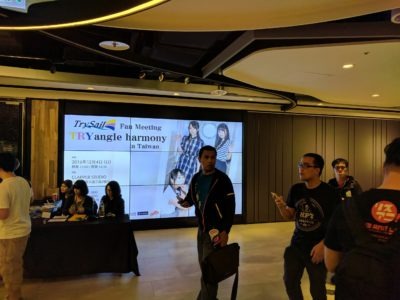
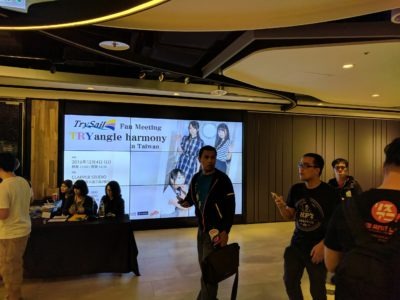
This brings us to TrySail’s TryAngle Harmony Fan Meet in Taiwan. To provide a brief background, the seiyuu idol unit TrySail, under SME’s seiyuu agency Music Ray’n, comprises three female seiyuu in the early stages of their careers as managed voice actresses. They are Asakura Momo (Mocho), Amamiya Sora (Tenchan), and Natsukawa Shiina (Nansu). As a unit, they were officially formed in 2014, and since their public debut in 2013, they have hosted a weekly radio show called Tryangle Harmony (Torahamo for short). Occasionally, the radio show holds public recording events. The fan meeting was billed as Tryangle Harmony, thus incorporating a public recording session along with additional activities, mirroring their Japanese public recording events.
What was particularly remarkable about this event was its largely monolingual setup: three young Japanese performers conversing amongst themselves, engaging in their usual lighthearted banter, to an audience predominantly speaking Mandarin. Japanese and Mandarin are not closely related languages. Taiwanese, a Hokkien dialect, might have some Japanese influence, but it’s minimal. I can assure you that out of the 60-70% of the audience that was local, more people understood Japanese than Taiwanese.
This is what makes Taiwan such a unique event venue. It was a point of considerable discussion among many of us who were traveling overseas to Taiwan for the TrySail event. How would they localize the talk event? Hosting an event with an interpreter would feel very stilted (think of a typical anime convention panel). Most Taiwanese otaku have a reasonable command of Japanese, proportionally speaking, compared to other overseas fan bases. What was truly interesting, and perhaps a little ironic, was that the TrySail fan meet was largely scripted – this was the crucial element.
For those who were not present or are unfamiliar with the typical seiyuu stage event format, the segments (including the public recording of the Torahamo radio show) are somewhat scripted. The radio show portion begins with the girls engaging in brief conversation (often about food when Japanese individuals are in Taiwan). This is followed by a segment called “Meigen Memocho,” where Asakura Momo must guess the correct famous saying from three presented statements, two of which are fabricated by her castmates. This segment’s questions and statements were clearly pre-scripted, and during the performance, their Chinese translations were projected on the screen behind them. It worked exceptionally well, at least for me, whose rudimentary Japanese skills are usually insufficient to keep up (and who is always too lazy to look things up). Once I grasped the topic, it was easy to follow along. Following the Torahamo segments, the fan meet proceeded to a live dubbing/play, which was entirely scripted and fully subtitled. Subsequently, there was a pre-recorded Q&A segment that involved a more traditional interpretation by an interpreter. During the free talk MC segments outside of the radio recording, the interpreter would provide some interpretation, typically aiming not to disrupt the flow. Consequently, the translations tended to convey basic meanings and lacked the full expressive nuance. However, this did not detract significantly.
If a panel solely consisted of pre-screened Q&A, it would feel rigid unless the participants were allowed to banter freely. The TrySail radio format is exceptionally effective in this regard, and much like their Japanese public recordings when produced with care and excellent coordination, this event exceeded expectations. It is also worth noting that I cannot envision this format working successfully in other countries. Perhaps the live dubbing segment could be replicated?
I’ve saved one key aspect of the TrySail Fan Meet for last. The final talk segment involved a game where Mocho, Ten, and Nansu competed to win some Oh! Bear souvenirs. This was also the funniest segment. The game involved presenting the kanji for a Chinese phrase that coincidentally matched a Japanese phrase with a different meaning. The person who correctly guessed the meaning earned points, and the individual with the most points at the end won the prize. The event organizers utilized the projection screen again, displaying the Japanese term and its meaning in both languages. The answer, after everyone had written down their guesses, was also projected in both languages.
This game was as localized as it gets. It transcended a mere imitation of playing with meanings and exploited common wordplays that well-traveled Japanese and Chinese individuals would recognize. I’m unsure if three silly voice actresses making fools of themselves would have been as entertaining without the ability to approach their tasks from both linguistic perspectives. This is one of those instances where my comprehension skills were sufficiently blessed, and I believe I gained more from it than even many of the visiting Japanese fans. As the saying goes, a pun is only funny if you understand it. And this segment was essentially about bilingual puns!
In any case, I find it difficult to imagine the Music Ray’n team replicating this kind of positive experience in another country. Perhaps they could, and it might delight the local weeb population just as it did here. It was genuinely a very amusing show that the TrySail girls put on last Sunday. It was undeniably tailored for the Taiwanese fans, which is truly special. Part of its success may also stem from the prevalent Japanese literacy within that specific fandom, allowing the production to directly target humor without needing to tiptoe around linguistic formalities. This represents the finest localization I have ever witnessed for a live talk event.
PS> Event report recap!
The event took place at Clapper Studio, which our Taiwanese-American liaison identified as a common venue for otaku events. It’s situated on the fifth floor of a distinctive mall building adjacent to the popular computer parts market in Taipei. The event was scheduled to commence at 12:30 PM, with doors opening at noon, but it experienced a 30-minute delay. This was inconvenient as attendees had to queue according to their ticket number within the mall’s fire escape stairwell corridors. The area lacked air conditioning and was densely packed with people. The queuing system was poorly managed, as the staff only spoke Mandarin, leading to confusion among Japanese attendees and requiring some fans to assist. Notably, a significant number of Japanese individuals were present, estimated to be around 40% of the attendees.
You might also be interested in : It’s Not Your Fault, Izetta; It’s Mine.
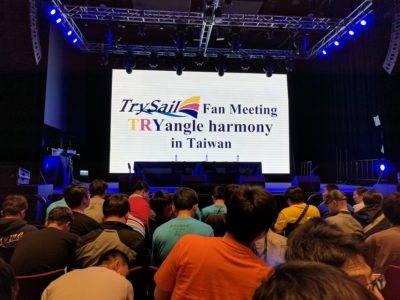
Upon being admitted around 12:30 PM, seating was available on a first-come, first-served basis. I secured a spot approximately six rows back, near the center, which was quite satisfactory considering the circumstances. The stage setup resembled what one might expect at an anime convention’s conference room, albeit with a slightly elevated stage and a large rear projection screen. Tables were arranged, but the performers used handheld microphones, with speakers positioned for a live event. The accompanying image provides a visual reference.
A seat in row 4, down the center aisle, was inexplicably reserved for “staff” and was adjacent to our friend Basu’s seat. It later turned out to be occupied by a regular staff member.
The event commenced with the performers entering the stage, followed by the interpreter/MC’s welcome. Standard pleasantries were exchanged, including discussions about Taipei and the Torahamo radio show itself. The ground rules for the radio recording were outlined, specifying acceptable levels of clapping and cheering, among other details. Following this, the show began.
During the event, it was announced that the Taiwan episode of the recording would be included in the fourth Torahamo fan disc, scheduled for release next month. I was uncertain at the time whether the fourth fan disc had been officially announced yet.
With rhythmic clapping, the show transitioned into recording mode. We cheered enthusiastically during the introduction and enjoyed the “Meigen Memocho” segment. For those who listen to the show but haven’t attended a live recording, it’s important to note that the performers’ body language and on-stage interactions significantly enhance the experience. The first question posed was a famous quote attributed to Nobunaga, which Mocho managed to recall, even though she remembered it from her school days. She cleverly secured the correct answer, puffing and huffing to our anticipation. The second quote was from Haruki Murakami, where Mocho provocatively dismissed the notion of a story being the universal language. Instead, she opted for Sora’s assertion that “Feels are the universal language” (as paraphrased). The third quote has completely slipped my mind, but Nansu made an error and recalled the wrong line, inadvertently prompting Mocho to select Ten’s fabricated statement. There was a degree of self-deprecating humor involved, as Ten and Nansu delivered their classic S&M dynamic.
?????????in????Part1 pic.twitter.com/nzrhBh9EAI
? ?????@??11/16?? (@syu_612) December 5, 2016
Following a musical intermission (during which the three performers mimed the choreography for “Cobalt”), a segment called “Marumail” took place. I believe they read three letters, if my memory serves me correctly. While the attendees were not explicitly named, at least one mail-in question was featured at the fan meet. Nothing particularly noteworthy occurred, other than Tenchan’s habit of chewing her lips. Additionally, since Mocho had a peach and Tenchan an apple on their heads, the question arose as to what Nansu would choose – perhaps a banana? Peeled? It was quite charming. I don’t recall all the specifics now.
The tweet above somewhat encapsulates some of the other details I’ve forgotten, such as the traffic signals in Taipei. Tenchan mentioned during the opening remarks that she particularly liked the countdown timers and the pedestrian crossing animations.
After the radio recording concluded, the staff removed the tables from the stage. Was it a mini-live performance? Not exactly. Instead, they opted to perform a live dub of episode 3.5 of TrySail’s current touring drama. As part of their ongoing tour in Japan, each stop features one of these skits, complete with “animation” or, at the very least, an animated opening. Since I was unable to schedule a trip to Japan that coincided with any of these stops, this was an unexpected treat, allowing me to witness their performance of it.
The skit unfolds as follows: Princess Peach (voiced by Mocho), Su Nan (voiced by Nansu), and Sky (voiced by Ten) embark on a journey to find various items, such as self-esteem (Nansu), OOParts for power (Ten), or bicycle training wheels (Mocho). They travel by boat from Omiya Island, Sendai Island, and Sapporo Island. En route to their next destination, Nagoya, Tenchan places her smartphone near the compass, and Nansu navigates them to the wrong location – Taiwan Island. Upon arriving on the island, they observe the 101 Tower (the exact name escapes me) and decide to investigate it for OOParts. They discover that they must “defeat” three tower keepers to advance. The first challenge involves the restaurant owner, an elderly lady, who tasks them with eating 10 soup dumplings (xialongbao). Mocho accepts this challenge, allowing the others to proceed. The second challenge requires them to perform Taoist fortune-telling with poe divination, aiming for a “yes” outcome. Ten undertakes this task, and Nansu successfully completes the final challenge by guessing the titles of several anime.
Incidentally, at some point during the introduction to this skit, they incorporated jokes related to Million Live. For example, they performed an “ouen suru yo,” which caught me by surprise but conveyed the intended meaning. Similarly, in the final challenge, they included a joke referencing “Your Name,” which was… well, quite amusing.
The ultimate prize turns out not to be OOParts, but rather Oh Bear. Oops. The skit concludes as the trio heads back towards Nagoya.
?????????in????Part2 pic.twitter.com/WmO0PrGfaR
? ?????@??11/16?? (@syu_612) December 6, 2016
Following the skits, the tables were brought back onto the stage, and they decided to address one Facebook question. Perhaps due to time constraints, only one question was selected. The individual whose question was chosen was seated two rows in front of me, waving frantically. However, there were undoubtedly more than one question posted on the Facebook thread.
Immediately after, they moved into a special corner where they played a game, as previously mentioned in the main post. The game worked as follows: for instance, “可?” in Japanese means “cute,” or “可???” in Chinese. But what does “可?” mean in Chinese? The answer is “pitiful,” or “???そ?”. This was the final question in the segment, and during the guessing process, the three performers sought hints from the audience. Nansu, to put it mildly, was quite entertaining and high-quality, writing down some amusing things while discarding her guesses and displaying them to the audience. It was certainly not “sexy,” to say the least. Ultimately, Nansu and Mocho managed to guess that particular question correctly. The final hint we provided





















