UlasanAnime.com – With the Umamusume game having launched only about 10 days ago at the time of this writing, there hasn’t been an extensive amount of detailed write-ups available. This is likely because most players are actively engaged in playing the game, and the developers did not provide early access to professional media outlets. Consequently, these media professionals, who typically work for sites like gamewith, haven’t had enough time to thoroughly analyze and publish their findings. In Japan, where official information might be delayed, information often spreads rapidly through platforms like Twitter. Players outside of Japan, like English speakers, must gather information directly from the game and social media, mirroring the experience of Japanese players.
This primer is intended for new players. I will omit the steps for downloading the Japanese version of the game, as the process is standard for most Japanese mobile games on Android and iOS. The PC version is expected to be available from DMM in approximately a week. For instructions on how to access it, you can refer to the Princess Connect Redive guide. For additional helpful links, please consult this post.
What is Umamusume?
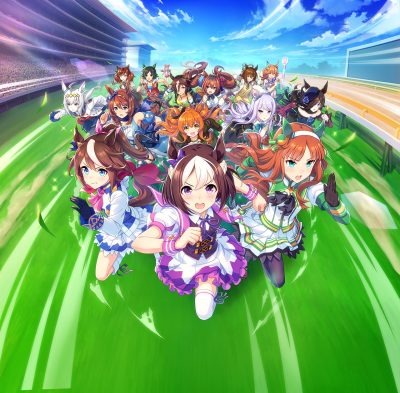
Umamusume is a franchise developed by Cygames that revolves around the concept of raising racing horse girls. Each horse character is loosely inspired by actual racehorses from Japan’s rich horse racing history. A good introductory resource to understand this concept is an ESPN short. While this article focuses on the video game, there are also related TV anime series that offer a comprehensive overview of the setting and introduce some of the characters.
The Umamusume universe features a diverse cast of horse characters, all based on Japanese racehorses, though their lineage may extend overseas. The official website lists 70 such horses. All of them are voiced, with the exception of four who have not yet debuted. As far as we know, the game does not yet include all 70 of these characters.
What is the Umamusume Game?
In short, it’s a raising and breeding game with a competitive social element.
To put it even more simply: It’s like Priconne meets Shiny Colors.
The game is a raising simulator with a competitive stats-based “racing” component. Players manage a roster of racing horses and a set of support horses. The primary objective is to develop the best possible stats for your racing horses, enabling them to win races. The actual racing sequences are primarily backend mathematical calculations, akin to rolling dice in Risk but with the complexity of 4D chess variables influenced by different horses, presented with attractive visuals. The majority of the gameplay experience is centered around managing the raising scenario.
It bears a strong resemblance to IDOLM@STER Shiny Colors. For those unfamiliar, the core gameplay involves selecting a racehorse (or an idol), choosing support horses to accompany it, and progressing through a scenario that spans up to 72 turns. At various points within the scenario, players must achieve specific objectives, typically involving winning or placing above a certain rank in a race by a particular turn. The races in the game are loosely or directly based on real-life races, much like the horses themselves, provided their rights holders permit Cygames to use them.
Upon completing a scenario, whether successful or through premature failure, players acquire a “raised horse.” This horse can then be utilized in player-versus-player (PVP) races, daily races (offering three free races to earn money or support points), main story races, and for “breeding” purposes, which is referred to as the inheritance system. Successfully completing the full training regimen results in a horse with enhanced stats due to the extended training period.
What is the Gacha System?
Racing horses are categorized from one-star to five-star rarity. The gacha system primarily dispenses horses rated from 1-star to 3-star, with 3-star being the rarest. However, all racing horses, including 1-star ones, can be upgraded to 5-star rarity. This upgrade process requires in-game currency and memory pieces specific to each horse. When you obtain a horse through the gacha, you also receive some memory pieces for that horse. Duplicating a horse grants additional memory pieces along with a “megami figurine token,” which can be exchanged for memory pieces of any horse.
Racing horses with higher star ratings are generally more powerful, boasting superior stats. Players can also increase their “social link” or affection level with these horses by using them in races and the raising scenario, which in turn unlocks character-specific stories. Furthermore, horses can be ranked up using drops from races, granting them additional skills.
Support horses are classified into R, SR, and SSR rarities. Each duplicate of a support card, up to five, allows for a level break of five levels. SSR cards have a default maximum level of 30, SR at 25, and R at 20. Duplicates beyond the fifth card can be sold for other tokens. Support horses are crucial during the raising scenario (currently the URA racing scenario) to enhance the stats of the racehorse. Leveling up support horses increases their effectiveness, achievable through support points, in-game currency, or by using them within the raising scenario.
The gacha system features separate pools for racing horses and support horses. Players can “spark” (guaranteed pull) after 200 rolls in either pool. It’s important to note that sparking is only available for the current banner, so careful attention to banner details is advised. Both gacha pools follow a similar pricing model: 150 for a single roll, a daily paid single roll for 50, and 1500 for a 10-roll with a guaranteed 2-star item. Remember that the spark mechanics are distinct for each pool.
Racing horses can also be acquired by trading in specific memory pieces in set quantities, starting at 50 pieces for 1-star horses. It is anticipated that, similar to Priconne, this system will be extended to all non-limited horses. Currently, memory pieces for all non-limited horses can be purchased in the shop. This shop system employs an incremental pricing structure: the first 25 pieces for a horse cost 1 megami figurine piece (or 25 pieces for 25 of them), the next 25 cost 2 (25 pieces for 50), and so on, up to a certain point, after which the price stabilizes for subsequent memory pieces of that horse.
For support horses, there isn’t a readily apparent method of acquisition besides rolling the gacha. However, free support horses can be obtained through in-game events and the main story progression.
What Do You Do in This Game?
For many players, the core activity involves raising multiple horses, perhaps three, fifteen, or even all of them. In essence, this is a raising game with a breeding component. Each turn in the URA scenario requires players to select an action and accept its consequences. This game is noted for its significant randomness; while some random events can be beneficial, many are not. A substantial portion of this randomness stems from how horses perform in races: skills need to activate, the horse must have a favorable gate position, opponents shouldn’t obstruct the player’s horse excessively, strong opponents might also face obstructions, or the horse might have a poor start. There are numerous ways to lose a race, and successfully completing the scenario typically requires securing first place in a series of races against 16 opponents. Additionally, the game incorporates the usual negative events common in raising simulators. Managing a horse’s development can be quite challenging, even if it’s a virtual horse!
At the beginning of each raising scenario, players must select two horses to serve as the ancestors for their new horse. Certain traits from these ancestors and their grandparents (a total of six horses) will be passed down to the horse being raised. In the URA scenario, this inheritance process occurs during the second and third turns of April First Half. Raising horses through inheritance is crucial as it not only allows for the acquisition of rare or limited skills but also enhances the horse’s base parameters, such as innate strength and weaknesses related to different track types and race strategies. Unfortunately, the mechanism by which skills are inherited from one horse to another is largely random.
You might also be interested in : Umamusume: The Game
However, because the inheritance is only largely random, there are aspects that are not random and can be manipulated by the player.
Once a player has successfully raised five mares, they can assemble them into a racing team and engage with that aspect of the game.
Alternatively, you can read the Japanese explainer here.
Finally, after certain races, the horses perform a musical number, which can be unlocked. The songs feature interchangeable vocals!
No, Really, What Do You Do?
Initially, players should engage in a reset marathon to obtain their desired starting setup. It is generally recommended to prioritize rolling for support cards first, as strong support cards seem to significantly ease the game’s difficulty, even if you have fewer powerful horses to raise. This makes the game more enjoyable by reducing excessive challenge. Once you have acquired some good support cards, aim to get your guaranteed 3-star racing horse and perform one roll on the racing horse gacha to acquire some 1-star and 2-star horses, as some of them can be quite effective. The game facilitates rerolling due to its built-in player data wipe feature in the menu, along with a tutorial skip option.
Follow 10 players who possess strong support cards. Select an accessible horse—recommendations include Sakura Bakushin O, Mayano Top Gun, Silence Suzuka, or Special Week. Assemble a support deck and proceed to raise the chosen horse.
When setting up your raising scenario, you have the option to breed from other players’ horses (for a fee). This can sometimes be a worthwhile strategy!
Repeat this process until you become accustomed to the game’s challenges, then move on to another horse, and continue until you develop a solid understanding of how the raising game mechanics function. Concurrently, accumulate support points and in-game currency, and upgrade your support cards.
Multiplayer
In summary: Circles are guilds, engage in PVP as much as you like, and receive free bonuses.
Players in Umamusume can form “circles,” which function as guilds. Members of a circle collectively earn points (in the form of fans) as they raise horses. It is anticipated that team racing will be introduced in future updates.
Individually, there is a ladder system (similar to Shiny Colors) where players assemble teams of horses to compete against random opponents. This system is structured as a ladder. Each horse is assigned a point value based on its power, and players are assigned a letter grade determined by the total point value of their racing team. Players within the same letter grade are then randomly matched against each other. Players can initiate a race using racing points, which regenerate at a rate of one point every two hours, with a maximum of five points. A race consists of five individual matches: Long, Medium, Mile, Short, and Dirt Mile. When building your team, you must assign one to three horses to each match. Most players, typically in Class 2, will assign two horses per match. Each match is decided by the horse that wins the race. After all five matches are completed, the player with the most won matches wins the overall race.
Regardless of winning or losing, the primary outcomes are the random loot drops and the highest score achieved (when defeating the strongest team). A ranking is generated approximately weekly, and rewards are distributed to players based on their high scores. Players can also advance in class based on their high score rankings, which unlocks additional benefits.
Additionally, there is a bonus applied to your support horses based on the strength of your racing team. Therefore, there is no incentive to neglect fielding a team (and allowing others to compete against it).
Anything Else?
There is a wealth of additional information about the game that could be discussed. However, I will leave it to those who are monetizing or gaining fame from it to elaborate further. I have horses to raise, and I’m not sure about you.
I will leave you with this.