UlasanAnime.com – In the 21st century, few developments in Japanese modern visual culture are as significant as 2.5D. This phenomenon leverages the full spectrum of show business expertise, transforming cartoon characters into lifelike representations. Essentially, it involves stage plays adapted from novels, games, anime, and manga. In this specific instance, we are examining a media-mix franchise that is original, spawning a manga and anime series, which culminates in a five-piece band. The members of this band are the very voice actors behind the characters they portray.
This represents the ultimate realization of a dream. While it was commendable for Minako Kotobuki to perform on the keyboard during her Kyoto Animation projects in the late 2000s, it took several more years before Aki Toyosaki could competently play the guitar in front of a paying audience. The K-ON generation highlighted the existence of such a generation in the first place. This dream of a girls’ band truly took shape later when AIMI, then a producer for IM@S and later involved in BanG Dream! cover songs, played guitar for the character Julia. This sparked the idea of creating an entire media mix video game. Nearly a decade later, BanG Dream! continues to dominate this segment, capturing the aspirations and spending of both young and adult fans.
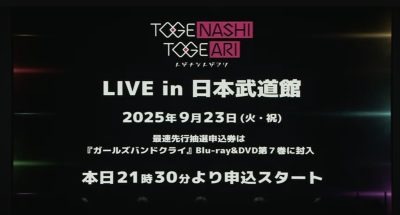
I mention “young,” as I observed a teenager with her mother a few rows ahead of me at Togenashi Togeari’s solo live performance on February 7, 2025, at Pacifico Yokohama. This was Togetoge’s (henceforth) first solo show in a theater. While this might seem like a step down, they had previously performed at larger venues, even appearing at Anisama 2024. As a band that debuted in 2023, they are already scheduled for a show at the Nippon Budokan in September 2025.
During the 20-minute intermission at the Togetoge concert, my seatmate and I discussed TrySail’s upcoming show at the Nippon Budokan in a few weeks, which marks their first performance at that venue and celebrates their 10th anniversary as a unit. This conversation served as an unintentional contrast, as both of us felt, after the announcement of Togetoge’s Budokan show at the concert’s conclusion, that it was happening very soon. Perhaps even too soon. However, I don’t believe it’s inappropriate to say it’s too soon, as this is a prime example of marketing capitalizing on current momentum.
You might also be interested in : Gundam GQuuuuuuX: Initial Thoughts
What is currently “hot”? Togetoge represents the pinnacle of the girls’ band media-mix project concept. This iteration focuses on a core of rock and roll, featuring a high school dropout meeting a high school delinquent. It’s a hilariously traditional premise, but it’s packaged with the signature BanG Dream! flair, making it incredibly accessible. Unlike the more superficial entertainment of earlier BanG Dream! bands before MyGO!!!!!, Togetoge offers substance alongside its rock-and-roll energy. While the established BanG Dream! bands still hold sway, Togetoge is a fresh and rapidly growing entity within these parameters. China, in particular, embraces this genre. MyGO achieved significant success there, and I believe Togetoge has as well, though perhaps without the extensive pre-existing network of rhythm gamers covering their songs. There’s a certain appeal to starting from a relatively blank slate.
This is precisely why a band can reach the Budokan “too soon.” BanG Dream! itself took several years to reach that milestone, and arguably, that too was considered premature by some standards. The principle remains: strike while the iron is hot. This is essentially BanG Dream! version 2.0, offering a more refined and less “empty calorie” experience within the 2.5D landscape.
Naturally, more discerning individuals may hold differing opinions. Personally, I observed a significant improvement in Togetoge’s performance and showmanship from their Anisama 2024 appearance. Given that two members are still on hiatus, resulting in professional musicians filling in on drums and keyboards, the impression is that the three active cast members are now actively engaging the audience, embodying their roles, and enjoying themselves while acknowledging their reliance on “training wheels” for the instrumental sections. This, in my view, is the ideal 2.5D experience. Compared to MyGO or Ave Mujica, where the performers are akin to actors in a play and the audience is merely a passenger, this approach is different. Perhaps that is your preference. I, however, prefer my girl bands to be primarily bands and secondarily stage actors, if one can even discern the difference. This is what makes RAISE A SUILEN exceptional and Popipa eternally best suited for live houses or street performances, and likely nowhere else. Alternatively, one could emulate the enduring popularity of Roselia, who, arguably, aren’t a girls’ band at all. (This observation may also apply to other groups I haven’t mentioned.)
Girls Band Cry is rock. I believe MyGO is also rock. My primary critique of BanG Dream! is that after creating a successful entity like the MyGO anime, they subsequently forced it into a media-mix machine designed for a different purpose. While younger audiences might appreciate the drama, for me, it becomes secondary to the core concept of relevant conflicts within a narrative. If the driving force behind such conflicts stems from a character’s deceased mother, it risks descending into the territory of B-rated Korean dramas. At the very least, I would prefer B-rated Japanese cinema tropes, as seen in Girls Band Cry.