
UlasanAnime.com – JP sums it up, but there are several points that require contextualization. Let’s reiterate the core aspects of anime conventions:
[#1] Interaction with professionals,
[#2] Procuring merchandise,
[#3] Gaining new information, and
[#4] Interacting with fellow fans.
JP elaborates on how anime conventions often fall short in meeting his needs for the first three points, and to some extent, this is understandable. However, the context is crucial.
Firstly, “anime cons in general” are not necessarily Otakon, Anime Boston, PMX, or AM2. Many are simply local vendor shows, like those in Florida that are often tweeted about but only attended by locals. These smaller conventions serve as opportunities for local fans to gather and purchase goods (#2 and #4) more conveniently than online. North America alone hosts nearly a convention every week, making the experience highly variable.
 Secondly, let’s examine JP’s specific criticisms of anime conventions.
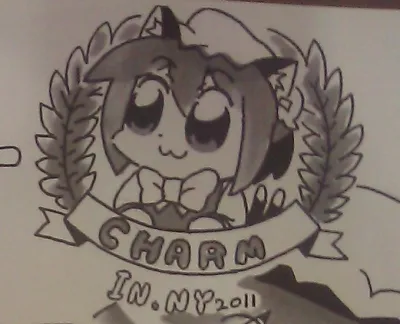
#1. Access to Professionals: My primary motivation for attending conventions is access. The fact that I attend conventions makes JP’s criticism less impactful for me. Even at NYAF (which was part of NYCC), I managed to obtain items like this. This illustrates the concept of access. I can make jokes about “splash” or “asking [insert person] to draw Anaru” because of the opportunities to interact with industry professionals. My interaction with Takaaki Suzuki at AX was a great experience, and listening to Shinkai speak at Otakon was insightful. Witnessing IwakamiP fulfill his promises gives me hope for the future; indeed, everything he said about Madoka and Fate Zero during his Otakon panel seems to have come true.
However, JP is correct that if one isn’t interested in the “industry,” “character designers,” “mechamusume,” “yaoi,” or “weeaboo merchandising”—essentially, any sub-section of the anime fandom represented at the con—then the appeal diminishes. It’s also worth noting that I don’t attend many conventions, even those very close to my home, like AnimeNext, which is considered a top-ten anime convention in terms of attendance.
Anime conventions offer interaction with professionals at various levels. However, it’s important to consider the broader context: compared to Japan, US fans have limited access and interaction opportunities. Not everyone is a Halko Momoi, and while many may care about dub actors, not all do. Anime conventions provide a taste of this interaction, comparable to reading a monthly issue of Newtype or Seigura. Even US-based dub actors lack significant commercial press coverage, with their exposure largely limited to what sites like ANN pick up. While the internet has helped bridge some gaps, a considerable disparity remains between the knowledge of hardcore fans in Japan and those in the US.
JP’s core argument on this point seems to stem from the realization that even at the most attended anime conventions in the US, many attendees are not particularly interested in creator access. Observing Otakon’s forums, one might notice that fan panels often draw larger crowds than panels featuring guests of honor who are creators of the very anime being discussed. This is a somewhat disheartening observation from a certain perspective.
I could likely dedicate several posts solely to point #1. To summarize, at this year’s AX, many Japanese otaku were engaging in similar activities as I was, precisely because they had opportunities to interact with some of these professional guests in ways that are not possible in Japan.
You might also be interested in : Fall into Fun
#2. Merchandise Acquisition: Similarly, most attendees at any convention do not spend extravagantly at charity auctions. In 2011, the Tohoku tragedy notwithstanding, the charity auction presented a prime opportunity to acquire some truly amazing items. This is a mere observation, but I wanted to mention it.
Anime Expo’s dealer’s room was also an excellent venue for acquiring merchandise. Vendors like MangaGamer offered unique items that would be difficult and costly to proxy. Specialty Japanese vendors occasionally appear at larger conventions. I’ve seen Cospa on the East Coast, for instance, and even a fraction of their inventory can yield desirable items you didn’t know existed.
Furthermore, there are less expensive, R1-centric items. I possess a Madoka charity poster that is otherwise unobtainable. Funimation also offers a range of trinkets and t-shirts exclusively available at conventions, such as the Eden of the East t-shirt I desired last year. This differs significantly from the scene at NYCC, where many attendees are seen flipping comic books on eBay. At this stage of my collecting journey, I find many items in my collection that are not readily available in any store, online or otherwise. The largest anime conventions in the US provide a curated selection of imported and domestic goods in their vendor halls. While specific examples are numerous, the underlying truth is that much of this spending is driven by marketing, rather than a robust secondary economy supporting it—though “the RULERS OF TIME” might have a different perspective. This situation is markedly different from what occurs in Japan.
Regarding the purchase of goods, while the internet has rendered much of this moot, the physical shopping experience still holds value. Certain items, like posters and figures, are best purchased in person. It’s safe to say that the mode of purchasing merchandise at conventions has not changed drastically compared to online options. This is why numerous shows and conventions catering to video games, comics, TCGs, anime, and books are still packed with small vendors. People continue to attend them specifically to shop. For fans in developed nations, this is a fundamental aspect of the convention experience.
#3. Information Gathering: God bless bayoab. This point somewhat overlaps with access, but it’s true that better news often comes from those reporting at the convention rather than from attending it. This is also why I now utilize a press badge. Regardless, all of this points to the fact that conventions provide new information. While I’ve had some exclusive insights, these are typically due to specific circumstances rather than general attendee access.
In summary, conventions serve as significant marketing platforms for anime companies, particularly the larger ones like NYCC. However, the anime convention circuit might be too centralized or not sufficiently amorphous, causing it to miss a substantial portion of the “megacon” audience.
#4. Social Interaction: Contrary to JP’s view, I believe this point is the least relevant to anime conventions. Unlike many who attend conventions primarily for social reasons, I do not. The internet provides an excellent platform for communication and socializing, wouldn’t you agree? However, similar to points #2 and #3, I don’t think the internet replaces existing forms of human interaction; it merely supplements them.
Of course, attending a convention with a group of friends is more enjoyable, and conventions are always a great excuse to party, so these aspects do occur. But in the spirit of “learn to offkai,” I socialize for the sake of socializing. If it happens at a convention, that’s great, but it’s not my primary reason for attending.
To conclude, I largely agree with JP’s sentiment:
You can’t apply the megacon style to an anime con, and anime cons are too amorphous and unfocused for the megacon attendees.
However, this observation is more about the people attending anime conventions than how the conventions themselves are run. Considering attendance numbers, Otakon and AX can be considered proper megacons. The issue is that unless one is a dedicated “weeaboo,” the programming at these conventions offers limited appeal. I would even argue that the attendees of AX and Otakon are already too amorphous. Examining guest request threads on their forums reveals requests for “geek” content that isn’t even anime-related, indicating a broader interest than even some of the most popular anime-related figures in Japan might suggest. [Every convention should consider inviting Yamakan.]
So, there you have it. Consider this: no anime convention, with the exception of Otakon for a few years, has featured proper 4chan programming. Yet, every major anime convention has become an internet meme convention. This is because the majority of people attending anime conventions are largely “internet people.” I suspect that companies like Intel and MLG might find better reception by targeting these events than mainstream conventions! It’s quite amusing, isn’t it?





















