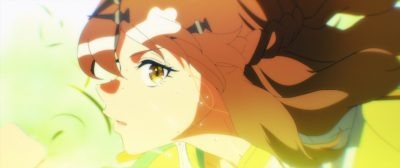
UlasanAnime.com – Kyoto Animation has once again delivered a remarkable TV anime, boasting solid themes and consistently stunning visuals. It’s a production that is both classic and ornate, with intricate details. The only aspect that might hold it back is perhaps its format as a TV show and its adaptation of Hyouka.
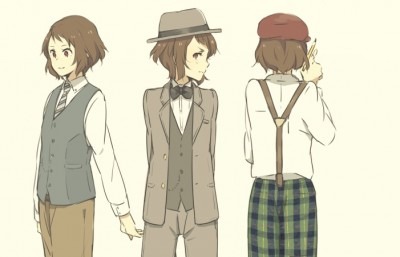
In some respects, my primary concern with Kyoto Animation, dating back to their Full Metal Panic! days, has been their approach to adapting light novels. It often feels overly stiff. Hyouka is not significantly better in this regard, but it is at least relatively resilient—perhaps even compatible—with a rigid adaptation. The direction is intentionally dichotomous at times, serving to highlight the disparity between reality and fantasy. After all, this is a narrative centered around a group of young individuals who maintain the “classics club,” and imagination is a crucial element in any story concerning such endeavors. This is where Kyoani truly showcased its strengths—the power of anime.
Looking back, the subtle translation of “classics club” in the first episode now seems like a foreshadowing of what was to come. Coupled with Hyouka’s inherently quaint nature, the series seemed destined from the outset to achieve deeper qualities, even if it wasn’t entirely by its own volition.
However, being quaint is perfectly acceptable. The show catered heavily to shippers and those who perceive significant character development in Hyouka. While I’m not entirely dismissing this aspect, it might be the least “Japanese” element of the story. I can recall very few Japanese films, whether live-action or anime, where characters or actors openly articulate their feelings aloud, even if it’s within their internal monologue. Verbalizing one’s emotions is, in a way, as un-Japanese as merguez and falafel are to Japanese cuisine. Nevertheless, they can both be incredibly delicious.
Of course, it is entirely possible to find both merguez and falafel in Japan. This diversity is partly why the musical influences in Hyouka can be summarized with a single YouTube link. It evokes a sense of quaintness, which is fitting.
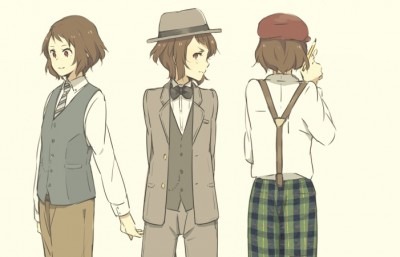
To conclude, the final episode was a delightful piece that brought to mind the finale of K-ON!. However, for reasons unclear, it took a dramatic turn, as the mystery dissolved into the background interactions between Chitanda and Oreki. The detective work served as a mere façade for youthful exuberance; children engage in play simply because it’s what they do, not necessarily because there’s a profound meaning behind their games. Even Oreki’s characteristic low-energy state of non-participation is, in essence, a game. Even Chitanda’s phone calls to secure permission to reroute the procession, and all the acting she and Irisu undertake, resemble a game more than anything of genuine significance. Ultimately, this positions Hyouka as a story that examines dull detective stories, rather than being a dull detective story itself.
Reflecting on it, I find it slightly bothersome that I endured this series primarily for superficial reasons—the impressive animation prowess of Kyoani. However, I suppose I don’t regret the experience. At the very least, it serves as excellent “coffee table-top” material, and there’s always a need for such engaging TV animation that appeals to adults.
Unless, of course, it fails to do so. In such instances, Hyouka can also serve effectively as a sleep aid.
You might also be interested in : Seiyuu Agency Random Half-Questions
PS. Ibara is, by far, the best character. She also ranks second on my Kayanon list. Second place goes to Kouchi Ayako, closely followed by Irisu. Speaking of the manga club members, the vocaloid cosplay group features a cast of intriguing voice actors. If only I were “M” enough to enjoy simulated bullying.