UlasanAnime.com – This article offers a critical perspective on the concept of an “anime licensing bubble” in the USA, suggesting that the narrative often presented is an oversimplification. It argues that the issues faced by some localization companies in the mid-2000s are more indicative of failures within the US localization industry to adapt and evolve sustainably rather than a widespread, global anime market collapse.
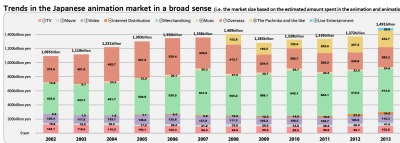
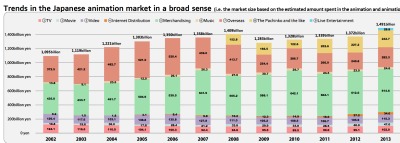
The author points to the significant growth in the “licensing” sector between 2008 and 2013 as evidence that talk of a “bubble” is misleading. This data suggests a robust and expanding market, contradicting the notion of a market crash.
The prevailing narrative surrounding the mid-2000s anime licensing bubble in the US is re-examined, with the author proposing it’s more a reflection of the US localization industry’s struggles to achieve sustainable business growth. This trend is seen as largely localized. While a global economic downturn in the latter part of the decade did affect the anime industry worldwide, it’s noted that anime-related sectors demonstrated a remarkable resilience and quick recovery, unlike many other entertainment industries.
Evidence of this recovery is provided by reports indicating that 2014 marked the highest growth in approximately eight years for the anime industry, with expectations for even greater success in 2015. This counters the idea of a prolonged or devastating market collapse.
Instead of relying on anecdotal accounts of companies like Geneon, Broccoli, or Bandai Entertainment USA, the author advocates for a more business-oriented post-mortem analysis of the situation. However, they acknowledge the potential difficulty in obtaining such a detailed and data-driven examination.
You might also be interested in : DereSute Week 7: Treats And a Few Tricks
The core news item discussed serves as a reminder that streaming is the undeniable future of content distribution. The author expresses sympathy for those who dogmatically resist this shift, predicting their options will become increasingly limited over time. While this might present a net loss for some consumers, the lowered barriers to publishing through streaming could foster a more diverse selection of anime and potentially grant animators greater artistic freedom.
The author draws a parallel to the Vocaloid phenomenon, which transcended traditional CD releases. Similarly, the landscape of anime distribution and creation is significantly different today compared to a decade ago. The emergence of platforms like Crunchyroll and the increasing involvement of major players like Netflix are highlighted as key indicators of this evolving market.
The significant involvement of a global giant like Netflix in co-producing Kodansha’s “Sidonia” anime as a launchpad for their Japanese streaming service is a notable development. This positions “Sidonia” as a Netflix original within the increasingly competitive streaming programming war, at least in the United States. The author acknowledges that Netflix’s strategies in this area are well-covered by English-language pundits.
Consequently, the news that Crunchyroll is entering the anime funding game is presented not as a surprise, but as an expected strategic move. This move signifies an opportunity for revenue generation and, more importantly, represents a significant step towards vertical integration for Crunchyroll’s anime streaming business. The fact that Crunchyroll has already co-produced and co-funded “Wooser” season 3 makes this new venture entirely predictable. The author speculates that this move might be an effort to leverage their strong relationships within the anime programming sphere to preemptively counter Netflix’s potential dominance and prevent being sidelined in an already crowded market.
Addressing the “bubble” issue further requires an examination of available data. Domestically, Japan’s anime industry is reportedly performing exceptionally well, as indicated by reports from January 2015. The industry in Japan is seen as robust enough not to be critically dependent on external opinions or funding from overseas to produce its vast array of light novel adaptations. While acknowledging that overseas markets contribute a significant portion of Japan’s profits, the author asserts that the overall health of the industry is not solely predicated on foreign investment.
This leads to a crucial question: when individuals refer to a “bubble,” which market are they actually referring to, and in what specific region? Even if the US industry were to collapse and every company licensing anime in the US were to disappear, the impact on global licensing revenue for anime would be limited. Based on 2014 figures, this would account for approximately one-third of overseas licensing dollars. The author concedes that the actual figure might be higher when considering merchandising licenses for properties like “Yugioh,” but clarifies that this is not the focus of the “bubble” discussion. In contrast to the less-documented “bubble” of the 2000s, current data suggests that US licensors are playing a significantly diminished role in the overall global anime market.