UlasanAnime.com – The author is preparing to present a panel at AnimeNext 2017 in Atlantic City, focusing on the practical aspects of attending events. This involves organizing thoughts and materials, akin to preparing ingredients for a meal, allowing for deeper reflection.
Eventing is considered a fundamental component of the modern Japanese visual culture complex, on par with anime, manga, and games. However, unlike these more established sectors, eventing hasn’t always been recognized as a distinct pillar. While detailed discussions about anime licensing, merchandise sales, and related intellectual property are common, analyzing the eventing sector proves more challenging.
This difficulty stems from the complex and varied nature of eventing, much like the production of late-night anime. While the end product might be similar across different intellectual properties, the underlying motivations and business models can differ significantly.
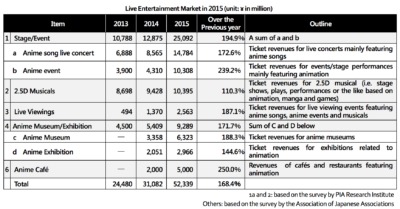
Referencing a 2016 report offers a clearer perspective on the industry. The report highlights significant growth in live anime-related entertainment, with the market doubling in the three years leading up to 2015, reaching 52.3 billion yen in 2015. This growth is attributed partly to improved survey accuracy and the broader expansion of the domestic live entertainment market, particularly the music sector.
Live anime?related entertainment continued to make important breakthroughs. The market doubled in
the past three years since 2013 when the survey started, and recorded revenues of 52.3 billion yen in
2015, increasing by 68.4 % over the previous year. This increase, which may partially be attributed to
improved accuracy of surveying methods, was also significantly associated with the rapid growth of
overall domestic live entertainment markets, especially the growth of music market (i.e. revenues of
music concerts, stage performances, plays etc., including live entertainment related to animation). The
market size, which was 333.4 billion yen in 2012, became 503 billion yen, increasing by 51% over the
past three years.
At the same time, non?staged live entertainment, such as anime museums, anime exhibitions and anime
cafs are also doing well. Although revenues of non?staged live entertainment fall far short of those of
staged live entertainment, the field still makes constant progress. Animation is shifting from a thing to
be watched to a thing to be experienced, and the non?staged live entertainment, which offers a feeling of
belonging to consumers, will continue to expand.
The sales amount arising from merchandise sold on?site (i.e. concerts, events, museums and exhibitions)
is not included in the values in this report. If such revenues are included, and in some cases such they
exceed ticket revenues, the live entertainment market size may reach 10 billion yen or more..
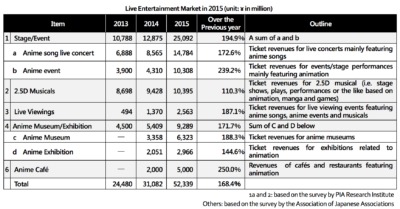
The chart provides a more detailed visual representation of these figures.
From a fan’s perspective, the business intricacies of eventing might not be the primary interest. For instance, a fan of “Uma Musume Pretty Derby” might be more focused on how such a franchise achieves a level of prominence that rivals established names like “IDOLM@STER.” Understanding the mechanics of a mobile game IP, including how related CD albums are released and the significant appeal of voice actresses, is often sufficient for a fan.
You might also be interested in : Saekano’s Clicker Mechanics
Similarly, the success of “Sailor Moon” live-action musicals, leading to notable cosplay appearances by voice actresses like Asumiss and ZAQ, or the export restrictions on “Wake Up, Girls!” Blu-rays due to Avex’s policies, are all part of the eventing landscape. The proliferation of themed cafes, from general anime cafes to specific ones like the “Panty & Stocking” cafe in Kobe, further illustrates this point.
As the data suggests, eventing in Japan encompasses a wide range of activities. Anisong and seiyuu events have a long history, predating their categorization by organizations like the AJA. The author expresses a desire to experience traditional “Sakura Taisen” kayo shows before they cease to be available. The rise of the “seiyuu idol” phenomenon in the 1990s, with artists like Hekiru Shiina, marked a significant shift. While these early endeavors might have been absorbed into the traditional music industry, the current market distinguishes between revenue streams, such as those generated by “Wake Up, Girls!” versus Mizuki Nana.
At its core, attending an event is driven by personal motivations. It could be a once-in-a-lifetime experience, a desire to support a favorite artist consistently, or simply the enjoyment of the event itself. The process of getting from one’s daily life to a specific event involves a series of steps, which the author plans to detail in their panel.
Beyond attending concerts or musicals, eventing can be a lifestyle. This is comparable to how American fans prepare for anime conventions. The anticipation, social aspects, and preparation involved in attending a convention mirror the planning required for an international trip. This can extend to activities like cosplay, organizing or participating in panels, sharing experiences on social media, hosting offkai (off-kai: informal gatherings), or simply possessing the knowledge to help others enhance their event experience, whether at AX or Anisama.
Covering all these facets in a single hour is a challenge. The key objective is to provide both specific details and a broader overview, empowering attendees to explore further on their own. The author ponders how to effectively connect seemingly disparate elements, such as the transition of a frugal otaku into someone who purchases bulk CD boxes for event lotteries.
PS. The 2016 English summary from AJA presents two points of interest. Firstly, the chart’s definition of “limited” live events in the bottom graph lacks clarity. Secondly, the report singles out anime music, prompting questions about how revenue from projects like DiveIIx81Produce compares to that of a typical major-label musician. The author also questions how the involvement of artists like X Japan or Man with a Mission in anime-related events is categorized, wondering if only events explicitly billed as anime music festivals (like Anisama, Animax, and Lisani) are counted.
PPS. The author also poses a question about how a particular link is classified.