UlasanAnime.com – The intricate process of digital composition in anime, particularly as exemplified in “Fate/Zero,” highlights the evolving landscape of animation production. This technique, which involves merging various visual elements to create a final animated sequence, plays a crucial role in achieving the desired aesthetic and emotional impact of a series.

A prime example of effective digital composition can be observed in the bonus video clips from “Infinite Stratos.” In these features, viewers are shown how 3DCG elements are integrated with traditional 2D animation. For “Infinite Stratos,” this often means incorporating 2D character designs and body parts onto complex mecha models, a process that demonstrates the blend of different artistic mediums.
The increasing sophistication and prevalence of digital animation techniques present anime with vast opportunities for innovation and creative exploration. This advancement is a significant factor in the industry’s growth, allowing for new visual styles and storytelling methods to emerge.
The importance of digital composition in modern anime production was underscored by a discussion involving Raito-kun and the director of photography for “Fate/Zero,” Yuichi Terao. Terao’s perspective suggests that “Fate/Zero” is not merely a “sakuga anime” (an anime celebrated for its animation quality) but rather a “satsuei anime” (an anime distinguished by its cinematography and visual direction).
The secret star of F/Z is Yuichi Terao, the director of photography. F/Z is no ‘sakuga anime’, but a ‘satsuei anime’.
Further insights into the production of “Fate/Zero” and the work of ufotable were shared through translations of interviews conducted by Mynavi. These interviews, compiled by duckroll, shed light on the meticulous work involved in the series’ visual presentation.
A notable segment of these interviews focuses on the background art and the role of Terao and Kim, the background artist. Their collaboration is essential in establishing the distinct atmosphere and visual identity of “Fate/Zero.”
– Terao joined Ufotable in Dec 2003. At the time he was hoping to apply for a job in production, but he was instead put into the newly formed Photography Department (Digital Compositing). He knew almost nothing about animation photography back then, but now he is the head of the department and the director of photography for Fate/Zero.
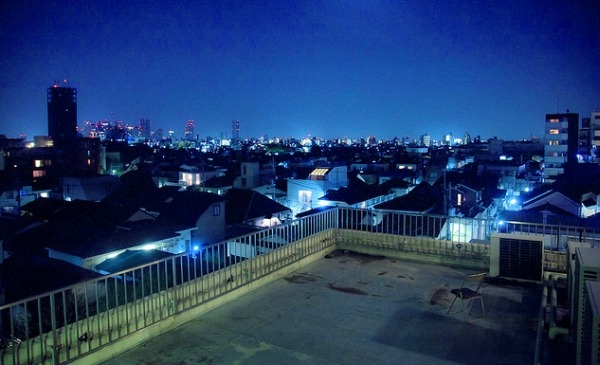
– For Terao, one of the most important aspects of the show is the sky. He uses a “Type-Moon Blue” to characterize the sky in the show because it is a color that works well with Type-Moon characters, and serves as a motif in all their original artwork. He tries to bring this out in the sky backgrounds as much as possible.
– To illustrate an example of the type of sky he is talking about, he shared a reference photo he took for Garden of Sinners on the studio roof. Incidentally, the studio roof is also the reference setting for the stand off between Tokiomi and Kariya in episodes 14 and 15.
You might also be interested in : KOTOKO Live at Animazement 2012
The challenges and innovations in digital compositing were particularly evident in episode 18. Despite the director Suhara’s initial reservations about using the standard deep blue for the sky, Terao utilized digital compositing techniques to achieve the desired effect for a specific date scene. This successful implementation led to the discovery of new methods for scene presentation and influenced future production decisions.
– The issue of the sky color became a bit of a problem with episode 18, when the director Suhara was adament on not using the same deep blue shade for that episode. Backgrounds had to be redone to match the image the he had in mind. But in the end, for the date scene with Shirley, Terao used digital compositing techniques to bring out that deep blue shade instead. Suhara approved of it, and that became a new technique they discovered to present scenes, having an impact on how they approached future scenes.
The V-MAX scenes in episode 21, which involved a complex integration of 2D art and CG elements, were particularly demanding in terms of resources. The successful completion of this sequence before its air date was attributed to the diligent management by Yoshida, the production runner for the episode.
– The V-MAX scenes in episode 21 contained a substantial mix of both 2D art as well as CG elements, which made sequence extremely heavy on resources. It was all thanks to the solid management by Yoshida, the production runner on the episode, that they managed to complete it before it aired.
Terao also hinted at a significant climax spoiler, noting that the final sequence in the series’ grand finale would feature a remarkable combination of background art and digital compositing, urging viewers to anticipate it.
– The final thing Terao mentions is a slight climax spoiler: He says that the final [SPOILER] sequence in the big climax scene is something that features their finest line-up of both background art and digital compositing, and that everyone should look forward to it.
Expanding on ufotable’s production philosophy, Terao emphasized the studio’s commitment to prioritizing the audience and the product. He stated that keeping audience expectations in mind is a core mandate for all staff. While complete creative freedom can be challenging in a large production studio, individual staff members are encouraged to make the most of their roles.
– Terao expands on the philosophy of Ufotable, and says what is most important for all the studio staff is that they have to think of the audience and the products they work on first and foremost. Keeping the expectations of the audience in mind is the studio’s mandate for all staff. Freedom is only what each person makes of it, because as a large production studio, complete creative freedom can be rather hard to come by.
These firsthand accounts offer a glimpse into the daily operations and creative processes of the individuals involved in anime’s digital composition and photography departments. The explanations provided serve as a solid introduction to the concept of digital composition.
– Digital compositing is the process of combining the character cels and the background cels for animation, and occasionally 3DCG data, into an animated end product. Animation no longer uses physical cels, but the layers are still called that for familiarity. During this process, various effects and lighting adjustments are also applied for each animation cut. Things like reflections, beams of light, or weather elements like rain and snow are often all part of the digital compositing.
– Yoshikawa compares digital compositing to a woman putting on make up. the characters and backgrounds in various different cuts are like different natural faces which people have. So each situation calls for a different approach. Some people look good with heavier make up, while others are best with a lighter touch.
– Depending on the requirements of a scene, a single cut can be finished and processed in just a few minutes, or it can even take a whole day to finish. Sometimes she works on something in the morning, and before she knows it, it can be nightfall. For episode 4, the scenes with Lancer using his spear to cancel Saber’s Invisible Air required quite a lot of work.
For those interested in other aspects of “Fate/Zero’s” production, further details on the roles of line producers at ufotable are available. Their work, while specific to ufotable’s system, mirrors the general principles of project management in anime production. Ben from Anipages provides a more in-depth look at the anime production line.
To complement these insights, additional notes from duckroll on the ufotable interviews from Mynavi News cover various production roles:
- Finishers
- Checkers
- Key animators – also tells you how the promotion system works
- Suhara (Episode Director)
PS. There’s an observation that the number of women entering anime production has been increasing over the years. Ufotable’s 2009 intake, notably, was entirely composed of women.
PPS. The spoiler scene mentioned by Terao is anticipated to appear in the upcoming episode, creating further excitement for the series’ conclusion.
PPPS. Occasionally, the NeoGAF forums may experience temporary errors. If encountered, trying again later is recommended. Efforts will be made to include relevant excerpts from the forums if issues persist.