
UlasanAnime.com – Bang Dream is a media mix project that brings together characters and performers to create a rock-band-oriented experience. Its most unique aspect lies in how it utilizes voice actresses to embody these fantasy girl band scenarios, with the actresses themselves actually performing the music that accompanies their vocals. In essence, Bandori’s selling point is the “cool” factor of youthful girl rock bands brought closer to reality.
It’s important to note that this “closeness” is primarily in the live performance aspect, as recording sessions often involve professional musicians. Voice actresses, with a few exceptions, are not professional guitarists, DJs, or drummers. There’s a significant gap between a real girls’ band striving for success and actresses portraying characters in girl bands. However, it also transcends a traditional stage show, as demonstrated by performances like Roselia’s.
Bandori features an assortment of bands, with Poppin’ Party leading in both musical production, boasting over a dozen original songs, and narrative focus through its anime and manga. Roselia appears to be the second most prominent. To the best of my knowledge, none of the other Bandori bands have performed live. The live events for Bandori so far are typical seiyuu events, with the significant distinction that the performers actually play the music.
The game itself is a Deresute-style rhythm game. Players select a team of five characters and tap the screen as notes descend. The rhythm game mechanics are quite solid, with a presentation reminiscent of Rock Band or Guitar Hero, where tracks align with seven tappable spots on the screen. The charts are generally beat-centric and groovy, making for an enjoyable experience when the music is engaging. While not excessively difficult, it presents a steeper learning curve compared to Deresute. The note input is generally good, with the exception of flick-up notes, which can be tricky due to tighter timing and potential issues with touch registration on fast flicks.
As a mobile app game, unlike Deresute, it lacks a unified login system, meaning game accounts are device-specific. In the early stages, players will spend considerable time navigating through a large volume of dialogue, which is fully voiced (excluding minor characters). This dialogue is crucial as it grants EXP, band EXP, various items, and/or jewels. Early in the game, there’s an abundance of dialogue to skim through, much of which is tied to leveling up, which happens rapidly at the start. The Bandori game exposes players to a comprehensive range of music and narrative content for not only Popipa but also other bands within the universe, potentially excluding some anime or manga-specific bands.
Bandori does not employ a stamina system. Instead, it uses “fire” as its time/money-gated resource. Players can play any unlocked songs at any time, as many times as they wish. Each song play consumes one “fire.” Successfully completing a song while using one or more fires grants a 5x multiplier on rewards. If no fire is consumed, rewards are at 1x. For event points, consuming more than one fire can yield a multiplier greater than 5x. This incentivizes playing with “fire” in stock for increased experience gain. Players can regenerate up to three fires (with a maximum storage of 99), with each regeneration taking 30 minutes. Once three or more fires are available, regeneration stops. Leveling up grants three fires, and three fires can be purchased with 50 jewels.
This system is appealing as it makes “stamina” less of a constraint. It contrasts with games like LLSIF, where it’s easy to accumulate over five hours of stamina. In Bandori, players are likely to use up their fires throughout the day. This encourages continuous play, especially for free players who can engage with the game extensively. Early on, by around level 10, players might have 20 or more fires stocked up, leading to significant playtime until they are depleted, likely around level 20. During this phase, players effectively don’t experience stamina recovery as they maintain over three fires. The abundance of dialogue, both in story mode and within game menus, further contributes to the extensive early gameplay.
There are two primary play modes: Free Play and Multi-Play. Free Play allows players to enjoy unlocked songs as expected. Multi-Play involves real-time online cooperative play with four other players. Players select a bracket based on team strength and potential rewards. The game then pairs players with four random individuals. Players can choose a song, or opt for “omakase” (random selection) or skip. Once song choices are made, the game randomly selects one from the submitted options. Each player then selects their own difficulty level before the game commences. Multi-mode introduces “fever time,” a bonus point mechanism where all five players must successfully clear the pre-chorus to earn bonus points during the chorus. Multi-play also offers significantly higher rewards than Free Play, despite consuming the same amount of fire.
A notable feature of the Bandori game is its integration of micro-content elements, similar to the 1-koma gags seen in Deresute’s load screens. Bandori incorporates these into loading screens and its main menu UI, which is depicted as the Bandori town. Players can navigate various locations and interact with randomly placed characters who offer brief, often 4-koma style, dialogue. This serves as an effective method for character exposition and developing a feel for the characters and the IP. However, the sheer volume of these early-game interactions, which grant EXP, can be overwhelming. By around level 30, players may have exhausted all available dialogue. Locating these dialogues across the map can be time-consuming and contribute to a “menu hell” experience, especially when they reset randomly between songs and app loads.
The gacha mechanism and jewel economy are fairly standard. A single pull costs 250 jewels. There’s a daily discounted pull for paid jewels, and a 10-pull costs 2500 jewels with one guaranteed 3-star (SR equivalent). An introductory package offers 1000 jewels with a 25-day login bonus of 80 jewels each, costing approximately $10 USD. This package, while unique, is quite transparent in its design.
Unless one is already invested in the game’s characters or voice actresses, it can be challenging to identify what Bandori offers that other games on the market do not. The primary draw is the music. Stylistically, it draws inspiration from the romanticized K-ON motif, featuring at least three bands within that spectrum: Popipa, Roselia, and Afterglow. The original songs cover a relatively narrow range of what Japan’s mainstream band scene offers, particularly concerning the imagery the bands aim to portray. Elements Garden, a renowned composer group known for many popular anime songs, has been hired to create original music and arrange band covers of existing songs. This includes girls’ band covers of popular anime music, which is a significant appeal given the talent involved in the arrangements and the voice actors/singers. A notable example is Hikasa Yoko (Mio’s voice actress from K-ON) being part of Afterglow, playing the drummer Tomoe, while Afterglow covers “Don’t Say ‘Lazy’,” with the vocals performed by her bandmate Sakura Ayane (Ran, the lead guitarist/vocalist).
The other two bands, PastelPalettes and Hello, Happy World, venture into less conventional territory, offering more comedy than distinct musical variety. PastelPalettes is positioned as an “idol” band, while Hello, Happy World is a concept band with eccentric members, including a mascot character. Musically, Pastel*Palettes is perhaps the least appealing aspect for some, as it leans heavily into idol music, akin to Love Live, which is theoretically the antithesis of girls’ band music. However, in practice, there’s overlap, which is understandable. Hello, Happy World currently adopts a more children’s pop style.
In practical gameplay after the “early game” phase, players typically log in every few hours to spend their fires in multi-play. The quality of the experience and enjoyment often depends on the random players one is paired with. If a player consistently encounters music they dislike from other players’ choices, it can detract from the experience. While disconnecting before the music starts is an option, it highlights a potential need for a “song blacklist” in multi-play. Free play offers fewer event points and rewards compared to multi-play. Despite the ability to mix and match band members based on gacha luck, there’s a noticeable lack of Popipa players, even though half the game’s songs are Popipa originals. This results in most players opting for covers or original songs from the other four bands, diminishing the musical diversity seen in multi-play. Many players, including the author, prefer covers as they represent proven market appeal and offer interesting arrangements, such as “Sobakasu” or “ETERNAL BLAZE.”
The multiplayer experience is further marred by occasional bugs, such as the game getting stuck on loading screens, resulting in lost fires. While restarting the app after each song can mitigate this, a more significant issue, particularly in the newbie and intermediate brackets, is the prevalence of “freeloaders” – players who contribute minimally and then give up. Since rewards are largely based on group performance, these players still receive benefits without actively participating. This can negatively impact the overall score and player morale, especially when missing a rank due to a lack of effort from teammates.
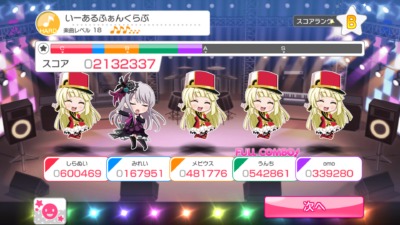
The event system itself is not highly competitive. While there are rewards for ranking, with achievement badges being the top prizes, the event SR and R cards are obtained by accumulating a specific point total. It offers a more casual experience compared to other rhythm games. The game provides a sufficient level of chart complexity to maintain player interest. The author expresses enjoyment due to their fondness for Hello, Happy World, citing positive experiences with a recent event and fortunate free draws, complemented by the generous jewel rewards provided at the start of the game.
However, motivation to continue playing dwindled after the event concluded and the author obtained desirable draws, including multiple 3-star and one 4-star Hello, Happy World character. The author feels confident about their chosen band if attending a Bandori live event. Currently, logins are primarily for freebies, with occasional checks for new songs.
You might also be interested in : The Meta Game: Spring 2017
Regarding live events, Bandori has a relatively high frequency. Poppin’ Party members have already held three solo concerts. Roselia recently performed their first mini-set, an advancement from their appearance at Bandori 3rd, and is scheduled for a solo event on June 30th. This is presented as exciting for fans of voice actors performing instruments. Aiba, in particular, possesses a strong vocal talent suitable for this genre, and fans can catch her at AX later in the year, potentially alongside Roselia guitarist Kudou Haruka.





















