UlasanAnime.com – This article delves into the complexities of the anime industry, particularly in relation to experimentation, funding, and audience reception, drawing parallels with the American media landscape.

A couple things.

The author expresses enjoyment for the nuanced discussions happening in the comments section and aims to expand on those thoughts in this blog post, referencing an original post titled “The Tunnelvision of Long Tails.”
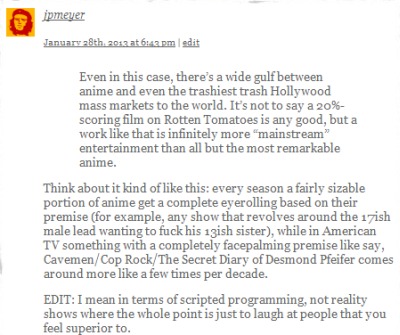
While the previous post covered a broad range of topics, this one focuses on a couple of key points raised in the comments, specifically the meaning of “eye-rolling” in the context of experimental anime.
In retrospect, the straightforward answer to “eye-rolling” is the low probability of “great” experiments succeeding. When viewers “roll their eyes,” it’s often in anticipation of encountering something like OniAi. This, the author suggests, explains why shows like Firefly are rare. The amount of vetting isn’t necessarily the reason for experimental anime being produced, but rather the status of an Intellectual Property (IP) being vetted.
There are numerous experimental anime, but a near-zero chance of unique content like Trapeze appearing on American broadcast television. This is presented as a downside for some, or an upside for others. Conversely, this system also prevents content like Juuden-chan from appearing, which is a downside for some viewers. Therefore, the American system is seen as a win-win for some and a lose-lose for those who enjoy shows like Juuden-chan, with a wash for the rest. The author believes these odds favor the American system.
The reasons for the abundance of experimental anime are twofold, both stemming from fundamental issues of price and funding. The first reason, though well-discussed, remains a rare piece of knowledge: its infomercial nature. The second reason is that anime is just one component within a larger system, and not necessarily the most significant one.
For instance, a show like Game of Thrones undergoes an extensive “will this actually sell/net a lot of viewers and interest” phase. This involves creating a pilot episode, pitching it, and conducting A/B testing to safeguard the substantial $50-60 million USD production cost for HBO. This process can be termed vetting.
The average anime is not created with the same level of rigorous vetting. While pitch trailers are sometimes created for IPs and shopped to investors, this is usually just one piece of the puzzle. Unless one is affiliated with a company like Aniplex, this wouldn’t be the starting point. A producer at a publishing company would likely be working with other producers to shop an IP, rather than an adaptation.
Consider the scenario where a producer creates K-ON, and it becomes a massive hit. The initial intention was simply to produce a lighthearted slice-of-life anime about cute girls playing music, similar to other shows. However, the success leads to the manga artist returning to create a sequel. The author questions who performed the vetting in this case, suggesting it was the viewers themselves.
Since the production of K-ON only required a few million dollars, which would likely be recouped even if it were a flop, it was allowed to run for a full cour instead of being canceled after three episodes. The author humorously notes that nobody anticipated a show like K-ON could be so financially successful for the hypothetical producer, or similarly, Haruhi.
The author recalls 2006, the year Haruhi aired, noting that the show had absolutely no hype. Vetting, in this context, is dismissed with a laugh.
Ultimately, the question arises: where does the money come from if you are Kadokawa Shoten? The author suggests following both avenues, as mentioned previously and in comments regarding McDonald’s. It’s best to think outside the conventional “box” when considering revenue streams.
You might also be interested in : Long Tail Blindness
The author mentions licensing, franchises, merchandising, and “the whole nine yards.”
The core point is that cheap anime serves a dual purpose: it acts as a pipeline for revenue and a method for vetting IPs simultaneously. This is why, the author posits, “we can’t have nice things” – because the audience acts as beta testers. The author adds that if Kickstarter is any indication, many people actually enjoy being testers, referencing Muv-Luv Alternative.
===
The article then introduces Ian Condry’s new book and a related write-up from the MIT news office, suggesting its relevance to the discussion. A key quote from the write-up is presented:
And yet, the success of Japanese anime constitutes something of a mystery. If you were to concoct a plan for entertainment-industry success in the digital age, Condry notes, it would probably not involve the painstaking development of hand-drawn cartoons.
“It’s incredibly difficult, and not very lucrative” for the artists, says Condry, who visited dozens of anime studios, workshops and artists while researching the book over the last eight years. “It’s one of the most labor-intensive forms of media there is.” Entertainment companies do not necessarily make huge profits off anime, which was an issue motivating Condry’s study; as he puts it, “How can things that don’t make money go global?”
The answer is that anime producers create many series and watch closely for what catches on — and then, once the characters in a series become a “platform” for audience participation, may cash in through toys, games and other forms of entertainment.
The author then prompts the reader to reconsider the concept of vetting in light of this information.
The author’s main argument is that anime, in its current, somewhat chaotic state, functions as a platform for the future. Lessons can be learned from both its successes and failures, which can then be applied to new emerging media trends.
The resurrection of Toonami might be a natural progression. The author speculates that the internet, copyright reform, and new copyright practices may have gradually eroded the power of Western content owners. While uncertain, the author feels that the landscape is clearly shifting in this direction.
PS. The author poses a philosophical question: If Tezuka cursed anime, did Tomino save it?
PPS. Drawing on a background in corporate law, the author concludes by referencing Dodge v. Ford Motor Co., offering a hypothetical “golden bonus hanamaru super star” to anyone who understands the reference.