UlasanAnime.com – If you were interested in English-language comics, you might have encountered the complex and peculiar history surrounding the ownership of Marvelman. It’s an odd situation, and perhaps not entirely relevant, but here’s a brief explanation: Marvelman is a comic franchise/character that Neil Gaiman, a renowned comic artist and scriptwriter, has attempted to revive for reasons unknown. At one point, Todd McFarlane believed he held the rights. Coincidentally, Gaiman is a co-owner of certain key Spawn characters, including Angela, Cogliostro, and Medieval Spawn. In 1997, Gaiman and McFarlane agreed to a trade: Gaiman would exchange the rights to Cogliostro and Medieval Spawn for Marvelman, which at the time was considered to be worth very little compared to owning a piece of the Spawn universe.
However, the arrangement did not work out, leading to legal intervention and the involvement of judges. The author admits a particular interest in this case due to Judge Posner’s handling of the matter and the subject itself. While Gaiman garners a small amount of interest, McFarlane elicits none. This sentiment extends to Spawn, Angela, and Marvelman as characters.
Reading about this case, it’s difficult to envision someone like Judge Posner, or perhaps one of his clerks, delving into the general concepts of Spawn. It’s likely that by the time he wrote the opinion, he would have had the opportunity to see the Spawn movie. The author confesses to being a bit of a Posner fanboy.
Judge Posner’s own words offer the best explanation:
We need to do some stage setting. Gaiman and McFarlane are both celebrated figures in the world of comic books, but they play different though overlapping roles. Gaiman just writes scripts; McFarlane writes scripts too, but he also illustrates and publishes the comic books. In 1992, shortly after forming his own publishing house, McFarlane began publishing a series of comic books entitled Spawn, which at first he wrote and illustrated himself. “Spawn,” more precisely “Hellspawn,” are officers in an army of the damned commanded by a devil named Malebolgia, who hopes one day to launch his army against Heaven. The leading character in the series is a man named Al Simmons, who is dead but has returned to the world of the living as a Hellspawn.
Al’s story is an affecting one. Born in a quiet neighborhood outside of Pittsburgh, he was recruited by the CIA and eventually became a member of an elite military unit that guards the President. He saved the President from an assassin’s bullet and was rewarded with a promotion to lieutenant colonel. He was placed under the command of Jason Wynn, who became his mentor and inducted him into the sinister inner recesses of the intelligence community. When Al began to question Wynn’s motives, Wynn sent two agents, significantly named Chapel and Priest, to kill Al with laser weapons, and they did, burning him beyond recognition. Al was buried with great fanfare in Arlington National Cemetery.
Now Al had always had an Achilles’ heel, namely that he loved his wife beyond bearing and so, dying, he vowed that he would do anything to see her again. Malebolgia took him at his word (“would do anything” and returned Al to Earth. But a deal with the devil is always a Faustian pact. Al discovered that he was now one of Malebolgia’s handpicked Hellspawn and had been remade (a full makeover, as we’ll see) and infused with Hell-born energy.
Returned to Earth in his new persona, Al discovers that his wife has remarried his best friend, who was able to give her the child he never could. He absorbs the blow but thirsts for revenge against Jason Wynn. He bides his time, living with homeless people and pondering the unhappy fact that once he exhausts his Hell-born energy he will be returned to Malebolgia’s domain and become a slave in an army of the damned with no hope of redemption. He must try somehow to break his pact with the devil.
The author finds Posner’s description of Angela and Gaiman’s contributions to Spawn issue #9 to be even more compelling:
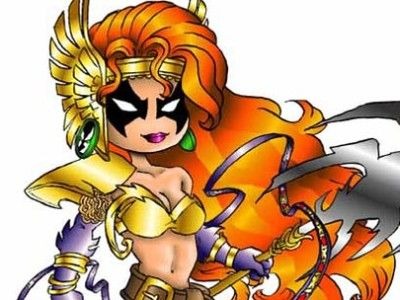
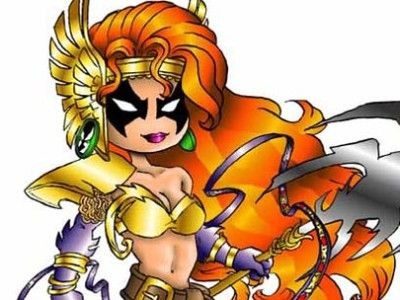
McFarlane’s original Spawn, Al Simmons, was a tall figure clad in what looks like spandex (it is actually “a neural parasite”) beneath a huge blood-red cloak, making him a kind of malevolent Superman figure, although actually rather weak and stupid. His face is a shiny plastic oval with eyeholes but no other features. Gaiman decided to begin Spawn No. 9 with a different Spawn, whom he called “Olden Days Spawn.” He explained to McFarlane that “[Olden Days] Spawn rides up on a huge horse. He’s wearing a kind of Spawn suit and mask, although the actual costume under the cloak is reminiscent of a suit of armour.” McFarlane drew “Olden Days Spawn” as (in the words of his brief) “essentially Spawn, only he dressed him as a knight from the Middle Ages with a shield bearing the Spawn logo.” To make him credibly medieval, Gaiman in his script has Olden Days Spawn say to a damsel in apparent distress, “Good day, sweet maiden.” The “damsel” is none other than Angela, a “maiden” only in the sense of making her maiden appearance in Spawn No. 9. Angela is in fact a “warrior angel and villain” who, scantily clad in a dominatrix outfit, quickly dispatches the unsuspecting Olden Days Spawn with her lance.
We learn that this event occurred in the thirteenth century, and the scene now shifts to the present day. Angela is dressed as a modern professional woman. The Al Simmons Spawn is lurking about in an alley and it is here that we meet Count Cogliostro for the first time. McFarlane had wanted a character who would be “basically. . . the wisened [sic] sage that could sort of come down and give all the information and assimilate it.” Gaiman interpreted this as an instruction to create “a character who can talk to Spawn and tell him a little bit more about what’s going on in the background and can move the story along. ” So he created an “old man, who starts talking to Spawn and then telling him all these sort of things about Spawn’s super powers that Spawn couldn’t have known. And when you first meet him [Cogliostro] in the alley you think he’s a drunken bum with the rest of them, and then we realize no, he’s not. He’s some kind of mysterious stranger who knows things.”
Gaiman further described Cogliostro in a draft of Spawn No. 9 as “a really old bum, a skinny, balding old man, with a grubby greyish-yellow beard, like a skinny santa claus. He calls himself Count Nicholas Cagliostro” (later spelled Cogliostro). In a brief scene, Cogliostro, drawn by McFarlane as an old man with a long grey beard who faintly resembles Moses–McFarlane had been dissatisfied with Gaiman’s verbal description, which made Cogliostro sound like a wino–explains to Simmons-Spawn some of the powers of Hellspawn of which Simmons is unaware. Cogliostro displays his mysterious wisdom by calling him “Simmons,” to the latter’s bafflement–how could Cogliostro have known? Angela then appears in her dominatrix costume, there is another duel, and she vanquishes Simmons (whose powers are in fact unimpressive), but does not kill him. He then blows himself up by accidentally pushing the wrong button on Angela’s lance, which she had left behind. Happily he is not killed–merely (it seems) translated into another dimension–and will reappear in subsequent issues of Spawn.
The author expresses admiration for Posner’s ability to articulate and grasp the intricacies of Spawn, a feat that many fans might struggle with. While the author was not a Posner fan and was unfamiliar with copyright law when this was initially reported in 2004, revisiting the material for a class has led to a newfound appreciation and amusement. This narrative serves as a cautionary tale for creative individuals, emphasizing the importance of carefully selecting collaborators.
The piece concludes by reflecting on the peculiar nature of American law and business practices.
You might also be interested in : Blogging Can Harm Your Reputation