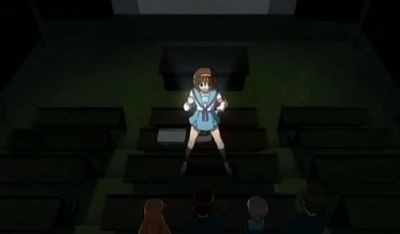
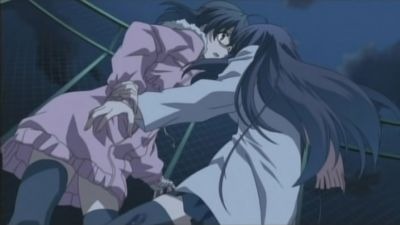
UlasanAnime.com – Attempting to understand the anime series “School Days” is a straightforward endeavor. It appears the creators of this adaptation recognized the inherent strength of its source material. Setting aside the criticisms from those who believed “the game was superior,” the anime likely achieved its fullest potential, incorporating as much as possible from the widely recognized “bombs of joy and LULZ” that the game was famous for.
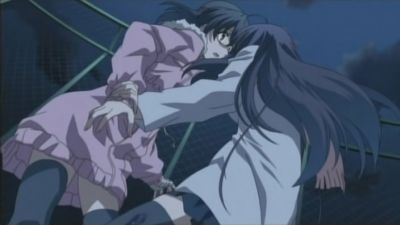
However, I find myself more inclined to discuss its connections to “Elfen Lied” and “Higurashi.” These shows employ similar narrative mechanisms to elicit emotional responses, and their successes or failures in doing so offer insights into why “School Days” resonated so effectively.
To be concise, I will focus on two primary points.
Sympathy. Many viewers find it easier to empathize with a group of high school students engaged in promiscuous relationships and a male protagonist who understands not love, but only the quagmire of selfish desires he is trapped in. This sentiment aligns with counter-cultural movements that have advocated for such ideas for decades, irrespective of religious or secular viewpoints. Witnessing this in anime serves as a refreshing departure, given one might assume it wouldn’t appeal to the otaku demographic. Yet, we are all human, and it’s possible to sympathize with Makoto, Sekai, and Kotonoha in their follies. This alone provides a strong advantage when comparing settings. Consider a scenario where a few youngsters reside in an abandoned shrine-like mansion, accepting random naked individuals, or being transferred to a remote location, attending a school with a single classroom for all grades from K to 12, and having their lives extinguished every five episodes only to be reset.
Believability. The quotient of gruesome deaths experienced by American viewers is likely higher than in most other demographics. American entertainment often glorifies violence. However, this doesn’t imply that other cultures refrain from doing so; the distinction lies in using violence to make a point versus merely glorifying it as a societal norm. In all three of these series, violence is not glorified. In fact, one could argue that in “Higurashi,” the violence serves as a device for parody, at times appearing comical in both “Elfen Lied” and “School Days.” Instead, violence is employed to evoke an emotional response from viewers, either towards characters who deserve a sharp, pointy object, or to demonstrate a form of plot-driven thematic balance, or to illustrate or symbolize a thematic concept, such as lost innocence. While this may not fully explain why it’s perceived as humorous, it certainly can be if one is in an inappropriate state of mind—that is, one more attuned to watching for violence itself, which is typically required for enjoying violence, rather than extracting the underlying reasons for it. The absurdity in all three cases is astronomically high, but “School Days” dedicates a substantial eleven episodes to establishing this premise, making it, at least, the least incredible of the three. “Elfen Lied” might have also benefited from its violence if the show’s central theme—the tension between slice-of-life and slice-of-death—had not been so thoroughly exploited from the outset. Alternatively, perhaps an alien with invisible, stretching hands is simply too bizarre for the audience to suspend their disbelief. The choice is yours.
In conclusion, “School Days” is a well-executed work, although it is certainly not something one would recommend to individuals who exclusively watch anime for cute harems or for gratuitous blood, gore, violence, and vampires.
The “Nice Boat” incident is merely bonus material, a thank you from Japan!
You might also be interested in : Naoki Satou Wins!
 DODGE” class=”pp_image” height=”225″ width=”400″ loading=”lazy” style=” display: block; margin-left: auto; margin-right: auto;”>