UlasanAnime.com – In 2023, Makoto Shinkai fans can be divided into two distinct groups: those who consider “5 Centimeters per Second” to be his magnum opus, and everyone else. During the screening of “Suzume” at the New York International Children’s Festival 2023, the emcee posed a question to the audience, which felt more like a directive, asking them to name their favorite Shinkai film. Based on the audience’s enthusiastic responses, it seemed like a clear majority favored films other than “5 Centimeters per Second.” However, this doesn’t explain why I, a staunch member of the “5 Centimeters” camp, continue to eagerly anticipate his new releases and revisit his older works.
The truth is, even “5 Centimeters per Second” is merely one component within a larger tapestry of interconnected ideas that define Shinkai’s filmography. Spoilers ahead for all of his works.
At its core, “Suzume” is a film about trauma. This is a broad theme, especially within Japanese media. To be more precise, “Suzume” primarily addresses the impact of the 3/11 Great Kanto earthquake and tsunami, which occurred over 12 years ago, and its profound effect on people, particularly children of certain ages. It was somewhat of a missed opportunity for the NYCIFF to screen it the week prior, instead showing other anime films on Saturday, March 11, 2023. Nevertheless, having watched “Suzume” for a second time, I can now detach myself from the self-discovery journey of our high school protagonist—who literally set out to find a lost part of herself, even if it wasn’t her initial objective—and fully enjoy the narrative.
In many respects, the film is quite literally a journey. The somewhat unconventional road trip from Ochanomizu to a location in Miyagi Prefecture marks Shinkai’s first “bro” road trip. It’s technically his second in this movie if we include the journey with the snack bar mama who gives Suzume a ride from Ehime, but the two children dominated that particular segment.
You might also be interested in : Master of Idol World 2023 Here We Come
I want to emphasize that across his filmography, Shinkai meticulously explores various modes of travel. His characters are depicted in motion, whether sitting, standing, surfing, walking, running, engaged in bike chases, parkouring, fleeing from authorities, catching trains, enduring freezing temperatures during snow delays, missing Mount Fuji while sleeping on the Tokaido Shinkansen, flying in futuristic airplanes, venturing into space, or descending into the abyss of the underworld. It’s fascinating to consider what new forms of movement Shinkai will introduce next. In “Suzume,” we finally get a substantial glimpse of the Road Trip as envisioned by Shinkai. In “Weathering with You,” it was the Overnight Liner (and bikes). In “5 Centimeters per Second,” it was trains (and other modes, let’s not forget the yearning gazes towards an orbital rocket). In “The Garden of Words,” it was flight. One might even argue that “Your Name.” is about “time travel.” Does this make “Voices of a Distant Star” the best of them all: a giant mecha?
The focus on people in motion is certainly more captivating to me than the existential crises he has explored for some time: global warming, a meteor, war, aliens, and now, shifting tectonic plates. There’s something to be said for those who rank “5 Centimeters per Second” above his other works, as it is notably devoid of such thematic clutter. (A special mention also goes to “The Garden of Words,” which, in a way, is a walk in the park. After all, a film literally about shoes speaks volumes about the filmmaker.)
That road trip, however, was incredibly enjoyable. It was brimming with classic songs—the very ones that seemingly inspired the choice of theme songs in his earlier works. Suzume’s aunt throws a fit. The college-aged guy who appears indifferent but still cares enough to make things work. As a piece of pop culture, “Suzume” leans heavily on the materials that inspired it. I’m uncertain how well it resonates with an international audience, but you can certainly appreciate it without delving into the intricate details of its construction or its inspirations.
I believe Wah makes a pertinent point about authenticity. Regardless, Shinkai’s work achieves a level of naturalism that, at least for me, doesn’t become a focal point until the narrative threads begin to connect. How deeply can we empathize with the emotions—and the distances between them—of a woman who was once a lost child, searching for her deceased mother after a natural disaster? I think this narrative writes itself. What requires a master’s touch is the surrounding context.
It’s safe to say that the abandoned thoughts and abandoned towns referenced in “Suzume” symbolize the things we should probably not forget as we heal and move forward. The locations highlighted by Suzume all suffered from some form of natural disaster (broadly speaking, none so specific that it warrants particular attention, but it serves as a good excuse for remembrance; the Great Kanto Earthquake of 1923 receives an in-film acknowledgment). However, it remains fundamentally a film about 3/11, as the heroine literally embodies its impact.
It’s somewhat peculiar when the gap between the work and reality is so thin. Many elements in “Suzume” are literal, real-life occurrences: her journey, the hospitality (omotenashi, indeed), the experiences. The people she encounters feel genuine, albeit somewhat cartoonish. Other aspects are more exaggerated, such as the god-cat, the romantic interest, the intriguing way the old man in the hospital knows things, and the fact that Suzume ultimately becomes her own savior in this time-loop allegory. I’m simply stating that we don’t need to resort to narrative tricks, as might be the case with “Weathering with You” and its commentary on global warming. Children truly do pull themselves up by their bootstraps; I see them, and you see them too, Mr. Shinkai.
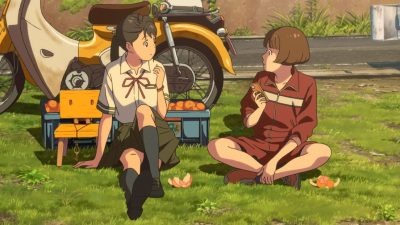
And it’s precisely that—seeing it, and it simply works on its own. It’s akin to defining miso soup. The rage and turmoil of emotions stemming from suffering sing their own tune. Shinkai has woven it together, given it his unique spin, and animated it with a presence that makes you feel as if you were stopping rolling mikans by the country road of Ehime or stumbling out of a bar after the last train in Dotonbori. Is Ochanomizu truly that pristine? As a nation, Japan grieved, but so much more suffering continues beyond what we see, or even realize. It’s not the kind of warmth I actively seek out, much like how there’s always a tinge of bitterness when I play “Wake Up, Girls!” while driving.
As a society, we may tend to look away from this suffering. And that’s precisely why “Suzume” resonates—we look away only because we know it deep down, all too well. As an aside, this is also why I’m writing about “Suzume” (releasing in US theaters nationwide on April 14th, if not earlier) on the same day Luca is announced for Shiny Colors proper. It will take me some time to process everything from Shiny Colors 5th and the anime announcement. Please, just give me some time.