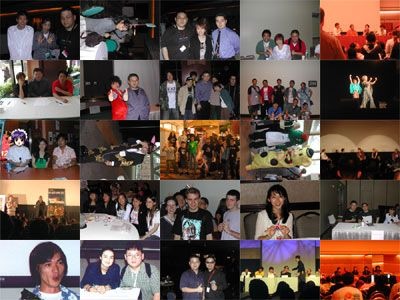
UlasanAnime.com – The concept of “2.5D” emerged from discussions at Anime Boston, particularly in the context of Momoi’s Afilia Saga East. This group of Akiba idols, associated with a maid cafe chain, brought the term to the forefront during a fan panel. The discussion revolved around the sub-categorization of otaku in Japan, suggesting that their experiences might be more intense than those of overseas otaku.

The term “2.5D” highlights a fascinating intersection where fans share common interests but engage with them for distinct reasons. This phenomenon appears to bridge various groups, including 2D and 3D fans, otaku, academics, shopkeepers, and individuals from different sub-genres. It suggests a complex interplay of factors, possibly related to media mixing, that creates a unique shared space of attraction.
Several examples illustrate the distinct expression of 2.5D, including seiyuu (voice actors), virtual idols like Hatsune Miku, and idol groups such as ClariS and AKB0048. These entities embody the essence of this hybrid category.
To understand 2.5D, it’s crucial to consider the otaku’s appreciation for 2D elements – the realm of anime, manga, and game characters. Merchandise like moe figures and hug pillows are tangible expressions of this 2D affinity. While one can express affection for both 2D and 3D characters, the latter might elicit more unusual reactions in real life. “3D” generally refers to real-life individuals, particularly idols for idol otaku who follow groups like AKB48. These fandoms have their own established customs and dynamics, often influenced by the agencies involved.
Given that 3D fandom has a longer history, it’s a complex area to dissect. The true “2.5D effect” arises when the 2D and 3D worlds collide. This occurs when 2D elements aspire to exist in a 3D form, or conversely, when 3D entities attempt to emulate 2D characteristics.
Like many niche otaku terms, defining 2.5D precisely can be challenging. It often conveys a sense of bridging a gap or a certain “uncanny valley” effect. The concept shares similarities with ideas like artificial intelligence and memes. The appearance of a holographic Tupac at a concert, for instance, serves as a potent example of 2.5D. Conversely, the physical manifestation of 2D characters through hug pillows and figures, or the integration of virtual idols into 3D roles, also falls under the 2.5D umbrella. In many ways, anime itself can be considered inherently 2.5D.
You might also be interested in : Design-Led Outcomes
A broader perspective suggests that 2D represents ideas, while 3D signifies their manifestation. Many Japanese idols are, in essence, individuals produced to project a specific persona or image. This manufactured persona can be seen as no less artificial than a virtual idol like Hatsune Miku, especially in how fans interact with them. Similarly, a live stage show featuring characters from “Precure” at an amusement park represents a real-life embodiment of animated cartoons.
There seems to be a particular fascination with these crossover behaviors, and the reasons behind it are subject to speculation, particularly for those within the otaku community.
The 2.5D approach offers significant marketing advantages. Promoting an idea, image, or persona can be easily achieved through digital means like social media. Engaging fans with a 3D personality, however, often requires extensive personal appearances or costly television campaigns. While neither method is entirely replaced, leveraging both 2D and 3D aspects alongside the 2.5D dimension can be highly effective. A manga with a compelling story and art might gain even greater popularity if its anime adaptation becomes a major hit. The benefits of 2.5D are numerous and evident across various media.
Returning to the Tupac example, it illustrates the enduring nature of ideas. Concepts can theoretically live on indefinitely, far beyond a person’s lifespan. Even if the 3D component is gone, 2D and 2.5D forms can persist as long as there is sustained interest. This longevity strongly suggests that the future is increasingly oriented towards 2.5D. The advancement of hologram technology promises to further blur the lines, potentially allowing for even more immersive and enduring forms of 2.5D expression.