UlasanAnime.com – The narrative of anime series that are adapted from ongoing manga, especially those that conclude without a definitive manga ending in sight, often sparks discussion about their ultimate impact and reception.

A prime example that comes to mind is Kare Kano. The manga’s writing style, particularly its extensive internal monologues and what some perceive as overly saccharine shoujo elements, can be off-putting for certain readers. However, the anime adaptation is widely regarded as one of Gainax’s finest works, despite facing challenges in production, pacing, and ultimately, an abrupt shift in narrative direction that led to a somewhat chaotic conclusion.
This raises a question: how does one objectively evaluate a show like Kare Kano? Its uniqueness makes a standard numerical or alphabetical rating feel insufficient, potentially even misleading. Recommending such a series also becomes complex. While it’s often easy to identify viewers who will either love or loathe it, understanding the underlying reasons for these strong reactions is crucial. The term “unique,” in this context, doesn’t necessarily imply a positive attribute.
I find myself in a similar predicament now. Binge-watching shounen anime is, in my opinion, the most effective way to experience the genre. I appreciate cliffhangers for the suspense they build and the emotional journey they create, compelling me to eagerly await the next installment. The satisfaction of immediately diving into the subsequent episode after a thrilling conclusion is unparalleled. Conversely, a shounen anime that doesn’t hold up well to marathon viewing might indicate a fundamental flaw in its storytelling or an intention to cater to a broader, perhaps more casual, audience.
However, the very nature of marathoning can sometimes prevent a full appreciation of the overarching narrative arc. As I near the end of Ookiku Furikabutte, I’m compelled to reflect on the events of the past twenty-odd episodes. The prospect of its conclusion, as I anticipate it, is tinged with a sense of melancholy for several reasons:
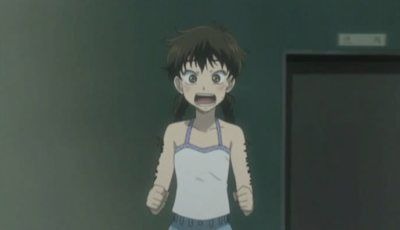
1. The meticulous foreshadowing and groundwork laid for a shounen series are a hallmark of well-crafted narratives. Typically, these stories begin with a simple plot and a straightforward progression, gradually revealing the broader setting. My favorite aspect of Ookiku Furikabutte isn’t solely the baseball, which is expertly depicted and forms the emotional core of the show, but rather the character of Momokan. Her appeal extends far beyond her physical attributes, which are secondary to the enigma surrounding her. The series consistently highlights her as a distinct figure within the large ensemble cast, posing questions about her identity as a woman in a male-dominated field, her financial independence at a young age, her unexpected prowess in hitting, and her sudden appearances. I am eager to uncover her backstory, motivations, and any accompanying flashback material, which I surmise is being reserved for later in the narrative. The same curiosity extends to characters like Shinoouka and Ruri.
2. The portrayal of baseball is exceptionally refreshing. It’s a sports anime that genuinely focuses on the sport itself, eschewing common tropes like “sports-themed yaoi bait” in favor of a compelling, character-driven sports drama. This approach offers a welcome respite from formulaic storytelling. Even if the underlying narrative structure remains familiar, the mangaka’s dedication to meticulous research is evident throughout. The attention to detail in depicting the nuances of the game is truly commendable.
3. Visually, the series is stunning. I wish productions like Princess Nine had even a fraction of the visual appeal of Ookiku Furikabutte. The direction is superb, and the overall attention to detail is remarkable. While the available fan translations might suffer from poor encoding, they are insufficient to obscure the high quality of the production. The animation team has delivered a truly solid performance.
Yet, the series is heading towards its conclusion! And it’s happening right after their first significant game. This abrupt ending leaves me approaching the final episodes with a considerable degree of reservation. If I were to adapt the events of the first 21 episodes of Ookiku Furikabutte into a Hollywood film, it would likely be a mere hour and a half long, as the story has yet to reach its primary climax. This is largely due to the pacing, where each episode covers approximately six outs in a game that typically consists of 57 outs. It’s quite frustrating.
Furthermore, the fact that all the characters are first-year students (tenth graders) with their entire high school careers and the current academic year still unfolding adds another layer to the sense of incompleteness. Their journeys have only just begun.
The despair is palpable.
Perhaps, after all, I will delve into the manga to discover the rest of the story.
You might also be interested in : Going the Distance