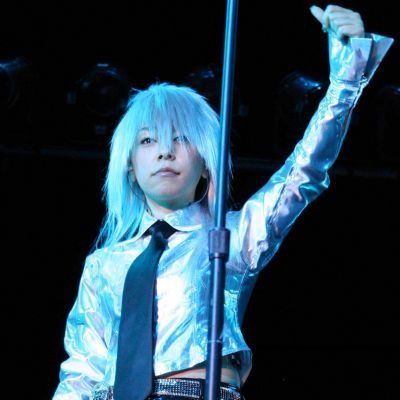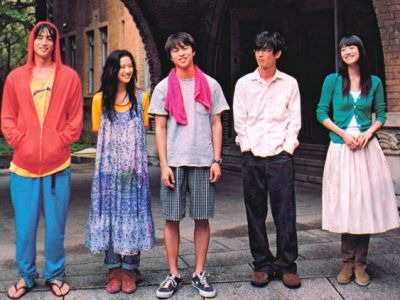
UlasanAnime.com – The WUGLOVE Bus Tour Part 3, also known as the TUNAGO Tour Finale, marked the culmination of Wake Up, Girls!’s 5th Anniversary Live event. This fan club exclusive event focused on the individual talents of the seven members, a departure from previous years where solo shows were more broadly accessible.

In past years, these solo events were typically held over two days, with each of the seven WUG members performing for one to two hours consecutively. This year, however, the events were restricted to fan club members and spread across weekends in March. Each event featured a single WUG member performing twice daily, hosted in small live houses across the Tohoku region.
This setup presented a challenge for dedicated fans, requiring them to travel extensively throughout Northern Japan during March. The cost was particularly high for fans outside of Tohoku. While local Japanese fans voiced their complaints, overseas fans persevered. The fan club-only nature of the events generally ensured ticket availability, with the exception of Myu’s shows, which were reportedly the most popular, possibly due to her performance being in Sendai, the most accessible location, and the quality of her new solo song.
The tour itself added another layer of expense, costing around 50,000 yen, with an optional post-event gathering (nijikai) costing an additional 6,000 yen. It was an undeniably significant financial commitment for attendees, regardless of their origin.

Reflecting on the completed event, the author expresses mixed feelings about this year’s WUGLOVE bus tour. A significant difference was the scale of participation; the tour hosted nearly 500 attendees, a considerable increase from previous tours which typically had around half that number. The smaller group sizes in earlier tours allowed for more intimate fan interactions, such as handshake events (watashikai) and autograph sessions, offering more frequent opportunities to see the WUG members. This year, interactions were limited to special Niconama streams viewed in hotel rooms, a greetings event at the hotel, surprise appearances at the nijikai, and, of course, the main 5th Anniversary Live concert.
While the author’s mixed feelings are personal, they acknowledge that the significant changes from previous bus tours might lead to disappointment for some fans. The tour’s itinerary offered limited traditional tourist attractions. However, the onsen ryokan where they stayed, Akiu Grand Hotel, served a dual purpose: it was a location featured in the WUG anime, making it a pilgrimage spot, and it was also a respectable onsen ryokan. The food, however, was noted as being somewhat subpar.
Moving past the meta-commentary, the author provides a detailed account of the tour’s progression.
Arriving the day before the tour, the author utilized the JR East Tohoku Rail Pass for their journey from Narita. The experience of Narita is described as peculiar.
Even here?. pic.twitter.com/72K0rbZkL6
? omo@KawaiiKon2024 (@omonomono) March 30, 2018
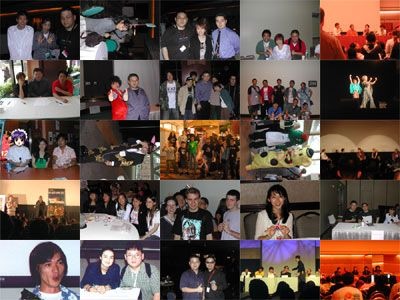
As WUGLOVE bus tour part III was the largest to date, a significant number of international fans participated, including members from the old LINE chat and Discord. Seven friends managed to secure the same room, even after some had initially missed the room-sharing application deadline and had to follow up via email. Grouping the international fans together was seen as the most practical arrangement for everyone involved. They were also assigned to the same bus, while the author noted that known Taiwanese WUG fans were mostly on bus 3, with the author on bus 4.
Many attendees met up the night before the tour, with the author connecting with Discord members for the first time. All but one of the group were in Sendai the night before, leading them to gather at Luvya.
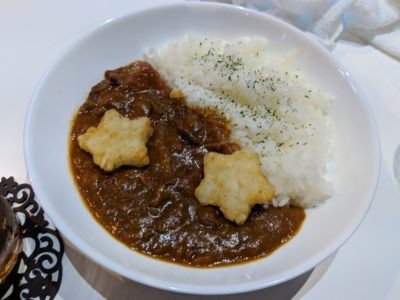
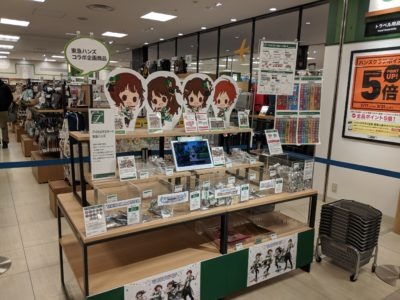
On the day of the tour, the author checked out of their hotel and engaged in some shopping, including purchasing Idolm@ster merchandise at Tokyu Hands and Gamers. Lunch was then consumed. The gathering point was on the roof of the hotel, which required navigating to the eBeans department store. The author faced the inconvenience of having to carry their luggage, as the nearest lockers were a block away at the JR station, and the elevator did not reach the roof. The gathering took place in an outdoor event space. Upon the arrival of the two buses from Tokyo, attendees began to line up around 2:30 PM. The WUG members eventually appeared and officially commenced the tour from the stage.
During the waiting period, from 1 PM until the 2:30 PM lineup, some fans reported encountering Nanamin in the restroom, a detail that became a humorous anecdote. Such coincidental encounters were described as not uncommon at WUG events.
Following the initial talk segment, staff guided attendees downstairs bus by bus. The author found it inconvenient to carry their belongings down ten flights of stairs. They then walked several blocks to reach the buses.
The bus journey to the first destination, the Akiu Grand Hotel, lasted approximately 40 minutes. The hotel, like many large establishments in the region, showed signs of age but was well-maintained. During the ride, the bus guide, Kumagai-san, provided essential information regarding check-in and check-out procedures, meal tickets, the watashikai, and other rules. A notable rule was the request not to post event details on social media, a sensible precaution. The tour’s overlap with April Fools’ Day and Easter meant the author missed out on many potential jokes.
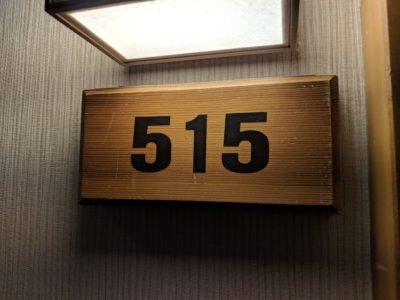
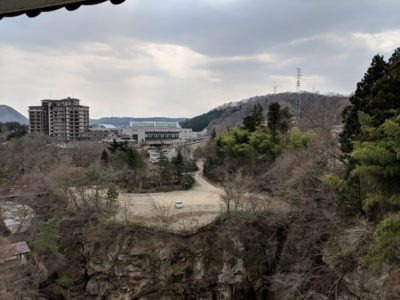
Upon disembarking the bus at the hotel, the watashikai commenced with the seven WUG members waving as attendees passed through the entrance. The author managed to wave back with their free hand. The event was brief, as attendees were quickly ushered along to allow the next bus to unload. The process was described as quite directive, with participants being directed to take the stairs, which was particularly taxing for those on the fifth floor. The author considered using the elevator but ultimately decided against it.
Following this, attendees had free time until dinner. They settled into their spacious suites, appreciating the ample room for the large group. They also checked the in-room entertainment systems and amenities. To accommodate the large number of attendees, the hotel designated all onsen facilities for male use and arranged for a separate onsen for women nearby, with shuttle service available. Approximately 10-20 women were on the tour, which was noted as being double the number from previous tours. The author’s suite was quite large, and their Taiwanese WUG fan counterparts from the same floor, residing in a room just down the hall, joined them for a hangout.
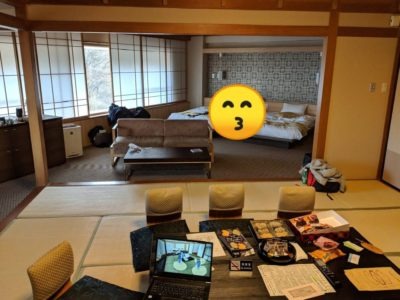
Inside each room, standard ryokan amenities were provided, including tea sets, red bean jelly, yukatas, and vests. Meal tickets were also included. Both dinner and breakfast were served buffet-style in a large dining hall. Although attendees were staggered for dinner, the author felt it did not significantly impact the experience.
The first “surprise” of the evening occurred after dinner when the PA system announced the second event: participation in a special Niconama broadcast. While this was known from the schedule, attendees were unaware it would be streamed within the hotel via its closed-circuit system. The PA instructed attendees to tune in for a surprise and divided them into seven groups based on room numbers. This arrangement meant that the audience cycled through viewing the WUG members performing karaoke approximately every 15 minutes, with song selections made randomly.
The author did not find the arrangement particularly bothersome, likening it to running on a hamster wheel within a large ryokan. It was, however, an interesting experience to witness an entire hotel collectively watching the same live stream. Attendees had to queue outside the “studio” (large karaoke rooms used for the broadcast) before their group’s turn. While waiting, they watched parts of the broadcast on smartphones and tablets huddled with other fans until their designated time slot.
The author speculated that it might have been intended as a group-building activity. As it was a Niconico live stream, viewers could watch it until the timeshift period expired a week later, on April 7th.
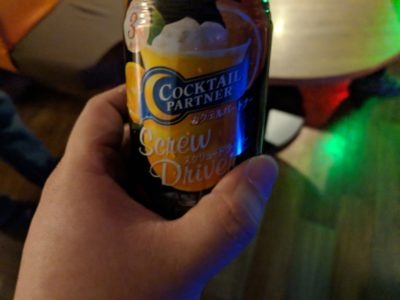
After the karaoke Niconama, there was a break before the nijikai, or “second party,” commenced. Attendees filed into the hall where dinner had been served, which was now set up for a dance party. Wristbands were distributed earlier in the day for those who had registered, and on-site registration was also possible. The nijikai offered a selection of light drinks, including a soft drink machine, canned screwdrivers (which ran out within 30 minutes), and a limited supply of beer (depleted in about 45 minutes). The setup was described as somewhat rudimentary. A stage in the dining hall featured DJ Yamada, who played popular hits. The atmosphere was significantly enhanced by the surprise appearances of the WUG members.
The WUG members performed segments of their new solo songs during DJ Yamada’s set. The author expressed particular excitement for the song “Now Is The Time.” Before that track, Yamada played several I’ve Sound songs, and the author regretted not pushing to the front of the crowd. DJ Yamada’s involvement was noted as significant, given his previous collaboration with Myu during her solo DJ set. The author appreciated Myu’s contribution to this subculture in general. The WUG members appeared at random intervals during the nijikai’s DJ set. Additionally, Mayuc and Minyami performed “Seventh Haven,” which the author described as the most energetic part of the event. Yoppi also made an appearance to perform a solo part of “Tachiagare.” The DJ set felt somewhat impromptu, adapting to the WUG members’ availability.
At the beginning of the DJ set, WUG’s main producer from Dive II/Avex spoke about his background at King Records. DJ Yamada then played “Bakuretsu Hunter” and “Blue Seed,” eliciting an unexpected surge of excitement from the author. The producer’s talk primarily focused on his career path, leading to lighthearted jokes about anime producers and the fantasy of getting to know voice actors.
The event continued past midnight, after which attendees quickly retired due to the early start for morning exercises with the WUG members. The author woke around 5 AM and took advantage of the ryokan’s open-air bath. Breakfast, described as average, followed. The author wished for more time to enjoy the baths.
The morning exercises, specifically radio exercises, with the WUG members were as described. Attendees lined up by their respective buses in the parking lot, and the WUG members jogged into the area to lead the exercises. Due to their short stature, it was difficult to see them clearly beyond the fifth row, given the presence of ten buses. After five minutes of stretching, the session concluded, and attendees returned to their rooms. The author found the ryokan experience, particularly the morning activities, to be less relaxing than anticipated.
There was also some free time in the morning, as many had completed their morning routines before the 7:45 AM radio exercises. This led to activities like playing ping pong. The ryokan was well-equipped, even featuring an arcade. The author noted that on Saturday, the gift shop was selling zunda-flavored soda, promoted by a regional tourism worker, whom some attendees had previously encountered in Taiwan. This was described as amusing.
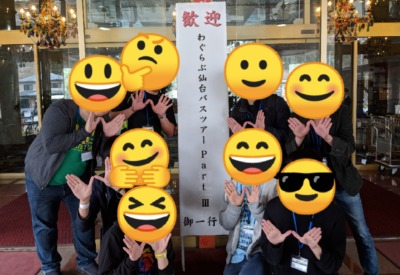
Soon after, attendees checked out and boarded the buses again, this time for “actual tourism.” This involved a visit to a nearby town in Sendai that was part of the post-3/11 reconstruction efforts. The destination was Natori, not far from Sendai Airport. During the bus ride, a documentary DVD was shown depicting the devastation of the town, where the tsunami had inundated miles of land due to the region’s flatness. Buildings, cars, and even planes were swept out to sea. The main activity at Natori was a seafood market visit for lunch. Each attendee received two 500-yen coupons and a free drink. This allowed some to purchase fresh clams and other shellfish for grilling. The author opted for saba (mackerel), a Tohoku specialty, and also enjoyed some Chinese food. Communal charcoal grills were available for those who wished to grill their clams.
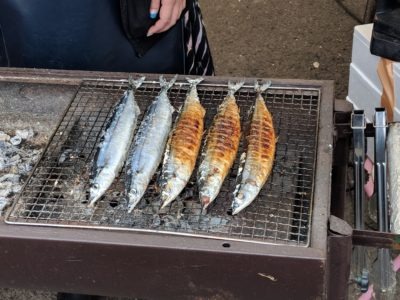
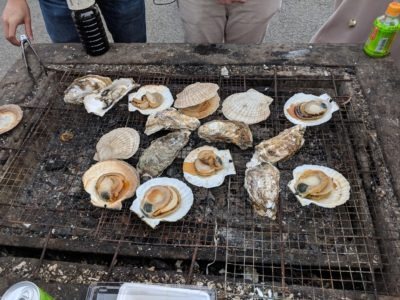
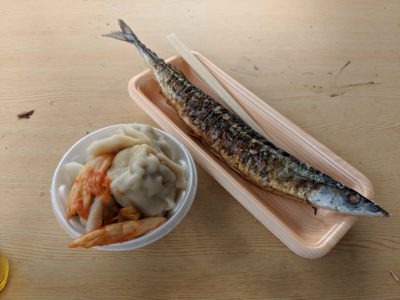
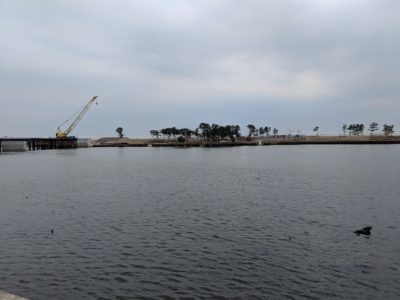
This part of the tour was particularly enjoyed by the author, as it felt like an authentic Miyagi bus tour experience. It was described as a prime example of gastro-tourism, and the author had a great time. The market was not directly on the coast but was situated near clam farms, which explained the abundance of seafood. In the broader context, this meal served as a prelude to the live concert.
After approximately an hour at the market, attendees were bussed to the live venue, Sendai GIGS, located about 30 minutes away. The author found it unusual to attend a live concert without the usual logistical complexities. They were able to leave their belongings on the bus while bringing only essentials for the concert. Attendees waited in line as the ten buses arrived and unloaded the WUG fans. Upon entering, the proximity of the stage to the seating area was striking.
The concert commenced around 2:10 PM on Sunday. The setlist is available on another page. The author offers a brief overview of the concert’s highlights, acknowledging that precise details might be hazy and inviting corrections from those with better recall.
The close seating arrangement was notable, allowing attendees to walk up to the center stage as it was not cordoned off. While ropes marked lanes and aisles, they were taped to the floor and not erected. The author missed an opportunity for a selfie with the center stage, which featured cool WUG 5th Anniversary graphics, despite having seats offering a full view right next to it. The setup resembled a wrestling ring, with LED lighting around the square center stage and fixtures at the corners, along with laser reflectors. The author’s seat, Row 9 Seat 25, was situated near the right side of the stage towards the back. Excitement grew, as the seat was unexpectedly close, less than a meter away from the center stage.
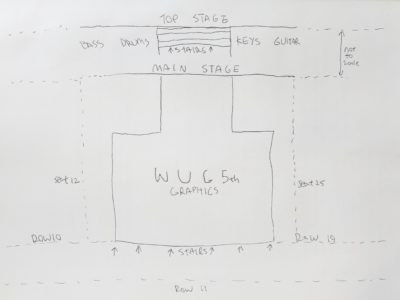
The presence of a center stage was unusual for a WUG solo event, making it a noteworthy feature. The seating arrangement, extending close to this central platform, was exceptionally special. With the venue seating only extending to Row 19, everyone had the opportunity to be quite close. The author humorously speculated that the organizers trusted the WUG fans to behave responsibly.
As the band members performed their final tuning, the venue quieted down. The show began with the curtain behind the main stage pulling back to reveal the WUG members on the upper stage, complete with their Higawari canes. The audience cheered enthusiastically for both the performers and the band.
1) HIGAWARI PRINCESS (??ver.)
2) ??で???で??で?!
3) One In A Billion
These three songs formed the opening set, effectively building hype. The recent release of Anisama 2017 on Blu-ray the week prior to the bus tour kept the two anime tie-in songs from 2017 fresh in the author’s mind. While the call-and-response for “Renai Bokun” took a moment to recall, it was manageable.
The WUG members descended to perform “Koi de ai” and “One In A Billion” on the main stage. The acapella opening of “One In A Billion,” facilitated by the live band, was particularly memorable.
Following the songs, a greeting MC segment took place. The members discussed their new outfits for the live performance. Each girl wore a sash across their chest displaying an English phrase they had chosen. Given the proximity to Easter, the author noted a thematic connection between the phrases:
Halleluja! Hope revived?never give up, try everything again and again:
Always smiling like a sakura.? omo@KawaiiKon2024 (@omonomono) April 1, 2018
You might also be interested in : Citizen Action, But Seriously
Myu: Always smiling
Kayatan: Hallelujah
Mayuc: Hope revived
Nanamin: Again & again
Aichan: Like a sakura
Yoppi: Never give up
Minyami: Try everything
The author expressed appreciation for instances where WUG members inadvertently referenced Western culture, noting the