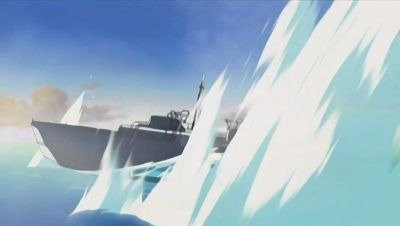
UlasanAnime.com – The concept of a “furry scale” exists, and similarly, there might be a “mecha scale” to categorize characters. This scale isn’t about Strike Witches, though it does exemplify different types of scales. A significant appeal of mechanical design in popular media lies in its transformative capabilities. The F-14’s appeal, for instance, is partly due to its movable wings, making its pairing with futuristic valkyries in Macross Zero unsurprising. Similarly, witches in Strike Witches transform into furry beings through magic and into mechanical parts through military weapons.

The value of transformation implies that the degree of mechanization for a “mechamusume” (a girl combined with mechanical elements) is not a fixed value but exists on a sliding scale. It’s one thing to adorn an aircraft or vehicle with a girl’s image, and quite another to replace a giant robot with a girl-android. On one end of this scale, we might find girls piloting conventional vehicles, while on the other, girls piloting more advanced, futuristic machines.

You might also be interested in : The Verge’s Love for Anime
Consider Aegis from Persona 3 as a mid-point example of a mechamusume. By definition, mechamusume combines traditional mecha elements with the aesthetic of moe bishoujo, such as a “girl + tank” or “girl + RX-78.” Aegis, being a straightforward android, exhibits human-like characteristics. If this style of femininity is inherent to the android, it might blur the lines, perhaps suggesting a new dimension rather than a strict mechamusume classification.
To a certain extent, one end of the mechamusume spectrum can be likened to niche interests like “guro” or ableist pornography, where the abnormality lies in a specific physiological aspect. Androids approach this from the opposite perspective: the question is how human-like they are, aside from perhaps their ears or an on-off switch, as seen in Chobits. These types of mechamusume are almost indistinguishable from normal people, which is their defining characteristic, representing the 0% on the scale. It’s why characters like Miku aren’t typically categorized as mechamusume.
Scarlet Rain from Accel World serves as an excellent example of both an extreme form of mechamusume and the idea of a fluid scale for such characters. In Accel World, your avatar is essentially an extension of yourself, not something you pilot in the traditional sense. You control it, but it’s presented as your virtual self. Therefore, within the Accel World universe, Scarlet Rain is known solely by that name, not as Yuniko. This represents a significant transformation compared to Strike Witches.
Alternatively, one could argue that Strike Witches is more progressive by integrating the mechanical aspects with the characters’ innate identities. Yuniko, after all, remains Yuniko in the real world. The ability of characters like the Power Ranger Pink to transform from mundane to magical, sometimes with the aid of hardware, speaks volumes about their place within the scope of what defines a mechamusume. It’s about venturing into a “2.5D” space, bridging the gap between common sense and the fantastical two-dimensional construct of a mechamusume.
It seems Drossel has finally met her match with the (tsundere imouto) Red King!
[This article was written before Summer Wanfest 2012. For reference, check out the Robot Damashii Sandrock AGP GP-03 and the plamo KOS-MOS, considered the most moe weapons platform.]