UlasanAnime.com – It seems premature to definitively conclude the saga of Horizon in the Middle of Nowhere. There’s a strong hope that the series will continue, adapting further volumes of the source material. While not an eager anticipation, the prospect feels almost inevitable given its strong performance in Japanese domestic home video sales. This post serves as a status update on the anime.
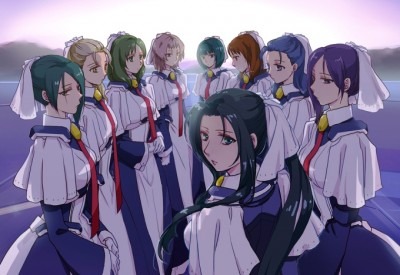
Instead of focusing on criticism, which has been thoroughly addressed by others, the primary concern for future adaptations of Horizon lies in its limited capacity to introduce novel elements. This isn’t about the inclusion of unexpected plot twists or the exploitation of historical anecdotes, but rather the adaptive approach itself.
You might also be interested in : 10 Facts About Psycho-Pass
The first season was particularly enjoyable for its relentless drive towards resolution, carrying all narrative threads forward even when they didn’t seamlessly integrate. This approach mirrors the nature of Horizon itself, where characters and plot points are all brought aboard. It functions as a battering ram that truncates the finer details, including those elements that might not be strictly necessary for viewer enjoyment. Forget about intricate procedures, explanations, logical consistency, or standard narrative conventions – there simply isn’t enough time in 12 episodes, especially when considering the sheer volume of the source light novels.
While the consequences of this condensed storytelling are manageable, the music, so to speak, is a greater concern. The second season felt like a rehash of similar cultural exploration, this time focusing on British and European history. Although marginally more familiar with this subject matter than Japan’s local history, the events in the first season were so distorted and detached from reality that familiarity hardly seemed to matter. However, in the second season, it does carry some weight, perhaps serving as a distraction. This highlights a potential pitfall of “anime tourism,” where the audience perceives a subject through the lens of what the average Japanese viewer might think, which can be closer to foreign perceptions than to the Japanese perspective itself. While this can be interesting, it was a minor issue even in Baccano!, an anime that was considerably more meticulously researched.
It appears that cultural imperialists, such as Americans, must simply learn to coexist with this phenomenon. In the meantime, there’s a hope that more anime will embrace settings like Neo Venezias, and Horizon certainly qualifies with its alternate-universe fantasy. This is precisely why the series has maintained its appeal and why continued viewership is anticipated.
PS. This past weekend featured a truly glorious XCOM battle, involving Rk. Aya Hirano and Sq. Kotono Mitsuishi, who found themselves ambushed by a nine-unit Muton scouting force. The engagement was fierce, and survival seemed uncertain, yet they managed to prevail. This was achieved despite the absence of a medkit, any support units, and with only one assault and one sniper in the task force. Their role as meat shields was instrumental. Rk. Hirano displayed remarkable courage, infiltrating the landed UFO from the rear and successfully tasing the sole Muton within range. This tactic proved more effective than attempting a shot from a “safe” distance, given the lower probability of success. Those grenades, however, pose a significant threat.