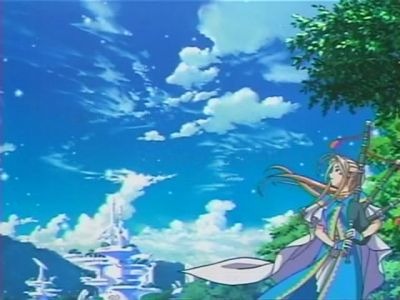
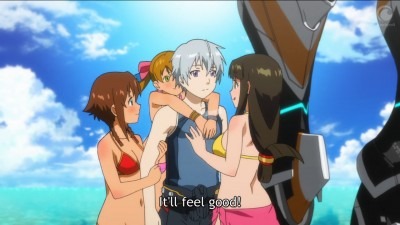
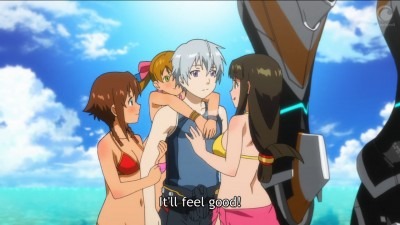
UlasanAnime.com – The fifth episode of Gargantia was a delightful experience, packed with enjoyable elements. It featured charming girls in revealing swimsuits, as noted by Hanaharu, alongside giant robots, a beachside barbecue, a lighthearted airplane race, and a thrilling chase up a spiral tower. The episode also offered stunning panoramic views, showcased innovative uses of advanced technology, and included scenes of pleasant weather, sunshine, relaxation, and intimate conversations among characters. Furthermore, it presented retro scuba suits, playful interactions with an AI, delicious food, a lively party, and a memorable moment depicted in an external link.
This particular episode delves deep into the core themes of Gargantia, revealing its true purpose as a sociopolitical statement aimed at supporting Japan’s younger generation, often referred to as NEETs and freeters, who face societal challenges. Urobuchi himself has indicated that the series was conceived to convey a message to these young individuals on the cusp of entering the adult world.
However, this message is delivered with remarkable directness, almost to the point of being unsubtle.
Consider Ledo’s predicament: for the first time, he finds himself questioning his life’s direction. His upbringing was characterized by a rigid, highly structured educational system that prioritized efficiency and was solely focused on a singular objective: passing exams, or in his case, eliminating space monsters. But in this new world, his skills in vaporizing people are met with disapproval. He possesses a Master’s Degree in Space Monster Vaporization, a qualification entirely irrelevant to the demands of the post-wormhole economy.
You might also be interested in : Girls and Pander: Complicating Simplicity
Adding to his unemployment, Ledo is burdened by substantial debt that he has no idea how to repay. While he has access to advanced technological gadgets that enable him to perform impressive feats, he is uncertain about his own intrinsic capabilities. This feeling of displacement is palpable as he searches for a place for himself within the ship’s community, seemingly finding none.
The overt nature of the message has been apparent since the series’ inception. For viewers who engage with anime on a regular basis, this approach of weaving societal commentary into narratives is not entirely new. It has been some time since creators have been bold enough to incorporate post-bubble economic philosophies into their storytelling, with the early to mid-2000s being a notable period for such trends.
For a more comprehensive understanding, it is recommended to read the insights from Butch, who, like many, has navigated a challenging career path to reach his current standing. His current enjoyment of his achievements is likely well-deserved.

An update has been made to include a quote from an interview with Kazuya Murata, the director of Gargantia.
What do you hope people take away from the experience of watching Gargantia?
For the Japanese audience, I would like “young people who are about to enter society” to take the message, “Don’t worry. Try. You can do it”. For the larger audience in the world, I want them to have the message, “Whatever could happen, we, human beings, will be alright. If we all together open the path, the future will always be ahead of us”.
It is evident that the creators are committed to conveying this message effectively. Indeed, Kazuya Murata’s involvement is likely a significant factor contributing to the show’s overwhelmingly positive atmosphere.