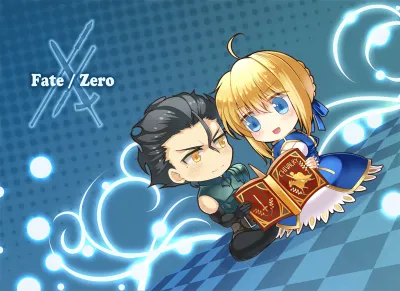
UlasanAnime.com – As I eagerly anticipate each new episode of Fate Zero, I’ve come to realize that the anime is primarily crafted for existing fans, rather than for those new to the Nasuverse. A prime example of this is Fate Zero’s meticulous adaptation of the initial battle royale.
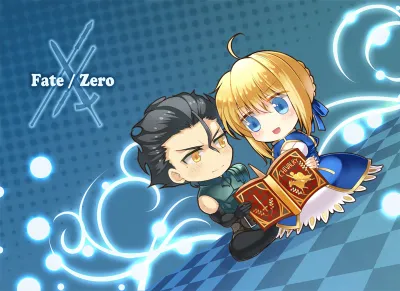
One of the immediate reactions to Fate Zero’s first episode highlighted the abundance of dialogue and exposition. While there are numerous subtle nods for Nasuverse fans, the episode largely serves as a preparatory piece, laying the groundwork for what’s to come.
Maiya wasn’t even introduced until the third episode, and Saber and Lancer didn’t clash until the fourth. This pacing closely mirrors that of the original novel. The majority of the first novel, out of a total of four, establishes the events leading up to the first episode, culminating in the scene where the masters summon their servants and concluding with the first significant battle. This suggests that the resolution of this battle might not occur until episode six, or approximately a quarter of the projected 25-episode run. Consequently, the battle that commenced at the end of episode three is unlikely to conclude before the end of episode five, and more probably, not until episode six. If memory serves, there’s a natural transition that bridges the end of the fight and the beginning of the subsequent scene. This is likely the first time in years I’ve watched an anime featuring a three or four-episode fight sequence that isn’t part of the climax.
The intriguing aspect for me is that I’ve already read the fan translations and am aware of what transpires in Fate Zero. There’s little reason to doubt that ufotable’s adaptation will deviate significantly, if at all, from Urobuchi’s novels. If Kara no Kyoukai is any indication, they tend to stick closely to the source material unless constraints of the medium necessitate changes. Therefore, for me, there are no remaining mysteries to uncover, save for the adaptation itself – the artistry of the animation, breathing life into what were once mere words. And yes, those elements are enjoyable, thanks to ufotable’s Kyoani-esque approach to the source material, often handled with a serious demeanor. However, this isn’t the primary driver of my dedicated viewing; it merely sustains my interest amidst the dialogue-heavy scenes, even during intense battles (complete with Dragon Ball Z-esque narration).
Yet, why do I anticipate Fate Zero with such fervor? Why do I eagerly await each subsequent episode when I already know what’s going to happen? More curiously, is this the experience for someone who hasn’t read the novels? What would compel them to follow the story with such keen anticipation? Unbeknownst to myself, I was constructing a framework and a set of expectations for viewing and appreciating Fate Zero, in a manner distinct from someone who might enjoy the Fate/Nasuverse but hasn’t read Fate Zero previously. And it’s likely safe to assume this differs even further from the reactions of those unfamiliar with the Nasuverse or who have little interest in it.
Upon reflection, none of these realizations are particularly surprising. In a way, I’ve already acknowledged these points – adaptations can cater to both new and old audiences, but these are distinct viewer groups with overlapping yet divergent needs for immersion and contextualization with the work. I simply believe that with Fate Zero, there’s a rather significant divide between these two groups. Or perhaps it’s just me and everyone else. Or at least, something that falls somewhere between these two extremes.
I suspect there are works where the opposite occurs; where, upon adaptation, there’s a single primary framework through which we engage with the work, regardless of whether we are fans or not. Given that so many anime are adaptations, this is likely a common phenomenon. To take it a step further, I suspect this is particularly significant for material like Lord of the Rings, Harry Potter, or Game of Thrones. In the case of Game of Thrones, I’ve already witnessed this dynamic at play; and the same kinds of pitfalls that anime adaptations encounter can also be observed in those – namely, when an adaptation tries too hard to cater to a specific audience at the expense of maintaining a consistent tone.
Still, none of that explains the peculiar scene where Kotomine Sr. and Tohsaka Sr. engage in conversation. That particular segment is entirely original and not present in any prior material.
You might also be interested in : The Collective Mindset