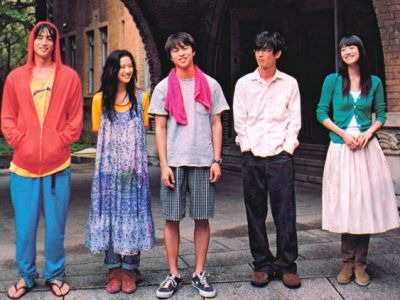
UlasanAnime.com – This report from Animazement 2013, focusing on “Kaku no Hana,” delves into the convention experience with a blend of personal reflections and detailed observations, acknowledging the author’s sleep-deprived state as a backdrop to the narrative.
The Big Picture
Marking the author’s first convention of the year, Animazement 2013 faced slight challenges. The shift in Anime Boston’s date impacted Animazement by drawing away some dealers, resulting in a less robust dealer room presence. This change also prevented the author from attending Anime Boston. Animazement itself appeared to be of similar size to the previous year, and the overall feeling was described as slightly less impactful, though still superior to many other conventions.
Cosplay trends were relatively balanced. Vocaloid remained popular, alongside the usual meme-inspired costumes and video game characters. A notable presence of Shingeki no Kyojin cosplayers was observed. While told there were iM@S cosplayers, the author did not personally see any. No single franchise’s cosplay dominated, which was seen as a positive. Due to the guest list, there was a slight increase in Dragon Ball cosplays compared to previous years.
This year’s Animazement was humorously dubbed “Dragon Ball Con” due to the significant presence of voice actors from various Dragon Ball series, with no production guests attending. The signing of an “Over 9000” book by these actors, with proceeds going to Tohoku and Oklahoma relief, was a notable event, highlighting the intersection of memes and charity auctions. The appearance of Masako Nozawa, the voice of Goku, was a significant draw, though the author noted that while Goku is a household name, Nozawa’s name is less recognized, which is perfectly acceptable, akin to not recalling the voice actor for Bart Simpson.
Guests (and panels)
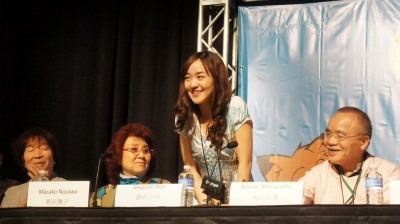
The author attended four panels, all focused on guests, with plans to potentially write individual reviews after transcribing. The first panel featured Nakatani and Maruyama discussing anime production. The panel experienced delays due to guest travel and was cut short. Nakatani, described as a large figure, was humorously nicknamed “daioh” by Maruyama. The discussion offered insights into production from individuals involved in long-running anime, with Nakatani’s focus being on his work. A planned panel with Megumi Han and Nakatani for HxH was missed, with the author musing that if Chihayafuru had been the focus instead of HxH, attendance would have been certain.
Maruyama’s comment about Koike and Redline being a failure was clarified. While acknowledging the financial failure of the movie, he emphasized the valuable experience it provided Koike as a director. The “firing” comment was self-directed sarcasm regarding Maruyama’s role as producer, who bore responsibility and later left Madhouse partly due to this. This topic was further explored in a later panel about Mappa.
Nagahama’s panel saw a significant portion of questions focusing on Aku no Hana, many of which had been answered online. Other questions pertained to his other works, directing, and selection processes. A portion of the Aku no Hana discussion involved watching episode 7 raw, which served as a non-spoiler viewing. An interesting point raised by the author was about the end card of Aku no Hana, specifically why Oshimi’s hair was animated. Nagahama explained that due to the show’s rotoscoping, he desired a “normal” anime look for the end card using Flash animation. However, lacking Flash expertise in the studio, he animated the hair traditionally himself, a process he described as both neat and peculiar.
The third panel, featuring Mikimoto, largely revolved around questions about Macross, with some inquiries about Orguss and Gunbuster, along with general questions on inspiration and influences. A surprising number of questions were about Ecole du Ciel, likely due to audience overlap. Mikimoto shared insights from his time at Studio Nue, offering a glimpse into his early career.
The final panel attended was MAPPA’s. Predictably, questions about Redline resurfaced. Maruyama shared his early experiences at Mushi Pro, working with Tezuka, and the concept of anime as a medium for cheap and fast mass consumption. He highlighted Tezuka’s innovative approach to animation, pushing animators to achieve impossible results for efficiency. Maruyama presented a balanced view, contrasting this with his tenure at Madhouse and outlining Mappa’s funding model, with the hope of longevity.
Addressing the author’s question about improvements in anime production over the years, Maruyama noted a shift towards individual creators rather than solely companies. Clarification was sought on whether this referred to copyright or the creative process. The producer’s role, he suggested, has evolved to better support creators. The mention of Toshio Suzuki was a notable point. The author expressed hope that future producers would be more adept at supporting creators.
Exposure to other guests was limited. At the opening ceremony, photos were taken. Nagahama wore an Ironman t-shirt, Nozawa bore a resemblance to the author’s late grandmother, Keiko and Megumi Han appeared to be mother and daughter, Nakatani projected a jovial yet serious demeanor, and Nakao and Furukawa maintained their usual class. The author missed programming featuring Toshi, Tsunoda, and Kotabe. Sho Asano performed during the opening ceremony and in an adjacent room.
US guests, including a costumer who worked for Cirque du Soleil, were also present at the opening ceremony. The author humorously noted having Kyle Herbert’s Mii on their DS.
At a convention with Yuko Minaguchi, the author did not encounter any DS running Love Plus! and did not attend her panels. Maruyama had invited her, possibly due to her residing in New York, leading to a potential Yawara reunion. Minaguchi’s autograph was obtained, along with one for Love Plus. While she seemed slightly detached from the convention atmosphere, unlike the fluent “convention state of mind” of the Hans, she recalled her significant roles, notably Sailor Saturn in American terms.
The rest of the con
Further details on cosplay were provided, with a dedicated session for photographing cosplayers for Jtor, with links to the published galleries. The author appreciated the ease of uploading, processing, and sharing photos via Google, facilitating collaboration.
An encounter with the Boomslank brothers, who are involved in a business venture, was highlighted. Their excellent artwork was praised, and their upcoming appearance at AX was noted. A brief discussion with one of the brothers covered potential collaborations. The author felt Boomslank’s work was exceptional and expressed a desire for them to send new shirts for review, acknowledging that while their business model might not be directly within the author’s immediate expertise, it falls within a related “wheelhouse.”
The “VocaNight Raleigh” event in June was mentioned. Amusingly, the designer of the event’s t-shirt knew the author’s convention buddy, and the author knew the event organizer, illustrating the interconnectedness of online acquaintances. The author recommended checking out the VocaNight Raleigh Facebook page for those in the area.
The convention featured a notable game room presence. The author’s social circle’s inclination towards gaming meant a significant amount of time was spent there. With limited evening activities, playing Taiko no Tatsujin became a primary pastime. The Bemani Invasion crew was present with Taiko 10 and 13 cabinets, offering a stress-relieving experience. The author managed to clear “Go My Way” on hard and was close to achieving the same for “Kiramekirari,” but Saturday’s long queues led to an early departure.
Time was also spent watching Project Diva F on a projector and playing Technika 3 arcade.
Food & Others
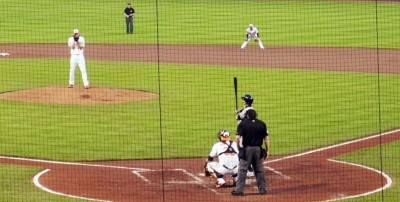
The trip incorporated a “vacation” aspect, including enjoyable meals and attending a baseball game between the New York Yankees and the Baltimore Orioles. The author had hoped for a competitive game, given the teams’ prior split in a three-game series, but the final match lacked excitement, save for the Yankees’ mounting injuries.
Inquiries about food in Raleigh invariably led to discussions about BBQ. The author visited The Pit, finding the BBQ satisfactory but not exceptional. A “combo” entree featured brisket, BBQ chicken, and chopped BBQ pork. The chopped BBQ pork, with its vinegar-based dressing, was particularly lauded as potentially “eastern” style. The author noted the rarity of non-tomato-based BBQ sauce in the US and how the sharpness of the vinegar complemented the pork. The brisket was also praised.
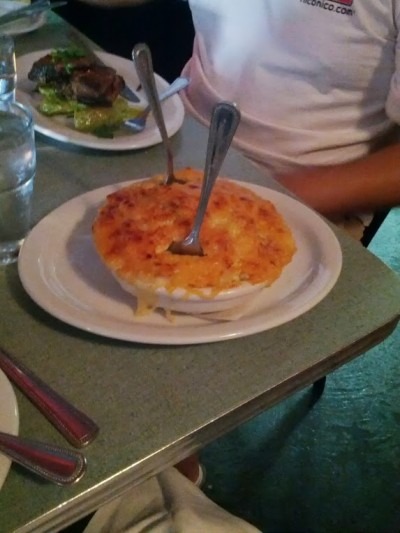
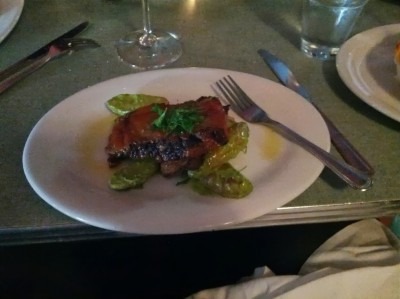
Poole’s again offered an expensive Belgian beer with a complex flavor profile. The mac and cheese remained a standout dish. While the menu was similar to the previous visit, the burger was absent. The author opted for short ribs, described as tasting like beef stew, which, combined with the beer, created a “double explosion” of flavors. The quality of American microbrews was acknowledged.
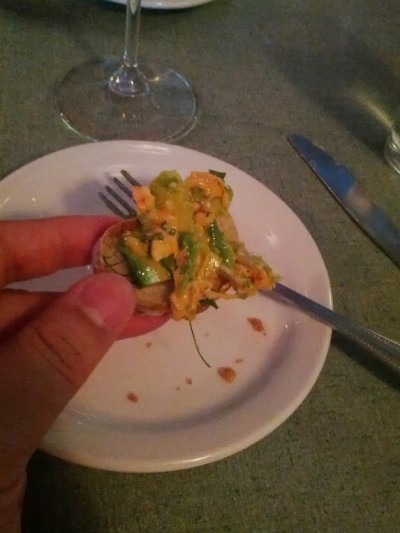
A shared appetizer of crab dip on avocado was described as a “triple explosion.”
Desserts at Poole’s were considered a slight disappointment, although sweet-and-salty combinations remained popular. The author chose a light Bavarian cream/shortcake option, which was unique but not particularly outstanding.
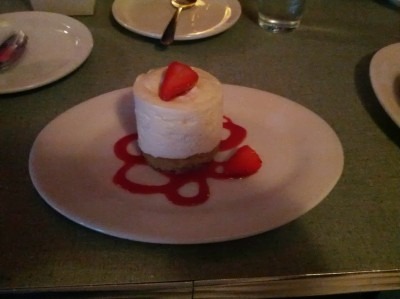
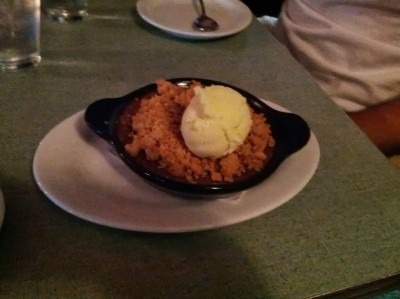
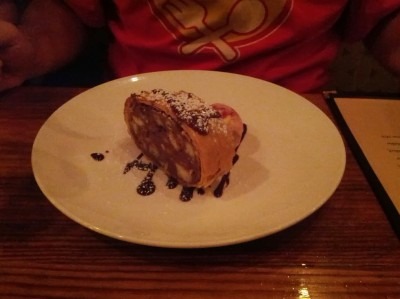
On Saturday, the author visited J. Betski’s, a German pub and grill, described as the most upscale of its kind encountered. While specials on German beers were available, one particularly hoppy beer was noted as a sign of craft beer decline. The prices were reasonable, and a white beer was a highlight. A fruity ice cream served with strudel was also a positive element. A shared chocolate torte, incorporating bacon bits and sea salt, was also enjoyed for its salty-sweet balance.
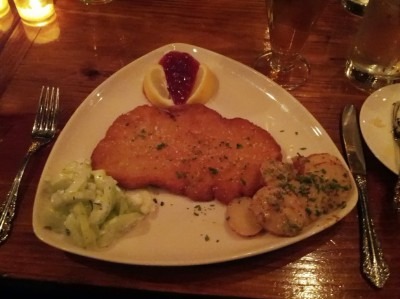
The entree of schnitzel was well-executed but not particularly remarkable. A shared appetizer plate included fois gras bratwurst, considered excessive, and artisan perogies, which the author felt clashed with the traditional perception of perogies as home-style comfort food, despite their excellent taste and higher price point. The overall assessment of J. Betski’s was that it is a good eatery, lacking the “Michelin-quality” of Poole’s, and while acceptable for a local, it wouldn’t be a destination for someone visiting.
Loot
A significant portion of the acquired items came from the charity auction, including a Sunao Katabuchi autograph, with a hopeful mention of Yoko Kanno’s potential involvement. Thanks were extended to Maruyama-san.
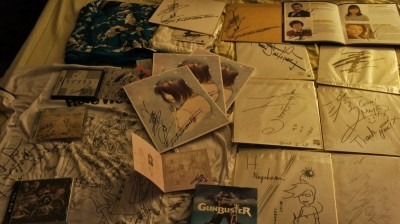
Gratitude was expressed to Mikimoto-san for his artistic contributions, with a wish for continued inspiration in designing pretty girls, regardless of age.
An apology was extended to Nagahama-san for causing him to be late to the opening ceremony, marking it as a first-time occurrence and hopefully the last.
Notably absent from the loot shot was a poster from Aku no Hana, promoting the single. Donated by Nagahama, he added a small Aku no Hana flower drawing to his autograph for the auction. This flower motif was also present on his other Aku no Hana autographs and the sketch obtained by the author, which wrapped around Oshimi-sensei. The drawing also appeared on the single acquired from the auction. The author humorously noted that after all the drawing, a joke was finally made, which now adorns the blog post.
The Kitchen Sink
Best noodles: Instant Yakisoba (prepared using a hotel coffee machine)
Name tag: Dry pulled pork
Best nickname: Nakatani Daioh
Most often referenced Star Trek movie of the weekend: Star Trek II
The best worst driver license plate spotted: “A GUN”
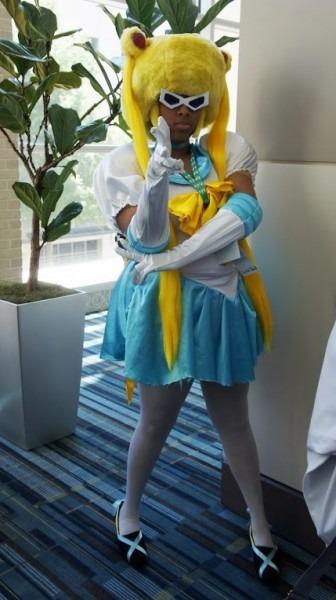
Favorite Cosplay: Drunk Rikka tied with Sailor Moon, forever.
You might also be interested in : Animazement 2013: Days 0 and 1