UlasanAnime.com – In its second episode, Classroom Crisis reveals its core premise. The most striking aspect, for better or worse, is how it portrays a future of space travel and human expansion across the solar system driven by a manufacturing company’s growth. The narrative centers on a school system that permits a rebellious group of elite students to pursue their own unconventional methods in hopes of achieving a breakthrough.
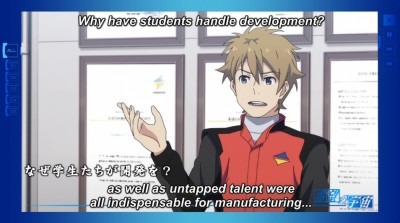
This scenario might sound eerily familiar if you follow news about the Japanese economy and social structures. The primary reason for Japan’s economic bubble largely stemmed from its difficulty in transitioning from manufacturing to information-based industries. While Japanese companies like Toyota and Sony could compete with global giants such as Ford and GE, Japan lacked equivalents to Apple or Microsoft. With Google representing the next technological wave, Japan risks being two revolutions behind in the next five to ten years, at least from a nationalistic standpoint. This issue is further complicated by the increasingly borderless nature of companies like Google.
In summary, Japan was entrenched in its manufacturing-based economy during the 1990s, failing to adapt to the information revolution. Whether it remains stuck today is debatable, but public perception certainly suggests it is.
You might also be interested in : Seiyu, the White Box, and a Million DDs
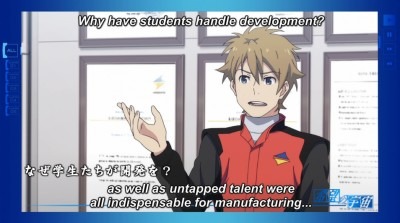
It’s disheartening to consider geniuses being groomed from a young age to work in megacorporations focused on manufacturing. Shouldn’t they be engaged in more scientifically advanced endeavors? In this depicted future, are robots not handling manufacturing tasks? Does Japan not embrace automation?
From this perspective, the future history presented in Classroom Crisis feels like an elderly person’s wistful fantasy. It’s as if it’s describing a world where cavemen rule with magical clubs. This setting also seems to have preemptively revealed the show’s thematic core, which revolves around youth, revolution, and related concepts.
Depending on one’s viewpoint, this theme itself could be seen as a rather naive fantasy. I firmly believe in the power of iteration; geniuses who mature and gain experience within the right environment become more potent and capable of driving revolutions than younger prodigies lacking that educational foundation. There’s no inherent magic in youth itself, beyond practical considerations like marketability for the series. While there are biological advantages, particularly in physical prowess, this doesn’t necessarily translate to intellectual superiority. Therefore, the true culprit, if we were to assign blame, isn’t solely human nature’s inability to think outside the box – a trait I don’t believe is exclusive to younger or newer individuals. Instead, it’s the oppressive and conformist environment, the institutional focus, that defines a significant component of Japanese society.
This makes the very notion of them being in schools at all quite ironic. Since Classroom Crisis refrains from assigning blame, we shall do the same.
P.S. The opening theme by TrySail and the ending theme by ClariS are fantastic! I wish I could financially support them more.