
UlasanAnime.com – In the ongoing Cinderella Girls anime, Shibuya Rin is consistently associated with flowers. The very first episode vividly depicts her reaction to Uzuki’s smile. Director Kouno’s impactful climax, intertwined with the imagery of blossoming plants, aligns perfectly with the fact that Rin’s family owns a flower shop, and she occasionally decorates its entrance.
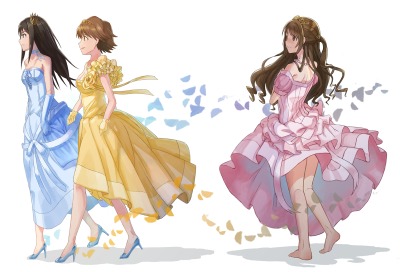
The initial setup in episode one shows Rin, Uzuki, and Mio crossing paths at a live event, each involved in a different behind-the-scenes role. This portrayal of Rin as a “flower girl” is, quite literally, akin to the flower girls that many fans have become accustomed to for events. It’s fitting that these fan-purchased flower stands were prominently featured in the Dereani concert scenes. It’s a nice thought to imagine that behind every substantial fan order for a live performance, there’s a Shibuya Rin meticulously assembling a wreath and transporting it to the venue.
While flowers from fans might seem like a superficial gesture, they hold a certain charm. In a broader sense, Rin’s existence isn’t entirely dissimilar. Both she and her fans likely hope that the flowers will be a fitting complement to her presence.
Comparing young women to flowers is an easily made analogy.
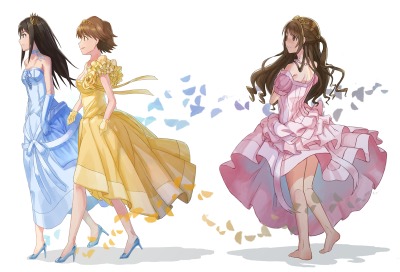
At times, I analyze Cinderella Girls from an agency perspective, focusing on the characters’ journey of self-realization and self-empowerment. This term feels appropriate, doesn’t it? In this context, the Producer acts as an agent of change, facilitating the idols’ careers. But what kind of change does TakeP’s character bring about? And will it be the change I anticipate, for better or worse, and from whose viewpoint?
You might also be interested in : Overlord: Too Powerful?
Recalling the first season, an incident where the police mistook the Producer for a suspicious individual provided the Dekoration girls with an opportunity to act, perhaps to rectify a perceived wrong. There are other instances where agency is disguised as a challenge, such as assigning Cat and Rock the same unit song to resolve their differences, or giving Minami a lead role as the eldest. However, aren’t these challenges simply part of their normal duties? It seems that by assigning them mundane idol tasks, the Producer facilitates their growth. In fact, Mio’s significant scene in the first half revolved around a very ordinary situation, though it might be unfair to diminish the challenges Mio had to overcome.
The same applies to Rin’s eventual change of heart in recent episodes, or Mio’s decisions. But to what ultimate end? And are these changes beneficial? I believe this is where the show delves into more profound discussions. Consider if the idols had to make sacrifices for their careers. For instance, refraining from dating individuals they like, or abandoning familial responsibilities and parental expectations to pursue their dreams and build a career outside the entertainment industry, could be framed as noble and commendable actions. Being pursued by a tall, stoic figure offering business cards is an unusual approach to career guidance. Essentially, many of the challenges presented in Cinderella Girls might seem trivial, but the show treats them with the same seriousness as the “real talk” aspects of the Japanese idol industry’s grittier side. It’s as if we were presented with placeholders for these issues, even if they weren’t directly addressed.
This might be why I’ve always considered Rin the quintessential Cinderella Girls character. Once I look past her relationships within NewGen and view her struggles as a Millennial’s personal journey. To be explicit, if we consider the Cinderella fairy tale as a narrative of someone realizing her potential with theatrical assistance, a magical godmother, and a cruel adoptive family, then IDOLM@STER Cinderella Girls takes this timeless adage and well-established marketing mechanism for young girls and reinterprets it into a Japanese idol phenomenon aimed at otaku enthusiasts. This is a bit peculiar, yet it also presents a strangely gender-equal approach: Do boys appreciate Cinderella in the same way girls do? After all, who doesn’t enjoy a generic coming-of-age story? This is far superior to creating a male-centric version of the same narrative. It’s like remaking a cake using the original cake as the primary ingredient.
Is TakeP’s Producer the true linchpin, our Fairy Godfather, whose résumé was merely 17 years old?
Perhaps I’m viewing this through the lens of someone who experienced the wave of otaku media in the 2000s, when Japan occasionally offered encouraging messages to its marginalized youth, such as “Don’t be a hikikomori, there is hope.” Or is that interpretation too subtle?
Ultimately, what I wish to convey is that if Rin blossomed, it was because she was destined to do so. It is natural for a character of her disposition to achieve such growth. The viewer’s response is typically admiration and awe, coupled with a desire for what she possesses. This is where Cinderella Girls becomes particularly engaging, in terms of how it sets up scenarios to elicit various expressions from its viewers, both those that are intentionally engineered and those that arise more organically.





















