UlasanAnime.com – While many might be tired of discussions surrounding “True Tears,” this particular analysis delves into a scene that showcases a remarkable blend of strength and dexterity, offering a unique perspective on the series’ nuanced storytelling.

The author admits to having a personal detachment from typical fanservice tropes, such as an attraction to characters’ knees or the “meganekko” (glasses-wearing girl) archetype, and generally finds most forms of fanservice to be counterproductive unless executed with exceptional skill.
An amusing anecdote is shared about a desire to taste “Jibeta’s feet,” humorously speculating on their flavor, and a previous craving for “imagawayaki,” a type of Japanese cake.
However, the focus swiftly shifts to Hiromi’s feet, which are presented as an instance of inadvertent fanservice that ultimately becomes a highlight of the series.
This particular scene is deemed so outstanding that it warrants an extensive discussion, exceeding several hundred words.
In episode 11, Hiromi is depicted enjoying a period of independence, free from the pressures of her adoptive family and the emotional burdens she has carried for a significant portion of her life. This newfound freedom is evident in her relaxed demeanor, a stark contrast to her usual persona as the picture-perfect individual at home and school.
Her adherence to societal expectations, particularly her desire not to be a burden to her host family and to make them proud, is highlighted. The narrative suggests that her suspension and the subsequent support from Shin’s mother might have led her to expect further oppression, making the plot twist more impactful.
It’s acknowledged that “True Tears” is primarily aimed at an otaku audience, a common characteristic of late-night anime. While not exclusive, this target demographic explains the inclusion of certain elements that might resonate with fans of eroge (erotic games), even suggesting that a “HCG unlocked” scenario isn’t entirely out of the realm of possibility.
Comparing it to a typical harem anime helps to underscore “True Tears'” unique approach. The scene in episode 11, where Hiromi emerges from her shower in her private residence, is interpreted as a genuine nod to this genre’s conventions.
When viewed through these lenses – her newfound freedom and the anime’s target audience – the shower scene transitions from mere fanservice to something more meaningful, conveying multiple layers of meaning without being overtly attention-seeking, thus rendering it decent fanservice.
A core characteristic of “True Tears” is its subtlety, requiring viewers to infer subtext from events and body language. This “less-is-more” approach, coupled with sharp visuals and art direction, creates a refreshing and crisp viewing experience compared to more conventional storytelling methods.
However, the scene’s true brilliance lies in its “awesome fanservice,” a testament to the director’s masterful execution of strength and dexterity.
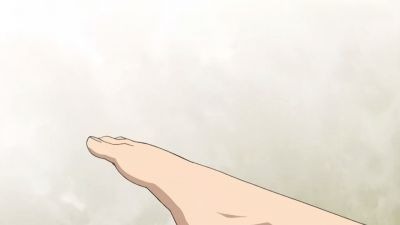
The visual presents a foot, extended into an empty frame, delicately yet awkwardly attempting to grasp a piece of women’s apparel hanging to dry between its toes.
This seemingly peculiar shot serves a crucial purpose. While much of “True Tears” is directed straightforwardly, this detached, curious, and highly suggestive image compels the viewer to question its context. For those who don’t delve deeply into the underlying meaning, it might simply be perceived as a playful, albeit slightly unusual, moment involving a woman’s underwear.
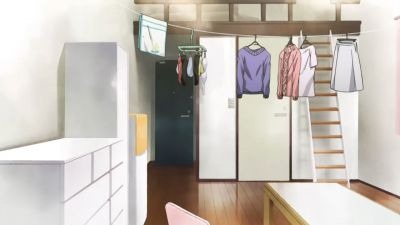
However, there is a deeper significance. By showing less, the scene paradoxically offers more. The viewer is prompted to consider the “why” and “how” behind Hiromi’s action. The garment appears to be hanging from the ceiling, its height ranging from her shoulder or neck level to above her head, suggesting an elongated shape.
You might also be interested in : How to Emulate Makoto Shinkai
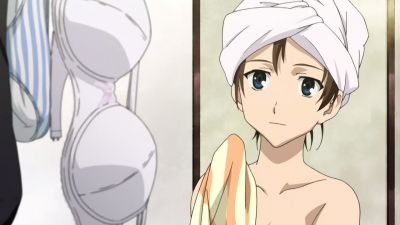
The author poses a rhetorical question: has anyone ever attempted to grasp something with their toes at such a height? The practicality and motivation behind such an action are questioned, especially considering Hiromi has just showered and is holding her towel with one hand. The narrative briefly touches upon the cold climate of Japan in winter and the likely reaction of someone trying to stay warm, implying that Hiromi’s immediate priority would be to avoid freezing.
Despite this, it’s acknowledged that the foot scene doesn’t chronologically follow the preceding shot immediately. The focus then shifts to the mechanics of the actual retrieval.
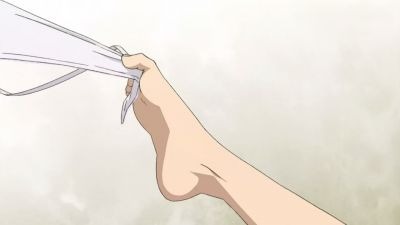
By analyzing the angle at which the undergarment is stretched, one can estimate Hiromi’s standing height at that moment.
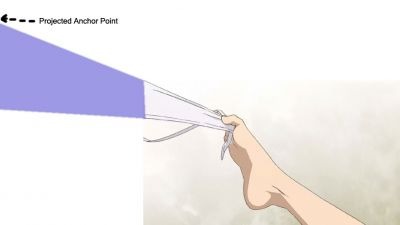
The blue area indicates where the rest of the garment would need to stretch, with the arrow pointing beyond the visible frame.
What is remarkable is that the estimated angle for this maneuver aligns logically with a high kick, considering Hiromi’s presumed height and the position of the clothing. Researching images of high kicks reveals that this pose is indeed plausible, even accounting for the fact that Hiromi wasn’t executing a full, explosive kick but rather a sustained extension of her leg.
However, the fundamental question of Hiromi’s motivation for this action remains. While it’s possible she is a serious athlete and performs such feats for amusement within her physical capabilities, the context of being cold and largely undressed makes this less likely.
So, why does she do it?
One compelling explanation is her newfound sense of liberation. By engaging in an action considered “improper” for a “lady,” she is embracing her freedom, a theme that is central to the entire scene, from her exiting the shower to her phone call with Tomoyo.
The production of “True Tears” is characterized by its meticulous attention to detail. While perhaps not as visually polished as works from Kyoto Animation, the collaboration between P.A. Works and director Junji Nishimura has yielded impressive results, including instances of casual yet effective fanservice.
It is understandable why more imaginative and verbose bloggers might be captivated by “True Tears'” subtle yet impactful storytelling techniques.