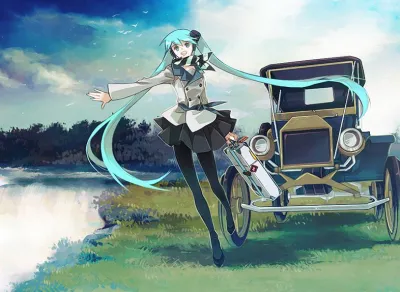
UlasanAnime.com – For those unfamiliar, Toyota of North America launched an advertising campaign featuring Hatsune Miku to promote the 2011 Corolla.
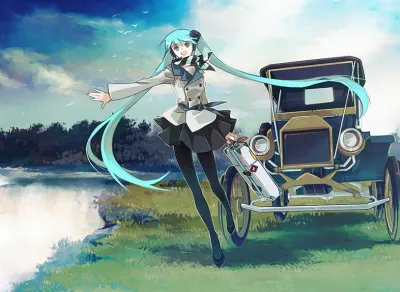
The initial reaction from fans has largely been one of bewilderment, with comments like “what the?”. While previous collaborations, such as Houkago Pleaides, were integrated across the brand, Miku appearing in a Corolla ad has raised eyebrows.
However, it’s worth considering the context. For an idol, appearing alongside Super Bowl MVPs and American sports heroes to endorse a car that is the third best-selling sedan in America is a significant achievement. Miku represents a multi-billion dollar business, and while she might be one of many faces, Toyota’s revenue far surpasses Crypton’s entire earnings, even when combined with all of Miku’s derivative works like doujin and non-doujin CDs, books, DVDs, and video games. It’s plausible that the Corolla’s North American revenue alone might match these figures. Assuming the marketing team at the world’s largest car company (or second largest by the end of 2011, due to the earthquake) has a strategic reason for partnering with Miku, this collaboration should be taken seriously.
Naturally, the public’s surprise is understandable. This situation can be attributed to the nature of corporate sponsorships, where even the most disparate entities can be paired. Examples like Hideki Matsui, the former Governor, or the movie Lost in Translation highlight this phenomenon. However, given that this is Toyota of America, such cross-cultural misalignments are unlikely to be the primary factor.
My own initial reaction to Miku’s new advertisement mirrored my response to the animated ad for the Nissan Sentra SE-R around 2001, which bore a resemblance to a less polished version of Avatar: The Last Airbender. It also brought to mind the infamous Honda Civic Del-Sol ad, which led to a lawsuit from MGM, a detail that might only be of interest to copyright enthusiasts. This was also around the time Initial D was at its peak popularity, making the connection between animation and cars quite evident.
In essence, this fusion of Eastern animation and vehicles is not unprecedented. When targeting an enthusiastic, accessible, and relatively large customer base, particularly young people who, unlike their Japanese counterparts, possess the financial means and need for personal transportation, advertisers will naturally cater to their interests.
Given Miku’s appearances on various variety news segments in America, she presents a compelling option. She is, in many respects, a genuine idol with a degree of name recognition. Her exotic and even bizarre appeal is undoubtedly eye-catching, ensuring that Toyota’s advertisement garners attention, regardless of whether viewers are familiar with her. This attention-grabbing quality is likely the primary objective for Toyota. They are seeking someone young, vibrant, perhaps representing a cutting-edge subculture, and most importantly, capable of capturing attention. The existing name recognition is merely a bonus.
Or, perhaps more accurately, the lack of a compelling reason for the ad’s execution is what’s noteworthy. The splash page for the Miku ad campaign, the advertisement itself, and all associated details have indeed rubbed some people the wrong way.
However, it’s worth remembering that the Nissan ad also elicited a similar reaction.
The key takeaway here is to appreciate the collaboration for what it is. I personally admire Miku as a concept and an entity, and her increasing visibility in America, her “15 minutes of fame” becoming ever more prominent, is noteworthy. While this partnership might not have a monumental impact, Toyota’s collaboration with Miku is likely more significant for her than for the top automotive brand. It’s akin to securing a lucrative advertising contract and then failing to make the playoffs the following season. To put it in perspective, many new and emerging bands are thrilled when their music is featured in large commercial projects. I was personally excited when one of Onitsuka Chihiro’s ads used her music, or when hearing Explosions in certain car commercials. Miku’s Toyota endorsement is, once again, a small nod to pop culture in a landscape dominated by commercial interests.
The question of why they didn’t opt for Scion, especially with their hard rock tie-ins, is an interesting point for further consideration.
You might also be interested in : A Positive Take on Some Anime