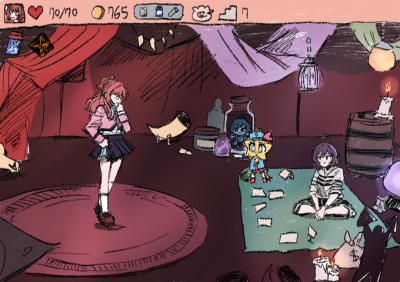
UlasanAnime.com – The phrase “letting herself go” perfectly describes Morimori’s current state. While Netjuu isn’t my top pick this season, with ImoSae taking that spot by a significant margin, there’s a great deal to discuss about this particular anime.

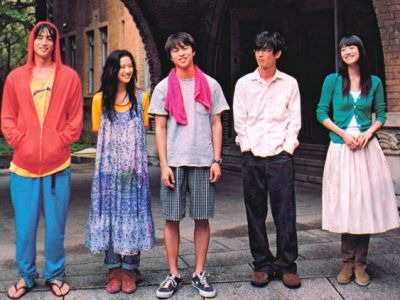
It bears a strong resemblance to another anime I recently watched, Re:LIFE. The series incorporates an element of fantasy within a largely mundane setting, which might feel more at home as a Japanese drama rather than an anime. In this case, portraying an MMORPG world is likely more achievable in anime than with live actors. To a certain extent, anime and voice acting can convey emotions, like deadpan shock, more effectively than live actors, for instance, the recurring facial expressions of Yui Aragaki.
What makes Netjuu compelling isn’t solely the delightful voice acting, as highlighted by Evirus. While Noto and Ueda are indeed fantastic, much of the supporting cast also delivers strong performances. The show offers a refreshing perspective compared to other recent anime focusing on relationships within video games. Gamers is a prime example that comes to mind, and there are likely others you could point to. The trope of a romance blossoming between MMORPG buddies might feel a decade late, but the premise of an attractive character becoming interested in someone through a chance encounter, and then having to overcome the barrier of a “le3t NEET,” is precisely what drives mainstream successes like Densha Otoko. It’s a transformation story, and it’s great to see gaming culture so prevalent nowadays!
===
You might also be interested in : Anime Pilgrimage and Tourism

In relation to my previous post about anime pilgrimages and tourism, I encourage you to read ChaosT’s post on Sakura Quest, especially if you haven’t watched the show. I also have a few additional points to share, primarily concerning immigration and population growth.
Using the United States as an example, population growth is often driven by immigrant demographics. Globally, the trend in established economies indicates that natural birth rates tend to slow down when considering specific demographics, while immigrant populations continue to contribute to growth.
From an external perspective, Japan’s situation is quite straightforward. While the reasons behind declining birth rates can be complex and vary among different groups, it’s perhaps too simplistic to attribute Japan’s challenges solely to isolationist and xenophobic tendencies, or “racism” as the term is commonly understood. The issue runs much deeper. Speaking for myself, there’s a long-standing sentiment that some Japanese individuals would rather face extinction than alter their traditions. This is leading to their wish being fulfilled. While it can be seen as a form of racism, it’s not necessarily about discrimination or an unwillingness to compromise. It’s more akin to an inability to adapt or seek alternatives. It resembles a flawed racial segregation, or in evolutionary terms, a society or set of cultural customs that fail to adapt for survival eventually disappears and becomes extinct.
This isn’t necessarily malicious. Imagine a hypothetical scenario where everyone exclusively rides buses, but only white individuals are permitted to sit at the front. Unfortunately for these hypothetical bus riders, sitting at the back of the bus significantly increases survival rates during accidents, which are frequent. The individuals dictating seating arrangements aren’t acting out of malice or discrimination against non-whites. Their primary motivation might be to have white people sit at the front for reasons unrelated to the continuous survival of the white population in this example. Hopefully, the people in this hypothetical situation can learn from Sakura Quest and access on-demand transportation via their iOS apps. Addressing the underlying issues of “racism” can be a secondary concern once people stop dying.