UlasanAnime.com – The home video business, particularly within the anime industry, is a complex financial landscape. Understanding how money flows between different parties is crucial for a more informed discussion about the industry’s successes and failures. This is especially relevant when considering the sales performance of anime titles, as it’s often oversimplified to believe that DVD or Blu-ray sales are the sole determinant of an anime’s success.

The author expresses a desire for greater financial literacy regarding the anime industry, hoping that a better grasp of these mechanics would lead to more intelligent discussions and criticisms. The piece delves into the nuances of anime financing, highlighting that not all anime, especially those produced by typical production committees, need to recoup their entire production cost solely from home video sales. Adaptations, for instance, benefit from the existing marketing efforts of their source material.
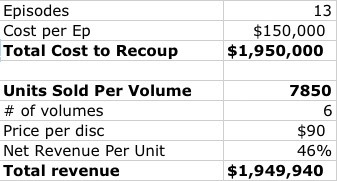
The complexity of the situation is further emphasized. The author references an essay on the home video business and a chart presented within it, expressing concern that it might lead readers to equate home video sales for breaking even with overall production cost recovery, thereby implying a profitable venture. This interpretation, the author suggests, might be a misreading of the original context, especially for those unfamiliar with the intricacies of industry finance.
A key point of discussion revolves around the “Manabi line,” a term originating from internet discussions. The author directs readers to a write-up that attempts to define sales categories, including the Manabi line. This section is quoted directly:
You might also be interested in : Anime OP: Part 1.5
2301~3000
Many titles fall in this category. Marginally performing shows, many of which didn’t sell as much as their popularity would make you think they would.
Ex: Manabi Straight!, true tears #1, Sketchbook, Gun X Sword, Yami to Boshi to Hon no Tabibito3001~4000
The line of profitability. Also the line at which one could say a title is doing okay, but some may call some titles that sell this many a failure, so it’s quite hard to judge.
Ex: Denno Coil, Soul Eater, School Days, Linebarrels of Iron, Super Robot Swars OG, etc
The author clarifies that the Manabi line refers to Oricon’s first-week sales figures. They acknowledge that the break-even point can be influenced by long-term sales, with an estimated 10-15% additional sell-through beyond the initial Oricon figures for typical late-night anime. Therefore, the figures around 3000 or 2900 for the Manabi line are considered a reasonable approximation.
However, the author stresses that accurately judging profitability is difficult, even for those who actively participate in online discussions about anime sales. The exact accounting methods are largely inaccessible to outsiders. Furthermore, different productions will have varying break-even points, even if they fall within a general range. As such, the author refrains from making definitive judgments about specific titles’ financial success.
The core argument is that breaking even on late-night TV anime is not an insurmountable challenge, and this is often the underlying principle of their production. The author hints at more detailed financial information that was omitted from the initial write-up, suggesting future discussions on the topic. The primary takeaway is a caution against oversimplifying the relationship between Blu-ray/DVD sales and profit, emphasizing that the issue is far more complex.
The author then poses a rhetorical question about the significance of these sales figures, suggesting that significance itself might be the true metric, and that it may not necessarily equate to profitability or overall success. This invites further contemplation on how the industry truly defines success.
Finally, the author leaves the reader with a concluding thought: the Blu-ray box set for “Manabi Straight!” is being released, joining other digitally-created anime from before the “Macross Frontier” era. This, the author implies, suggests that achieving break-even is a relatively safe bet for many anime productions.