UlasanAnime.com – This article continues the exploration of anime opening sequences, focusing on Part 1.5 of a curated list. The author previously promised only two parts but decided to include additional openings that, while not necessarily personal all-time favorites, are considered interesting, educational, or notable examples. The selections are roughly sorted by age, and the author humorously includes a disclaimer for any potential viewer disappointment.
The article then highlights the ef-memo OP1 and OP2, along with the ef-melo OP1 and OP2. The author finds these openings remarkable for their function as narrative devices within the show, akin to camera techniques or EDs that add dramatic tension and entertainment. This aligns with the SHAFT x SHINBO style, which is characterized by a willingness to experiment visually without sacred cows.
The author admits to a slight cheat by grouping four items under one entry but emphasizes that the difference between the two ef series’ openings is a key narrative element that makes them noteworthy. This difference, the author suggests, tells a story about celebrating differences in a convincing yet unconventional way. It’s noted that this approach is unusual in anime.
Next is the Paranoia Agent OP, which is praised as the only opening Satoshi Kon directed and is deemed “really good.” Despite the show itself being somewhat of a “mess,” the opening effectively conveys a sense of motion and momentum that might exceed expectations. The author also identifies it as a powerful visual representation of trauma, which leads to a poignant reflection on Kon’s absence.
The Tsukuyomi Moon Phase OP 1 (any version) is presented as a case where the strength of the opening heavily relies on its surprisingly catchy song, predating popular tracks like “Renai Circulation.” The author appreciates the subversiveness of the visuals and how they encapsulate the essence of the show. It’s also mentioned as a rare instance where the author approves of Shinbo’s use of “lolipedo baits” as a character development tool. The timelessness of the visual style is also noted, tracing the concept of “moe” back to earlier works and establishing this opening as a benchmark for otaku pandering.
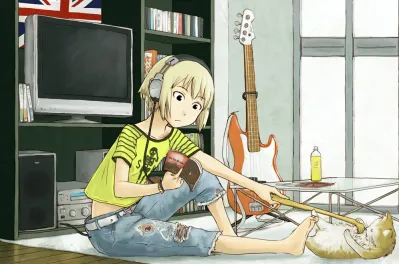
The BECK OP is discussed for its music video aesthetics, a popular element in openings like those for GTO or K-ON! endings. The author compares it to the memorable, albeit less catchy, intro of the Bebop movie. While some tunes can be annoying before becoming catchy, the BECK OP successfully utilizes corny Japanese rock bands for effective results, even if it was intended for a US audience. The visuals and animation are attributed to Kobayashi Osamu’s best work, fitting the show’s and manga’s style perfectly.
The article then moves to Dokuro-chan OP 1 and its sequel 2, with a particular focus on the first. The author states that the OP “literally is everything you need to know about the show,” a rarity in anime. Despite the typical seriousness of most anime openings, this one features catchy gag vocals and animation that closely follows the song. The song itself is praised, and its animated representation is described as glorious, with a sinister undertone. The author laments that such unique openings are seldom seen today, as current shows tend to “overshoot” this type of concept. The second OP is considered a powered-up version of the first but is deemed less effective on its own due to its similar structure and lyrical variations.
Finally, the Pani Poni Dash OP1 is presented as a standout. While all three openings are considered good, OP 1 is highlighted as the best. This opening is noted as an early example of Shinbo’s shift towards rhythm-based editing over extensive animation, where presentation becomes paramount. The author argues that this approach works because anime OPs are fundamentally a mode of presenting the rest of the show. A hypothetical chart of on-beat cuts per minute would likely show a progression from Pani Poni Dash to Nisemonogatari. A humorous observation is made about the metronome featured in the opening.
You might also be interested in : Geometry, Women in Anime, Aquarion EVOL