UlasanAnime.com – In the anime “Super Cub,” the life of Koguma, a high school orphan, undergoes a significant change after she acquires a used Honda Super Cub for a mere ten thousand yen, approximately one hundred US dollars.
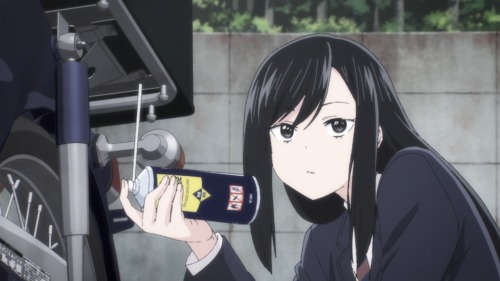
This remarkably low price is primarily feasible in Asia due to the Super Cub’s widespread popularity, which fosters a robust second-hand market. In contrast, a brand-new Super Cub retails for around $3000 in the United States. This acquisition serves as a plot point, reflecting the era we live in where even a small change, like obtaining this motorcycle, can dramatically improve one’s life. It presents a more tangible and impactful transformation than a mere smartphone app.
You might also be interested in : Umamusume Observations: April 2021
The premise of high school girls riding motorcycles itself challenges conventional norms, perhaps signaling the decline of mopeds. The Super Cub holds the distinction of being the most produced motor vehicle globally and exists in numerous variations. Reiko’s postal Super Cub (MD90), for instance, closely resembles Koguma’s purebred model once the splashguard is reattached.
The step-through chassis is a significant advantage for female students and other individuals who wear skirts, as well as those who find straddling traditional motorcycle frames difficult. This design element contributed to the motorcycle’s popularity, at least until scooters became dominant across Asia in the decades following the Super Cub’s international debut. Honda’s commitment to utility is arguably best exemplified by the Super Cub, boasting a reliable engine, tubeless tires, a semi-automatic transmission, and its distinctive chassis design. It represents a quintessential Japanese bargain from the post-war twentieth century.
The underlying point being subtly conveyed is the historical significance of the Super Cub. The Super Cub light novel and comic series were partly conceived to celebrate the 100 millionth unit sale of the Honda Super Cub. While the project may feel promotional, its core message emphasizes history in the making. The collective appreciation for the Super Cub stems not just from its current practicality as personal transport in developing economies, but from its enduring legacy.
A particularly evocative scene occurs when Reika and Koguma work together to remove the rear storage from an aging Super Cub belonging to a local credit union. The visual depicts:
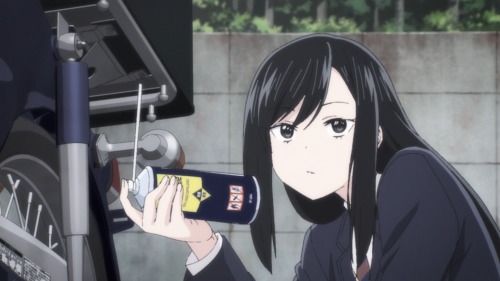
The image of a high school girl using WD-40 on a screw to detach a vehicle accessory is striking. It evokes a sense of mirroring actions, much like children imitating adults or individuals crossing traditional gender roles. The Super Cub itself has a history of breaking gender barriers in motorcycling, notably through its marketing. Its design, including the step-through frame, facilitated its accessibility to women. This scene can be interpreted as a powerful tribute to the Super Cub’s legacy, transcending mere “moe” aesthetics and venturing into a realm of niche appreciation.
While the computer-generated graphics of the motorcycles in the anime are rendered with a clean aesthetic, the act of using solvent on a rusted screw is a standard procedure. The anime’s color palette is predominantly drab, yet it manages to evoke sensory associations with grime and mechanical work: the scent of motor oil, the smear of grease, and the patina of rust. These are replaced by a subdued, time-worn tone. The bike shop Koguma visits doesn’t appear particularly pristine, mirroring the sensory experience of traveling in certain parts of Japan, distinct from the perspective of tourists who visit for leisure activities like camping.