
UlasanAnime.com – For me, “Tari Tari” is an experience that feels incomplete. Some viewers who truly enjoyed it might wish for it to continue, allowing them to savor it slowly. Similarly, I find myself unable to put it aside until I rewatch the entire series from the beginning, as there are many subtle details I still haven’t fully grasped. While attempting to articulate my thoughts for this post, I struggle to find the right words, and I haven’t encountered any other reviews or discussions on “Tari Tari” that truly satisfy my need for deeper understanding.
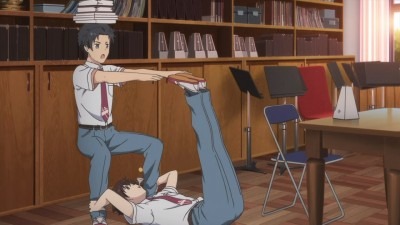
For instance, fans were quick to pick up on the significance of the show’s title well before its premiere. In promotional materials, “Tari Tari” was presented using English alphabet letters, a subtle nod to “True Tears,” which employed a similar stylistic choice. The first episode’s homage to “Reflectia” further solidifies this connection. What’s particularly intriguing is that one of the five main characters shares the same “T-T” moniker. The question then arises: what was his role in the narrative? If you found the interconnectedness of “Anohana” to be complex, then “Tari Tari’s” more understated approach to hidden connections might appeal to you.
While I dislike dwelling on such points, typical reviews, like those found on Fandompost, often present a rather conventional assessment. This approach, while perhaps solid, is fundamentally inadequate for evaluating “Tari Tari” because it fails to explore the overt elements that made the show so captivating through its marketing. It’s akin to comparing red wine to white wine without appreciating the nuances of each. On the other hand, I understand that many viewers seek well-filtered opinions, but that is not the kind of insight I am looking for.
Interestingly, I largely agree with the general consensus that “Tari Tari” might appear average to the typical anime viewer. However, this is an anime with a very specific target audience, making its intentions clear from the outset. It delivers a tactical experience that is inherently hit or miss precisely because of its focused nature. At its core, “Tari Tari” is a kuuki-kei anime that, much like “True Tears,” leverages the power of emotional warmth. It embodies the iyashikei genre, with its plot progression, reminiscent of “Manabi Straight,” serving as an almost effortless uplift, at least in form. Yet, “Tari Tari” distinguishes itself by being authentically itself, rather than relying on convoluted emotional drama. It presents a curious paradox, offering viewers unexpected elements. To some extent, it represents a progression from “Hanasaku Iroha,” a story that treads a well-established path of dramatic pathos but with a unique twist. “Tari Tari,” however, ventures out with a bold new direction, forging its own path. It doesn’t feel like live-action acting; rather, it evokes a sense of real life.
Much like its name suggests, “Tari Tari” is also somewhat scattered. If you approach the show expecting drama akin to the Noe-Hiromi triangle, you’ll likely be disappointed. It’s not solely about freedom, rebellion, or standing up for one’s beliefs, even though these themes are present. In fact, who is the main character? Is it Wakana, simply because Ayahime receives top billing? To borrow Dai Sato’s terminology again, it resembles a sekai-kei anime that doesn’t strictly focus on relationships.
I believe “Tari Tari” is noteworthy for this very reason: it defies numerous genre conventions. Perhaps this is why it feels so eclectic. The first two episodes cover a significant chronological span, nearly as much as the rest of the series combined. There’s no strong narrative “rail” to guide viewers, aside from the chronological progression of Shirosai and the Choir Club & Sometimes Badminton Club’s activities. The characters are presented as they are, with introspection, like those introspective lead-ins, lingering in the ether, contextualized only by the ongoing and concurrent dramatic focus. Despite the somewhat uneven distribution of plot and screen time, Wien, Tanaka, and Konatsu don’t always get the spotlight they deserve. The leader of the club isn’t even the central protagonist. The last time I enjoyed a show where the leader wasn’t the main character was likely “K-ON!”—if we can even agree on a definitive main character (perhaps Yui?). However, “Tari Tari” feels even more imbalanced than “K-ON!” I’m unsure if this is a negative trait, but it certainly appears confusing to some viewers.
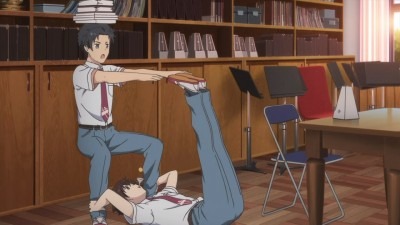
Fortunately, this off-balance nature makes “Tari Tari” a rather enjoyable viewing experience. It’s undeniably a mood-lifting series, thanks to its solid dramatic core (particularly Wakana’s story) and its lighthearted, often humorous, moments. In the face of such an experience, do we really have much to critique? Will any argument hold weight against its charm?

The way the three girls playfully teased their male club members is both endearing and amusing. It stands out as one of the show’s most delightful aspects. Sawa’s predicament was quite entertaining, once we moved past the forced drama. The singing and dancing sequences were a lot of fun, especially in a meta sense, as they held back Ayahime’s full potential until that moment of clarity in Wakana’s life.
TL;DR: It’s easy to dismiss “Tari Tari” as boring because it’s difficult to get into, but for some of us, we were already invested even before the series began. However, even if you weren’t, you could certainly do worse within the high school drama anime category.
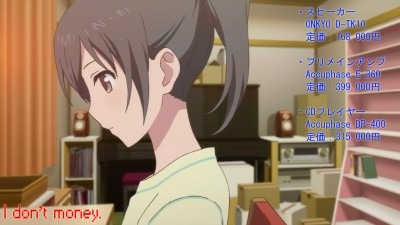
At this point, I like to think of “Tari Tari” as a second-hand, high-end piece of audiophile equipment—full of connections and components, lacking a manual. All these parts likely fit together somehow, but it will take at least another viewing to fully understand how.
You might also be interested in : 2012: A Sengoku Collection Episode Review
PS. Should we fault a show that is “all over the place” simply because its name is “tari tari”? The next time I delve into this topic, I will likely discuss its formula for what I perceive as lifelikeness.





















