UlasanAnime.com – Spoilers for Mahou Shoujo Madoka Magica ahead.
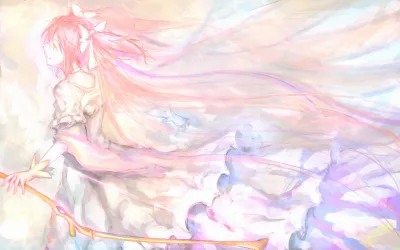
Break!
In a nutshell, I quote:
And if I was more of a dick than I am, I would be laughing at how it seems like you could say it’s a little wave in the face of people who liked PMMM for the fact that it supposedly deconstructed tropes that you would see in magical girl shows. To have the show end in a world that seems like it would reinforce those tropes makes it feel like things come full circle.
I’m not sure if this is even correct.
Coming from the perspective of reverse engineering the basic story concept of Madoka, this is what I have:
If magical girls is about fighting for justice using magical powers, what would it be like if magical powers weren’t magical?
This is the basic idea behind the new wave of superhero stories in the likes of Kick-Ass or Watchmen, to draw an analogy. [And the difference between those and Madoka? Worthy a post all on its own, but in short it’s about the practical application of these stories.] Now in light of genre subversion, it’s important to keep our assumptions lined up in a row. So let’s do that.
[On second thought, I should clarify: By “magical” I mean the ability to get something for nothing, as opposed to obtain any uncanny super powers (which may come from known technology). Getting something for nothing is also such a power, so they’re overlapped things. I call it magical just because that’s the term we’re all using.]
On magical girl genre tropes, I think SDS provides still the most succinct summary I’ve read, at least ones related to Madoka. (Granted, I am far from well-read, but I do take your suggestions.)
On magical powers, I would go as far as to say that when QB started on the whole Entropy thing, we are slowly cutting through the facade of magic. By facade of magic I refer to the notion/trope of Clarke’s Third Law: Any sufficiently advanced technology is indistinguishable from magic. It isn’t to say that the whole system as explained in Madoka is not magic, but part of the trick in Madoka is to demystify magic and to illustrate the cost of it.
In fact, if there is one thing that is subverted in terms of genre, that is it: Magic. Without it, we’re just talking about girls.
In essence, Madoka asks us to answer these three questions: What is magic? What are the costs of obtaining it (read: becoming a magical girl)? What are the costs of applying it in a manner that you want (read: fulfilling your wish)?
The audience’s expectation falls in line with these three questions as well. Most people who thought it was a cop-out or people hung up on Madoka’s supposed genius like this guy focused on the first question. The real “hole” happens in the second question. People who think Madoka is Jesus are responding to the third question.
In order to read Madoka as a genre subversion we would have to apply these questions to the genre either on the whole or inquire specific titles as to their compliance. Times like this I appreciate creators like CLAMP who do take some of this stuff into account…
There are flaws with the conclusion of Madoka. I don’t want to get too deep into it, but I’ve illuminated where it is largely. Let’s just say that there’s a nice bridge of suspended belief over that hole so I’m a happy customer. However I also respect that your mileage can vary, and as with most things worth watching, there is always room for different interpretations (but not so much on factual analysis). Reasonable people can disagree, etc. I personally think the mechanism behind Madoka’s wish is worthy of real examination, but honestly, how does it matter? I have no idea how it can contribute to the overarching analysis.
To keep this short, all I am trying to say is that if Madoka’s ultimate act is to reform the nature of Magical Girls in QB’s world to conform closer to the stereotypical definition of what a Magical Girl is, then you can read it as a critique as that the average stereotype for magical girls misses the blood, tears and hard work in which makes magical girls (as we know it) possible. But this is why people can choose to see Madoka’s conclusion to be a cop-out of sorts, ultimately.
When examined thematically, however, how can I argue against her noble sacrifice? Rather than Jesus (probably to avoid sacrilege), it is better to consider Lucas’s Force-form Jedi and may the Madoka be with you, always. Love and justice will triumph, once you’ve taken all 11 previous episodes to carefully consider the wish you would like to make. (See, I can’t even argue against the way she made the wish!) Humanity’s trump card is always played at the very last possible second, like any good scrub would. Difference being, gamblers have Lady Luck, and Madoka is the patron saint of Magical Girls.
You might also be interested in : Waking Up From K-ON!
Lastly, I enjoyed the ending. It is not exactly what I expected but it certainly did not fall short of my expectations. But I think on average I spend more time and effort gauging my expectation than most, so that doesn’t say very much. And if the best way to judge the show is from its aftertaste, I can say that there’s a distinct sweet fragrance coming from the whole Madoka experience, and I can understand why this is happening.