UlasanAnime.com – This article delves into the thematic depth and comedic elements of “Mawaru Penguindrum,” exploring its intricate narrative and unique presentation.
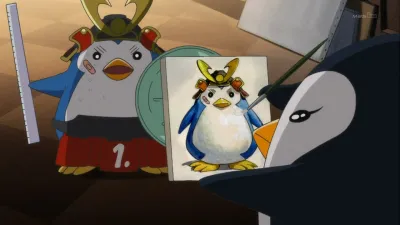
The author expresses appreciation for the detailed analyses of “Mawaru Penguindrum” and the effort put into uncovering its internal cohesion. While acknowledging previous discussions, the focus shifts to a particular point, encapsulated by Ringo’s character arc and a translated liner note from the Utena R2 DVD release.
The liner note, originally highlighted by another source, discusses the concept of desire and the struggle against the “blurriness” of the world. It uses the example of a man infatuated with an idol, who instead of pursuing her directly, settles for being a fan. This sets up the idea that true pursuit of desire requires becoming a “duelist” who confronts the world’s cruelty.
Let us suppose that a certain man has fallen in love at first sight with an idol he saw on TV. The possibility of him making the idol his lover is near zero, but it is not entirely zero. However, rare is the man who would strive with all efforts to make the idol his lover. Instead of making such effort, he buys her records, goes to her concerts and enters her fan club. In other words, he enjoys her as an “idol”. Such behaviour blurs his feeling of wanting to make her his lover. This world of ours is full of such blurriness. To say “no” to such blurriness and to strive for the object of your desire, you have no choice but to become a duelist and confront the world and all its cruelty in the face. Episode 7 (“Unfulfilled Juri”) is a story about “miracle”. Arisugawa Juri, who is a student council member highly regarded by all teachers, a national-level fencer and a beautiful young woman, had one weakness – “miracle”. It may seem contradictory that she believed requited love would be a “miracle,” and yet she denied that such miracle could possibly occur. If she truly believed that such love was unrequited for certain, then she might as well call it an impossibility instead of calling it a “miracle”. She called it “miracle” precisely because she wanted it to occur even though it was unlikely to occur. The reason why she wanted to deny it is because she knew the pain of not obtaining it. May we not say that Juri was the most duelist-like duelist in the sense that she continued to be a duelist fighting for this miraculous power called “the power to revolutionize the world” while knowing this pain? Juri challenged Utena to a duel because the latter said she could believe in miracles. Juri was probably jealous of Utena’s innocence and felt angry. Juri lost the duel even though she was technically the superior fencer. Just as Miki who lost the duel due to “the shining thing” which was his weakness, Juri was defeated by Utena who fought the duel without such mental distractions.
To say “no” to blurriness, and to be defeated by the very thing that one stood up to fight for while knowing full well the hurt it would bring – that is the duelist’s sad fate.
This passage is presented as a modern fable, carrying a profound message that can significantly alter one’s perspective on certain matters. The author finds this aspect to be highly commendable.
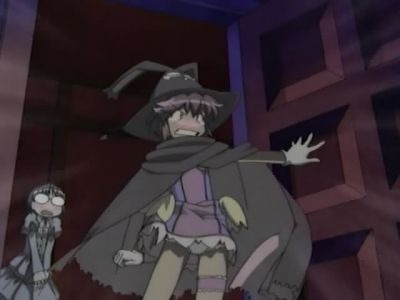
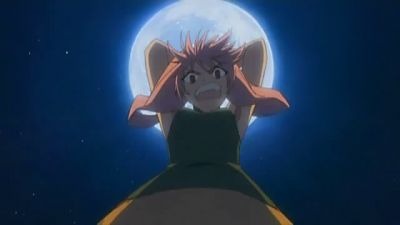
Shifting focus, the article highlights that beyond its visual and auditory appeal and exploration of modern themes, “Mawaru Penguindrum” also excels in its comedy. The author notes with some surprise that this comedic aspect is often overlooked by viewers, despite being an integral part of the show’s presentation. The inclusion of penguins is also mentioned as a reason for watching.
The question is posed: “Does Ringo make you laugh?”
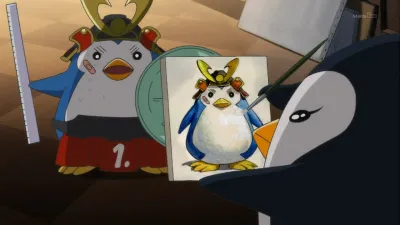
The author admits that Ringo’s character elicits laughter, though acknowledges that her actions often cross boundaries, making it somewhat peculiar to laugh at or with her.
The article suggests that the 3D children’s book-style scenes might serve as a lens through which Ringo’s pursuit of Tabuki is viewed. A meta-perspective is also introduced, contrasting the different ways Ringo and Yuri manipulate Keiju’s emotions. This is further illustrated by the slapstick comedy involving carps and frogs between Ringo and Shoma. While acknowledging that real-life accidents are serious, the article questions whether they maintain that gravity within the show’s context, especially given the show’s willingness to address such themes.
The author references a point made by “2dt” about “enjoying the show” as a way to acknowledge that the whole is greater than the sum of its parts. Focusing too much on individual elements risks missing the larger picture. One danger of this over-analysis, akin to a “toaster oven,” is drying up the humorous essence of the material.
You might also be interested in : Steins;Gate: The Distant Avalon