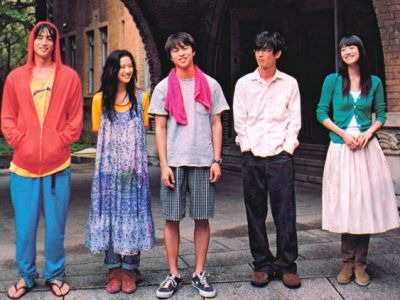
UlasanAnime.com – It’s a rare occasion when a piece of media watched in one year can be definitively declared the best of the following year. While not a futurist, I’m familiar with the concept of looking ahead, a question one might pose to figures like Neil deGrasse Tyson or other prominent science communicators: “An anime about making anime that is remarkably good?” This is a sentiment that feels long overdue.

To be clear, Shirobako isn’t the type of series that will captivate everyone in the same way as, for instance, Parasyte or even Oremonogatari. However, it undeniably deserves critical acclaim, particularly from those who value story, plot, character development, and thematic depth. Furthermore, the collective rating of this show speaks volumes about the prevailing opinions within online anime communities and their potential echo chambers.
When discussions arise about individuals who create a stir online but don’t translate that into tangible support in stores, this is precisely the kind of situation it brings to mind. Audiences often express a desire for mainstream narratives, mature characters outside of typical school settings, or non-harem concepts. Yet, it has been repeatedly demonstrated that these elements do not necessarily drive commercial success. Collectively, we tend to favor titles like SAO, and angsty teenage ninjas will consistently find a place in the industry’s financial strategies, often paired with Linkin Park for AMV competitions. The shows we champion often reveal more about ourselves than about the series themselves, as the anime industry is not a matter of chance; it’s largely formulaic. Creators generally understand what resonates with audiences and continue to thrive by delivering what is desired. This, too, is a valuable lesson one can glean from watching Shirobako.
It’s crucial to preface any praise for Shirobako with the understanding that its depiction is, in many respects, an idealized scenario. We’ve always made room for the concept of “Kurobako,” representing the darker realities that can sometimes accompany working within that industry, particularly as a contractor or employee. This thought arises when considering the production of Trigger’s “Turning Girls” earlier this year. (Oddly, this doesn’t come to mind when watching “Ninja Slayer…”) The Kickstarter campaign to fund animator dormitories highlights the often stark reality of the lifestyle for animators and frontline industry workers, as evidenced by real-life accounts that can be quite sobering. Ultimately, these are often just points for discussion. The primary deterrents for animators remain the excessive working hours and the generally low pay.
You might also be interested in : Year in Review 2015: Musical Highlights
Did you know that there are more scientists alive today than have ever existed throughout history? I believe we have long surpassed the point where the number of anime created in a five-year span exceeds the total number of anime produced up to that point. This tipping point likely occurred around 2002-2006. While I could impress you with the mathematical details, the core issue is a shortage of animators to handle the sheer volume of work required within such a condensed timeframe. If we estimate 60 TV series per season, that amounts to approximately 240 intellectual properties per season, not including annual theatrical releases, net shows, or other formats. We’ve been operating at this capacity for over a decade; the industry reached its asymptotic growth point about ten years ago.
This brings us to the realization that individuals like myself, who enjoy (or perhaps don’t enjoy) Shirobako, are simply viewers of anime. The industry, however, belongs to the creators and producers. Our opinions and actions hold weight only to the extent of their impact. This is because these works are crafted by human beings, not so different from you or me. The human element behind anime transcends the armchair quarterbacking that often occurs on blogs. I deeply appreciate when we can bring the artist back into the art itself.

[*] A rough estimate: The ANN Encyclopedia lists 3286 TV series in its database (as of December 1, 2015, 5:35 PM Eastern). Assuming this count is comprehensive and averaging 240 IPs per year, we are approaching that threshold within a 7-year window and would have crossed it within the 2006 line with a 5-year window. There’s some room for adjustment, as discounting ongoing series would lower the average count. My attempt to use MAL’s database was unsuccessful in extracting data in a meaningful format. Expanding beyond TV anime further complicates matters, as defining the line between art projects and genuine commercial ventures, or how to categorize franchise films, becomes more challenging. ANN tags 7537 entries, but this count is likely less complete than its TV anime figures.
Year-in-review 2015:
- Introduction
- Shirobako, Kurobako
- Sounding Off
- Eventing
- The St@te the Union
- N-Listing