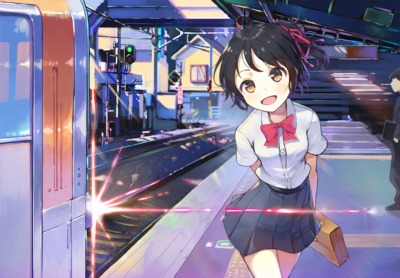
UlasanAnime.com – The film “Your Name” by Makoto Shinkai is often seen as a turning point, but for some, Shinkai’s peak was arguably with “5cm per Second.” This perspective suggests that while “Your Name” achieved broader appeal and commercial success, it might have diluted the distinct artistic voice that captivated fans in earlier works.
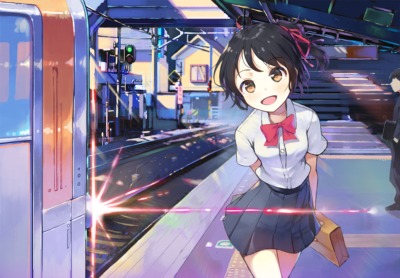
Shinkai Makoto has been a notable figure since his early, experimental works, like a groundbreaking film about SMS messages and a short about feet-eating and beer-drinking under a rainy Tokyo sky. His soundtracks, particularly those by Tenmon up to “Beyond the Clouds,” are often praised for their sublime quality. Tenmon continues to contribute music, notably for “Tsuredure Children” this season.
The argument for “5cm per Second” being Shinkai’s artistic zenith rests on two main points. Firstly, many of Shinkai’s films, including his major works, tend to explore similar thematic ideas and narratives. “Your Name,” in particular, is viewed by some as a more commercially accessible version of “5cm per Second.” To achieve this wider appeal, the film adopted a more conventional three-act structure, explicitly explained plot points through character actions and dialogue, and provided a clear, satisfying conclusion for romantic subplots.
This shift towards a crowd-pleasing format meant that the experience of watching “Your Name” relied more on attention-grabbing visual techniques like dynamic editing and lens flares, comedic elements related to sex and romance, and the central comet narrative. While these elements contributed to its success, they are seen by some as less profound than the poignant emotional core that defined works like “5cm per Second,” making “Your Name” feel somewhat diluted in comparison.
The second reason for “5cm per Second” being considered a peak is that “Your Name,” despite its polished execution, represents Shinkai’s most challenging film to date. It attempts to blend his distinctive visual style and artistic prowess with a mainstream-friendly narrative that incorporates elements like time-spanning, body-swapping, and star-crossed lovers. This balancing act, akin to creating a perfect yet familiar gelato flavor like Stracciatella, highlights Shinkai’s directorial skills but also exposes potential flaws that were less apparent in his more experimental earlier works.
You might also be interested in : Otakon 2017: A Summary
There’s no denying the incremental improvements in “Your Name” compared to Shinkai’s previous films. The development of new techniques and their refinement are essential for any creator’s growth. This aspect makes “Your Name” a significant and welcome addition to his filmography, and it’s understandable why its success is celebrated, regardless of whether it’s perceived as entirely “unwarranted.” Commercial success, after all, doesn’t always directly correlate with the quality of the craft, although craft can be a prerequisite or a limiting factor. This phenomenon is observed in Hollywood and globally, where many poorly made films achieve significant financial success.
However, the core argument remains that Shinkai may have reached his personal artistic peak with “5cm per Second.” While he has dedicated much of his adult life to exploring a specific set of concepts and undoubtedly possesses further creative potential and room for improvement as an animator, his message as an artist may have been more potent and less diluted in the earlier work. This leads to the suggestion that perhaps it’s time for Shinkai to venture into entirely new territory rather than revisiting familiar themes.
Conversely, one could argue that “Your Name” is Shinkai’s best film precisely because it demanded him to be a more well-rounded creator. It necessitated collaboration, drawing on the strengths of his team to elevate the overall quality, address past weaknesses, and produce a film that is strong in all aspects. However, for fans who were drawn to Shinkai’s films for specific reasons, these broader collaborative achievements might not resonate as deeply as the singular artistic vision of his earlier works.
In a related note, the Chinese science fiction trilogy “The Three-Body Problem” by Liu Cixin is also a noteworthy read. Like Shinkai, Liu Cixin openly acknowledges his admiration for the genres he contributes to, and this passion is evident in his work. His writing often references seminal authors like Asimov and series like “Legend of Galactic Heroes.” This reminds the author of their own recent experience watching “Legend of Galactic Heroes” and recalling a past convention panel where Shinkai mentioned he was slowly working through the same OVAs.