UlasanAnime.com – While GATE is undeniably a nationalistic fantasy that subtly champions Japanese superiority through its depiction of the Self-Defense Forces (SDF) handling a primitive and backward civilization, it warrants closer examination to confirm this assertion.
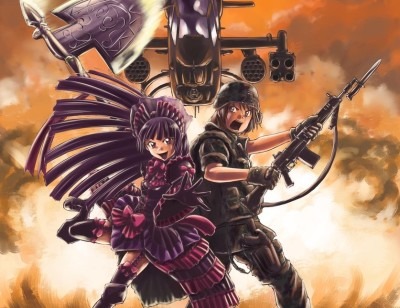
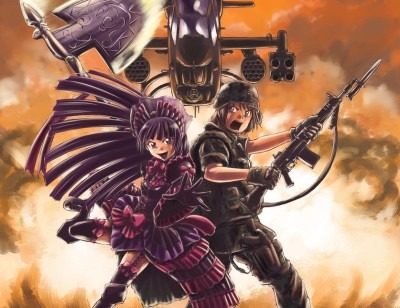
The SDF is consistently portrayed with a high moral standing, not only in contrast to the barbaric societies they encounter but also as the clear protagonists within the anime’s geopolitical and domestic narrative. The Japanese parliament is shown with various factions, and some political voices are subtly dismissed, particularly during the inquiry concerning Rory. Other scenes, like the international wetworks teams clashing at the onsen, further emphasize this point.
The core question is whether glorifying the SDF positions GATE alongside other pro-military and right-wing narratives, and to what extent. As a commenter noted, the “right-wing” aspect of a story like Muvluv’s Total Eclipse is debatable. While it exhibits racism and conservative themes, the link between racism and right-wing ideology isn’t always direct. Similarly, how does GATE fit into the right-wing spectrum? One could argue that GATE, as a fantasy escapism, could be interpreted as a liberal work. The individuals from the fantasy world are treated as normal humans, unlike the depicted roaches in Terra Formars. The world beyond the GATE, while fantastical and exploitable, is implicitly managed by the SDF’s sense of justice and proper conduct. This raises questions about the intervention of foreign states, the potential for imperialism, and whether these are the very policy discussions that Japanese right-wingers might wish to engage in.
It’s unlikely that GATE delves deeply into these grey areas, as such realism might not resonate well. However, the series does touch upon the complexities of foreign intervention, reminiscent of historical accounts of American bribery in Afghanistan. The narrative at least introduces these issues as points of consideration, perhaps offering a tangent for further thought, a topic that readers of the novel might offer more insight into.
The true measure lies in how one perceives these issues without being swayed by the narrative’s inherent biases.
Addressing the question more directly, for every scenario GATE presents, it’s plausible that another country or political viewpoint would offer a different resolution. This is not unlike how, in romantic comedies, protagonists often find themselves in awkward situations. The question remains: is a show of force or a massacre always the required response when dealing with fictional barbarians? While it might be an engaging thought experiment, is it an appropriate response from an American perspective? Or, perhaps, is it more fitting to explore such themes through fictional characters rather than re-examining the actions of Japanese soldiers in historical contexts?
[There’s a potentially critical perspective that this type of escapist fantasy serves as a nationalistic pressure valve for Japan, much like lolicon manga might be seen as an outlet for certain desires. This viewpoint isn’t necessarily endorsed but is presented as an argument.]
A broader issue emerges when GATE is elevated beyond mere fantasy to a parallel with real-world events. From this perspective, arguments against GATE being a right-wing fantasy begin to falter. This becomes particularly evident when viewing the story from the standpoint of another nation’s armed forces – how might Americans, Canadians, Europeans, Russians, or Chinese perceive these events? Such a perspective could effectively highlight both the strengths and weaknesses of GATE’s narrative choices. Many viewers, encountering GATE with a neutral lens, might project their own political views onto it, associating the SDF’s assertive actions with their own national military organizations. While this is a natural human tendency, it also reinforces the perception of GATE as a right-wing narrative.
While we can appreciate GATE for what it is, perhaps by stepping into the protagonist’s shoes, it’s possible that some viewers might eventually wish to make different choices than he does.
You might also be interested in : Japan Winter Trip 2016
This, arguably, is the essence of a compelling story, regardless of genre elements like harems. For the most part, viewers can choose to enjoy or overlook this aspect of GATE, and that may be sufficient.